Counting the Real Cost of Launching Your Business
Starting a limited liability company in the United States costs anywhere from $35 to over $500 just to file, with ongoing annual costs that vary widely by state. This guide breaks down what every new business owner should expect to pay, what paperwork to file, and how starting a business compares across borders.
At a Glance:
- LLC state filing fees in the U.S. range from $35 in Montana to $500 in Massachusetts
- Most states charge an annual fee or biennial report fee to keep your LLC active
- A registered agent costs $0 (if you serve yourself) to $300 per year through a service provider
- Operating agreements, EIN registration, and business licenses add to total startup spend
- International LLC equivalents (Ltd, GmbH, SARL, Pty Ltd) have their own filing fees and capital requirements
- TeraOpenScience connects new business owners with global experts who have launched companies worldwide
Forming a limited liability company is one of the most popular ways to structure a small business because it combines liability protection with flexible taxation. But the price tag for getting one off the ground depends heavily on where you file, what extras you buy, and the ongoing costs of staying compliant.
How Much Does It Cost to Start an LLC?
The total cost to start an LLC in the United States typically runs between $50 and $800 in the first year. Most of that goes to the state filing fee for your certificate of formation, plus optional services like a registered agent, name reservation, and operating agreement drafting. Ongoing costs (annual reports, franchise taxes, business licenses) add to the long-term price.
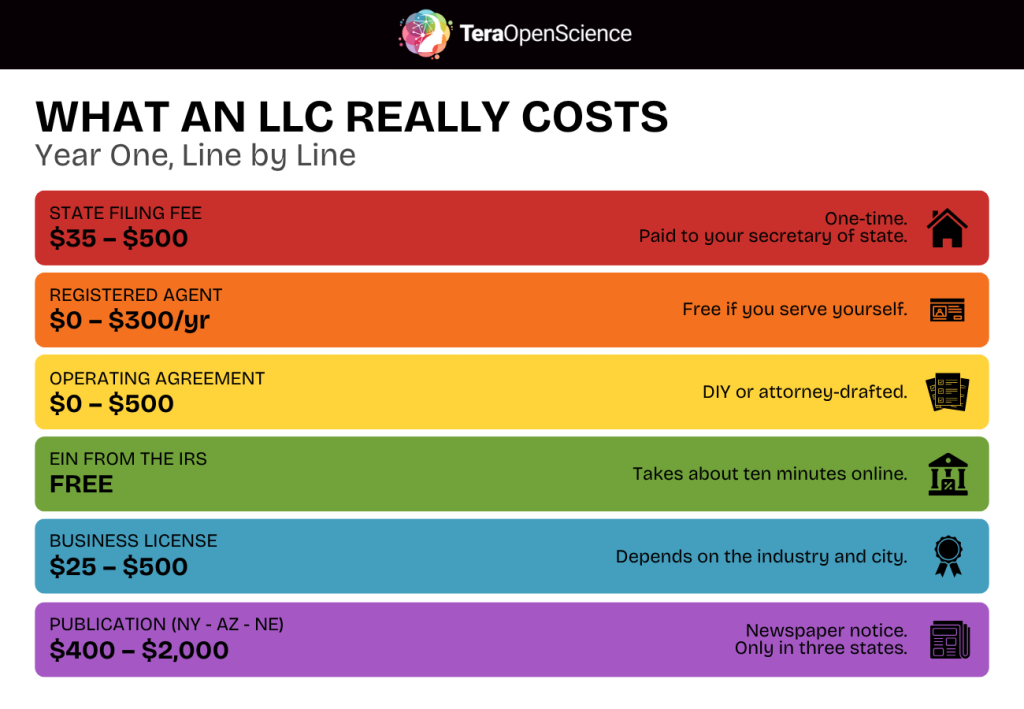
Here is a breakdown of common startup costs:
- State filing fee: $35 to $500 (one-time fee paid to the secretary of state)
- Name reservation: $10 to $50 (optional)
- Registered agent service: $0 to $300 per year
- Operating agreement: $0 (DIY) to $500 (attorney drafted)
- EIN from the Internal Revenue Service: Free
- Business license: $25 to $500 depending on industry and city
- Publication requirement (NY, AZ, NE): $40 to $2,000
State Filing Fees by Location
State filing fees are the single biggest variable in LLC startup costs. Every limited liability company files formation documents with its state’s secretary of state, and that filing fee changes based on where you incorporate. New York requires a publication step that can push first-year costs past $1,000 in expensive counties, while Kentucky lets you file for $40.
| State | Filing Fee | Annual/Biennial Report | Notable Costs |
| Delaware | $110 | $300 franchise tax | Popular for holding companies |
| California | $70 | $800 franchise tax + $20 statement | Highest ongoing cost |
| Texas | $300 | No annual fee | Franchise tax for $1.23M+ revenue |
| Florida | $125 | $138.75 annual report | Affordable to maintain |
| New York | $200 | $9 biennial report | Publication in local newspaper adds $40 to $2,000 |
| Wyoming | $100 | $60 annual report | No state income tax |
| Massachusetts | $500 | $500 annual report | Highest filing fee |
| Montana | $35 | $20 annual report | Lowest total cost |
| Kentucky | $40 | $15 annual report | Cheapest combined fees |
These numbers reflect publicly listed state fees and can change without notice, so confirm current rates with your secretary of state before filing.
What You Actually Pay For
Filing fees cover the legal registration of your business entity, but a working LLC needs more than a certificate of formation. Most small business owners spend on a handful of supporting services in their first year. Understanding what each one does helps you decide which is worth paying for and which you can handle yourself.
Registered Agent
Every LLC must designate a registered agent with a physical address in the state of formation to receive official correspondence and legal documents. You can serve as your own agent for free if you live in the state and keep regular hours at a registered office. A professional agent services company charges $100 to $300 per year and adds privacy by keeping your home address off public records.
Operating Agreement
An operating agreement is an internal legal document spelling out how the LLC is owned, managed, and dissolved. Only a few states (California, New York, Delaware, Maine, Missouri) legally require one, but every LLC should have it. Single-member LLCs can draft one for free using templates; multi-member companies usually pay $200 to $500 for legal advice from an attorney.
Employer Identification Number
An employer identification number (EIN) is free from the Internal Revenue Service and takes about 10 minutes online at IRS.gov. Anyone charging you for an EIN is reselling a free government service. You need one to open a business bank account, hire employees, and file federal taxes.
Business License and Permits
A business license is a legal requirement for most companies, separate from your LLC registration. Costs depend on industry and city. A home-based consulting LLC in suburban Texas might pay $50 for a general permit; a restaurant LLC in San Francisco can spend $1,500 or more on health, zoning, and alcohol permits combined.
Ongoing Annual Costs
LLCs do not pay once and forget about it. Most states require an annual report or biennial report to keep the business in good standing, and many add a franchise tax on top. Skipping these filings is the fastest way to get your LLC administratively dissolved, which strips your liability protection and forces you to refile from scratch.
Typical ongoing costs include:
- Annual report or biennial report filing ($15 to $500)
- Franchise tax (California charges every LLC $800 minimum)
- Registered agent renewal ($100 to $300)
- Business license renewal (varies by city)
- Federal taxes filed with the IRS
- State income tax where applicable
Building these into your business plan prevents an end-of-year cash flow surprise.
Starting a Business Outside the United States
The LLC structure is uniquely American, but most countries offer a similar business entity that limits owner liability. Costs and capital requirements vary dramatically. Some nations let you incorporate for free; others require thousands of dollars in paid-in capital before you can register. According to the World Bank’s Doing Business reports, business formation costs in OECD countries average about 3% of per capita income.
| Country | Equivalent Structure | Typical Startup Cost | Minimum Capital |
| United Kingdom | Private Limited Company (Ltd) | £50 online filing | £1 |
| Germany | GmbH | €400 to €1,000 (notary + registry) | €25,000 (half paid at formation) |
| France | SARL | €200 to €400 | €1 |
| Canada | Corporation (federal or provincial) | C$200 to C$400 | None |
| Australia | Pty Ltd | A$597 | None |
| Singapore | Private Limited (Pte Ltd) | S$315 | S$1 |
| Mexico | Sociedad de Responsabilidad Limitada | $1,500 to $2,500 USD | 3,000 MXN |
| India | Private Limited Company | ₹6,000 to ₹15,000 | None as of 2015 reform |
Germany’s GmbH stands out for its €25,000 minimum capital, which is one of the highest entry barriers in the developed world. Singapore, by contrast, has built a reputation as one of the fastest jurisdictions to incorporate in, with filings often approved in under two hours.
Should You Form Your LLC Yourself or Use a Service?
DIY filing through your secretary of state’s website costs only the state filing fee and takes 30 to 90 minutes. Filing services like LegalZoom, ZenBusiness, and Bizee charge an additional fee of $0 to $300 for handling paperwork, providing templates, and adding optional services. The right path depends on your comfort with legal documents and how much your time is worth.
DIY makes sense when:
- You are forming a single-member LLC with a simple structure
- You live in a state with a clear online filing portal
- You have time to research state requirements yourself
A formation service makes sense when:
- You need a registered agent in another state anyway
- You want bundled legal services (operating agreement, EIN, compliance reminders)
- Multiple members or complex ownership require professional setup
Tax Considerations
LLCs are flexible for tax purposes. By default, the IRS treats a single-member LLC as a sole proprietorship and a multi-member LLC as a general partnership, with profits passing through to owners’ personal returns. LLCs can also elect S-corp or C-corp taxation by filing the right forms. Some states charge a separate franchise tax regardless of federal classification.
Talk to a CPA before your first tax year ends. A simple election can save thousands compared to default treatment, especially once your LLC earns more than $40,000 to $80,000 in profit.

Build Your Business With a Global Network at Your Back
Starting an LLC is a paperwork exercise. Building a business that lasts takes connections, expertise, and access to ideas from people who have already done it. TeraOpenScience is an AI-powered open innovation platform that links new business owners with researchers, professionals, and entrepreneurs across STEM, healthcare, and business sectors worldwide.
Inside TeraOpenScience you can:
- Compare notes with founders who have launched in the U.S., Europe, Asia, and Latin America
- Access grant funding leads and research tools that most small business owners never see
- Validate your business idea with peer feedback before spending on filing fees and licenses
- Earn ScienceCoin rewards for contributing knowledge back to the community
Join TeraOpenScience today and surround your new business with a global brain trust. BE OPEN. BE SEEN.