Mapping the Path From Question to Discovery
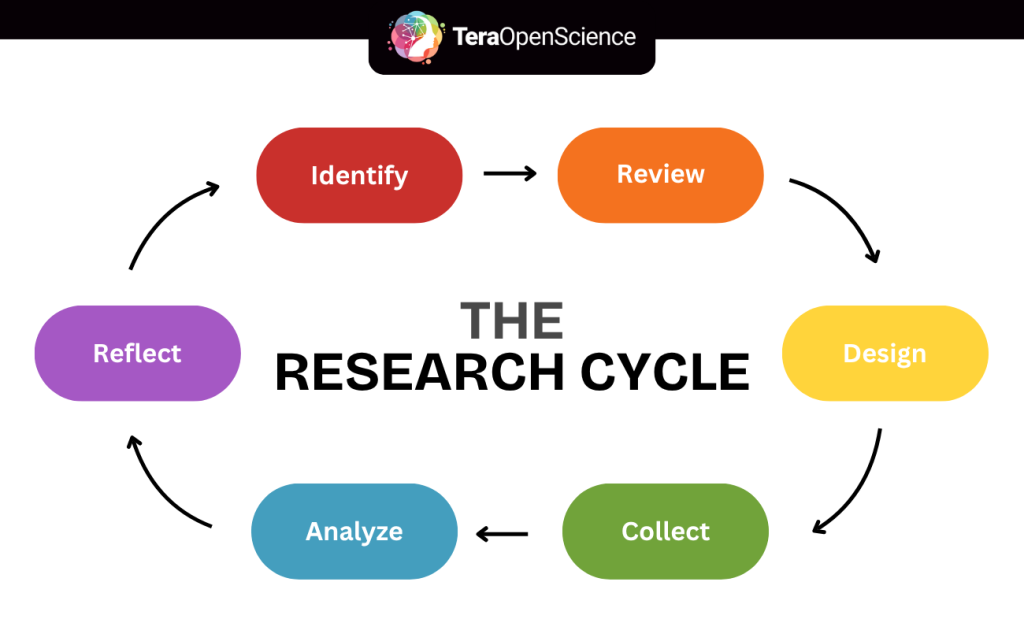
The research cycle is the iterative process researchers follow to move from an unanswered question to validated findings, and then back into the next question that the work uncovers. It typically runs through six recognizable phases, repeating as new evidence reshapes the original research topic.
At a Glance:
- The research cycle is a structured, iterative process that turns a research question into validated findings and new questions.
- Most versions of the cycle include six core phases: identifying a topic, conducting a literature review, designing methods, collecting data, analyzing and sharing findings, and reflecting on what comes next.
- The cycle is rarely linear; researchers often loop back to earlier phases as data, peer feedback, or sponsor requirements shift.
- Open science platforms shorten the cycle by giving researchers access to shared tools, data management resources, and the broader scholarly conversation in real time.
The research cycle is not just a checklist for finishing a research paper. It is the underlying rhythm that connects every research project, from a student’s first literature review to a multi-year R&D program inside a spinout company.
Understanding the cycle helps researchers plan better, collaborate more effectively, and avoid the common pitfalls that stall a research journey before publication. The sections below walk through what each phase looks like in practice.
Why the Research Cycle Matters
The research cycle gives researchers a shared language for planning, executing, and revisiting their work. Without it, individual studies can feel disconnected from the broader scholarly conversation, and findings risk being duplicated, lost in an institutional repository, or never reaching the people who could use them.
A study published in PLOS Biology found that an estimated 85% of biomedical research funding is wasted on poorly designed, unreported, or duplicative studies. A clearly understood research cycle is one of the simplest tools for reducing that waste, because it forces every researcher to identify gaps in the literature before designing a new study, and to share results in a way that other researchers can build on.
The cycle is also useful for engagement with funders. Most sponsor requirements, including those from the U.S. National Institutes of Health and the National Science Foundation, expect a research proposal to map directly to the phases of the research cycle: a clear question, a literature review, validated methods, a data management plan, and a path to dissemination.
The Six Phases of the Research Cycle
Different fields describe the cycle with slightly different language, but most versions converge on six phases. The table below summarizes them.
| Phase | Core Activity | Typical Output |
| 1. Identify | Define a research topic and specific question | Research question, scope statement |
| 2. Review | Conduct a literature review | Annotated bibliography, gap analysis |
| 3. Design | Build methods and a data management plan | Research proposal, protocol |
| 4. Collect | Gather data through experiments, surveys, or fieldwork | Raw datasets, lab notebooks |
| 5. Analyze & Share | Interpret findings and disseminate them | Journal article, preprint, dataset release |
| 6. Reflect | Evaluate results and identify the next question | New research questions, follow-on proposals |
Each phase feeds into the next, and the loop closes when reflection in phase six surfaces a new specific question that restarts the cycle.
Phase 1: Identify the Research Topic
The first phase of the research cycle starts with curiosity and ends with a focused research question. Researchers move from a broad area of interest to a single, testable question that fits within their time constraints, available resources, and funding.
In practice, this phase looks like:
- Brainstorming around a research topic with a topic advocate, advisor, or collaborator.
- Refining the idea into a research question that is specific enough to answer and broad enough to matter.
- Checking whether the question fits within current funding priorities or sponsor requirements.
A useful test for any research question is the FINER framework, which asks whether the question is Feasible, Interesting, Novel, Ethical, and Relevant. Questions that fail any of these checks usually need refinement before the rest of the cycle can move forward.
Phase 2: Conduct a Literature Review
The literature review is where a researcher figures out what is already known about a topic and where the gaps sit. A good review pulls reliable information from peer-reviewed journal articles, books, conference proceedings, and trusted institutional repository sources, and then synthesizes that evidence into a clear picture of the field.
Strong literature reviews share a few traits. They use carefully chosen keywords to search databases like PubMed, Web of Science, and Scopus. They cover the full scholarly conversation, including older foundational papers and the most recent findings. And they document the search process so other researchers can reproduce it.
This phase often surfaces a new approach to the original research question. A researcher who started out asking how a specific asphalt mix performs in cold weather, for example, might discover after the literature review that the more useful question is how the mix performs across freeze-thaw cycles, because that is where the field has the largest gap.
Phase 3: Design Methods and a Research Proposal
With the question sharpened and the literature mapped, the next phase is designing the study. This is where the researcher writes a research proposal, builds the methods, and locks in a data management plan that meets sponsor requirements and any institutional ethics rules.
Key activities in this phase include:
- Selecting research methods that match the question, including quantitative, qualitative, or mixed approaches.
- Building a data management plan that covers how data will be collected, stored, shared, and protected if it includes sensitive information.
- Identifying the sample, the variables, and the analysis plan in advance, which helps reduce bias later.
- Securing funding, ethics board approval, and any partner engagement needed to run the study.
The research proposal that comes out of this phase is the document most funders and review committees will read. Open science platforms can help here by giving researchers access to shared protocols, tools, and reviewers from outside their immediate faculty.

Phase 4: Collect the Data
Data collection is the phase most people picture when they think about research, but it is usually the shortest in elapsed time relative to the rest of the cycle. The work here is execution: running the experiments, recruiting participants, conducting interviews, deploying surveys, or running the simulations described in the protocol.
Discipline matters in this phase. Small deviations from the protocol can compromise the entire study, and missing documentation can make it impossible to reproduce the work later. Researchers typically keep detailed lab notebooks, log every change to the protocol, and back up raw data in multiple locations as part of their data management plan.
For projects involving human subjects or sensitive information, this phase also includes ongoing engagement with the institutional review board and any meaningful patient or community partners involved in the work.
Phase 5: Analyze Findings and Share With the Community
Once data is in hand, the next phase covers analysis, interpretation, and dissemination. Researchers run their planned analyses, test their hypotheses, and write up the findings for an audience that usually includes peers, funders, and the broader healthcare community or scientific public.
Sharing the work can take several forms:
- A peer-reviewed journal article in an open access or subscription venue.
- A preprint posted before formal peer review to speed up scholarly conversation.
- A dataset release through an institutional repository or domain-specific archive.
- Conference presentations, blog posts, or public-facing summaries of the findings.
Open access publication has measurable effects on how widely a paper is read and cited. A study from the PeerJ journal analyzing roughly 67 million articles found that open access papers receive 18% more citations on average than paywalled articles. That citation advantage matters because it shortens the distance between a finding and the next research project that builds on it.
Phase 6: Reflect and Restart the Cycle
The final phase is the one most often skipped. After publication, researchers reflect on what worked, what did not, and what new questions the study uncovered. This is where the research cycle closes the loop and feeds the next round of inquiry.
Reflection in practice looks like:
- Reviewing peer feedback on the published work, including post-publication comments and citing papers.
- Documenting lessons learned about methods, data management, and partner engagement.
- Identifying unanswered questions that the study raised but could not address.
- Planning the next research proposal, sometimes with a new approach or a different team.
This phase is what makes research a cycle rather than a one-time project. Each completed study becomes the starting point for the next one, which is why the research cycle is often described as an iterative process rather than a linear pipeline.
How Open Science Platforms Speed Up the Cycle
Traditional research cycles can take years from question to publication, slowed by paywalled literature, isolated faculty teams, and slow peer review. Open science platforms shorten that timeline by putting tools, data, and collaborators in the same place.
Specifically, open platforms help researchers:
- Run a faster literature review by surfacing open access papers, preprints, and datasets in a single search.
- Connect with co-authors, topic advocates, and reviewers across disciplines and across the United States and beyond.
- Manage data and protocols in one place, with version control built in.
- Share findings before, during, and after publication, which keeps the scholarly conversation moving.
Move Through the Research Cycle Faster With TeraOpenScience
Every phase of the research cycle becomes easier when researchers, students, and professionals can work in the same ecosystem. TeraOpenScience pulls open discussion, manuscript review, grant funding pathways, and a knowledge content center into one platform, so a research project does not have to wait for the next conference or extra login to keep moving forward. Members keep ownership of their work, gain visibility to potential co-authors and funders, and contribute to the community.
Sign up at TeraOpenScience to start your next research cycle with the right tools, the right collaborators, and an open path from question to discovery.