Why Smart Projects Start Before the Experiment
Preliminary research is the groundwork that turns a rough idea into a study worth running.
At a Glance:
- Preliminary research tests whether your question, methods, and resources hold up before you commit real time and money.
- It includes reviewing existing literature with both databases and AI search tools, refining your research question, running a pilot study, and checking your sample size.
- Strong preliminary work improves your funding odds, cuts wasted effort, and protects the reliability of your findings.
- Open platforms like TeraOpenScience give students and researchers the tools and collaborators to do this groundwork in public.
Every strong project has a quiet phase that rarely makes the headlines. That phase is preliminary research, and it often decides whether the main study succeeds or stalls.

What Preliminary Research Actually Is
Preliminary research is the early investigative work you complete before launching a full study. It covers reviewing existing literature, sharpening your research question, running a small pilot study, and confirming that your methods and resources can carry the project. The aim is to reduce uncertainty and catch problems while they are still cheap to fix.
Think of it as the difference between guessing and knowing. Before you recruit a single participant or run one experiment, this stage gives you evidence about what is realistic. A graduate student who wants to test a new approach to a health condition can first check whether enough participants exist, whether the measurement tools work, and whether previous research has already answered the question.
You will also see this stage described as a preliminary study, a pilot study, feasibility work, or background research. The labels differ, but the purpose stays the same. A pilot study, for example, exists to test the feasibility of your approach, including recruitment, retention, and procedures, rather than to prove your hypothesis. Preliminary research is the decision-making process that tells you whether an idea is ready to scale.
What Preliminary Research Looks Like in Practice
Preliminary research usually combines four activities: a broad search of previous research, a sharper research question, a small-scale test, and an early preliminary analysis. Each one produces something you can act on. Together they show whether your research project rests on solid ground or needs another round of planning before data collection begins.
| Type of preliminary research | What it does | What it produces |
| Literature review | Searches existing literature across databases | A map of previous research and open knowledge gaps |
| AI-assisted search | Scans papers and web sources by meaning | A faster first pass at the literature that still needs human verification |
| Research question | Frames one clear, answerable question | A focused and testable direction |
| Pilot study or focus group | Tests your methods on a small group | Early feedback on feasibility and design |
| Sample size check | Estimates the numbers your study needs | A realistic recruitment and power target |
A broad search is where most projects begin. Databases such as PubMed, which holds more than 38 million citations, along with Google Scholar, let you scan what has already been studied. Reading widely here does more than build a reference list. It surfaces research gaps, the unanswered questions that give new work its purpose, and it can reveal that a question has already been settled, which saves months of effort.
Once you understand the existing literature, you can narrow a broad topic into one answerable question. A strong research question should be feasible, interesting, novel, ethical, and relevant– the five FINER attributes that many faculty members teach first. A short pilot study or focus group then tests your methods on a small group, giving you honest feedback on your design and your data collection tools before the full project begins.

Where AI Fits Into the Groundwork
AI belongs in preliminary research as a discovery and triage tool rather than a replacement for your own judgment. It can scan far more literature than any one person can read, surface adjacent work you would have missed, and group findings into themes in minutes. Every result it returns still needs verification before it enters your review.
The practical gains show up in the slowest parts of the process. Screening records alone consumes roughly 25 percent of the total effort in a systematic review, and validation work on human-in-the-loop AI systems reports time savings near 50 percent in abstract screening and 70 to 80 percent in qualitative extraction. Purpose-built research tools such as Semantic Scholar, Elicit, and Consensus pull from academic databases and link back to real papers, which makes them safer starting points than general chatbots that can fabricate citations. Reviewers of these tools reach a consistent conclusion: they are not yet ready to be used without human oversight.
Treat AI output as a lead list, not a finding. Confirm that every source exists, read the papers that matter to your question, and run the same search through PubMed or Google Scholar so you can document a reproducible strategy. TeraOpenScience includes built-in AI tools that help you outline a project and map early sources, then puts that groundwork in front of collaborators who can check it.
What Preliminary Research Helps You Avoid
Preliminary research is easiest to value by looking at the failures it prevents. Most stalled projects trace back to a problem that early work would have exposed for a fraction of the cost. Catching these issues at the start keeps your research agenda realistic and your budget intact.
- You avoid chasing a question that previous research has already answered.
- You avoid building a study around a sample size that cannot detect a real effect.
- You avoid collecting data with tools that do not measure what you intended.
- You avoid underestimating the time, cost, and staffing a full study demands.
How Preliminary Research Strengthens Your Project
Preliminary research protects three things that every research team cares about: funding, feasibility, and reliability. It gives reviewers evidence that your plan can work, it flags weaknesses early, and it improves the odds that your final findings will hold up when other people check them. In short, it lowers risk before the expensive phase begins.
- Funding: Major public funders now expect substantial preliminary work before they back a large trial, and some grant mechanisms exist specifically to pay for it.
- Feasibility: A pilot study gives you a clear go, modify, or stop decision before you scale, so a weak design gets corrected rather than funded.
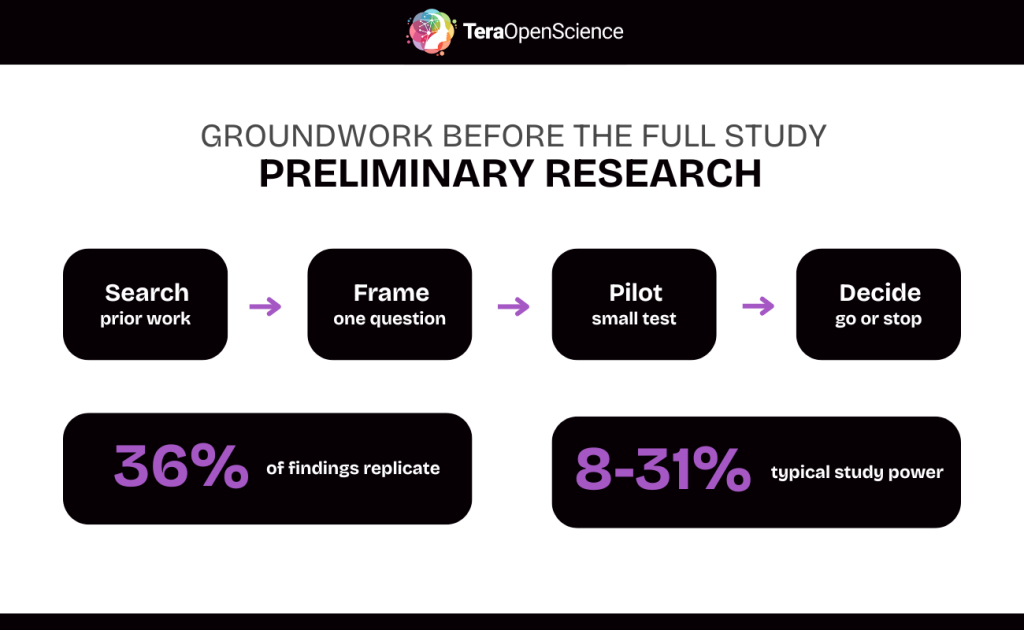
- Reliability: Underpowered studies are a well-documented problem. Median statistical power in neuroscience has been estimated at roughly 8 to 31 percent, far below the 80 percent target, which is why an early sample size check matters. Thin groundwork also feeds poor reproducibility. One landmark project found that only 36 percent of replications reproduced the original result, against 97 percent of the first studies.
The Power of Open and Existing Data
Preliminary research does not always start with collecting new data. Often the quickest preliminary analysis uses data that already exists, which lets you test an idea before spending a dollar on recruitment. Large open resources have made this approach practical for students and for postdoctoral fellows shaping their first independent project.
The UK Biobank is a leading example. It is a prospective cohort of about 500,000 participants aged 40 to 69, recruited between 2006 and 2010. Because the resource is open to approved researchers, it has been used by more than 8,000 institutes and has supported more than 8,000 publications. A researcher studying a specific health condition, from cardiac rehabilitation outcomes to broader disease control patterns, can run an early analysis on existing records long before designing a new study. Open data turns preliminary research into a fast, low-cost first move.

How to Run Preliminary Research for Your Own Project
You can run useful preliminary research in a few structured steps, even on a student budget. The sequence moves from reading, to framing, to a small test, to a decision. Following it in order keeps your work focused and stops you from committing to a full study that the early evidence does not support.
- Start with a broad search of existing literature using PubMed, Google Scholar, and other trusted reference sources.
- Map the knowledge gaps you find, then write one clear research question that meets the FINER criteria.
- Run a pilot study or a focus group to test your methods for the first time on a small scale.
- Complete a preliminary analysis and estimate the sample size your full study will require.
- Use the results to decide whether to advance, adjust, or shelve the project, then plan your future research around that decision.
Collaboration makes every step stronger. Sharing early findings with a wider community on TeraOpenScience invites feedback from people across STEM, healthcare, and business, which often exposes factors that a single research team would miss. A second opinion at the preliminary stage is far cheaper than a correction after the data is collected.
Turn Your Groundwork Into Momentum
Preliminary research is the most affordable insurance a project can buy. It sharpens your question, proves your methods, and gives funders and collaborators a reason to trust your plan before the main work starts. Skipping it rarely saves time, because the problems it would have caught tend to return later at a higher cost.
If you are ready to test an idea in the open, create a free TeraOpenScience account and start a project today. You can post work in scientific, healthcare, or business fields, use built-in AI tools to outline your research, and connect with collaborators who help turn early groundwork into real momentum. Be open, be seen, and give your preliminary research the audience it deserves.