Your Roadmap to a Registered Mark
Registering a trademark in the United States follows a clear sequence handled by one federal agency.
At a Glance:
- A trademark protects the name, logo, or slogan that identifies the source of your goods, while a service mark covers services.
- You register a federal trademark through the United States Patent and Trademark Office (USPTO), the country’s trademark office.
- The base application fee is $350 per class of goods or services as of January 18, 2025.
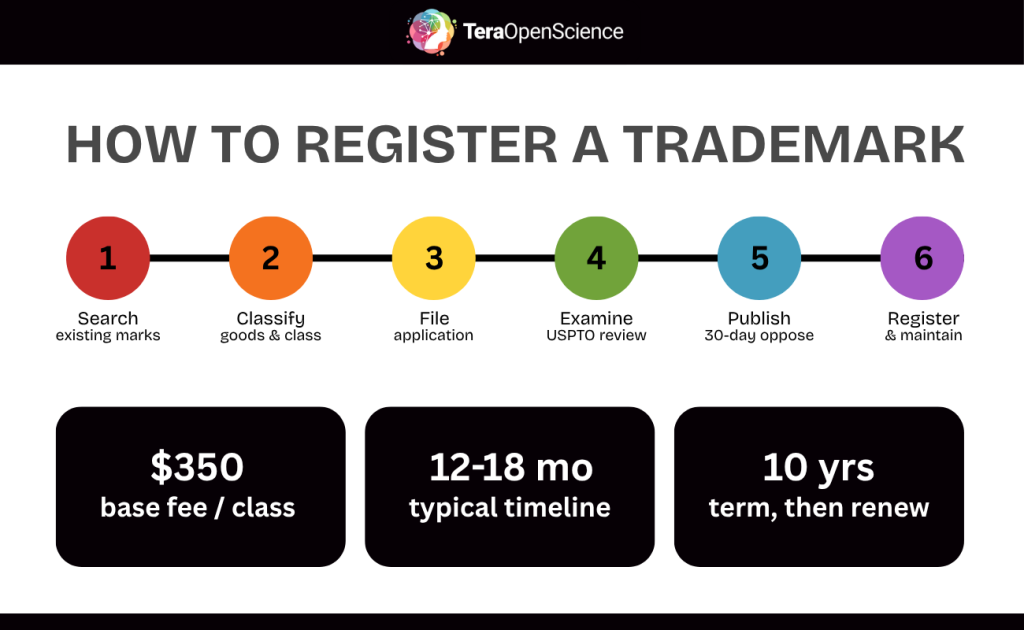
- The registration process moves through search, application, examination, publication, a 30-day opposition window, and final registration.
- Most applications take 12 to 18 months, and a registration lasts 10 years before it needs renewal.
A trademark turns a business name or logo into a legal asset you can defend. Knowing the steps ahead of time helps you avoid the delays and extra fees that catch many first-time applicants.
Why Register a Trademark?
Registering a trademark gives you the exclusive right to use your mark nationwide for your listed goods or services. Federal registration creates a legal presumption that you own the mark, puts the public on notice, and lets you bring an infringement case in federal court. Common law use alone offers far weaker trademark rights.
A registered trademark is also one of the most recognizable forms of intellectual property a business owns. Once your mark sits on the federal trademark register, you can place the ® symbol next to it, block later applicants from registering a confusingly similar mark, and point to a clear filing date that fixes your place in line. For a researcher or founder building a name around their work, that record protects a personal brand as much as a product. The same steps apply to a service mark registration when your brand stands for services rather than physical goods.
Here is what federal registration adds on top of basic trademark rights:
- Nationwide protection tied to your filing date
- A public record on the trademark register that deters copycats
- The right to use the ® symbol once the mark registers
- A legal presumption of ownership during disputes
- A foundation for filing mark registrations in other countries
Step 1: Search for Existing Marks
Before you file, search the trademark register for any existing mark that could conflict with yours. The USPTO will refuse a new application if your mark is likely to be confused with one already registered or pending. A careful search early on can save you the application fee and many months of waiting on a filing that was never going to clear.
Look in more than one place. The USPTO search system covers federal applications and registrations, but a business name can also carry common law rights from use alone. Checking your secretary of state records for a similar trade name or business entity adds another layer. You might also see the term written as two words, a trade mark, or filed as a trade mark application abroad, but in the United States the USPTO uses one word. Marks that simply describe the goods are harder to register, so distinctive names hold up better.

Step 2: Identify Your Goods, Services, and Class
Every trademark application ties your mark to specific goods or services, sorted into classes. There are 45 international classes, and you pay the application fee for each class you claim. Picking your descriptions from the USPTO Trademark ID Manual keeps your filing fee at the base level and speeds up review.
The wording here carries real cost. Each class has a class code, and you select the ones that match what you sell. If you write a custom, free-form description instead of selecting a pre-approved one, the USPTO adds a surcharge per class. Long descriptions trigger another surcharge for each extra block of characters. Naming your goods clearly and concisely, using the manual where you can, is the cheapest path through this step.
Step 3: File Your Trademark Application
You file your trademark application online through Trademark Center, the USPTO’s online filing service. The base application fee is $350 per class as of January 18, 2025, when the USPTO replaced its older two-tier system with a single base option. Your filing date sets your priority over later applicants, so filing promptly protects your place in line.
Your application form names the applicant, which can be a person or a legal entity, along with the mark itself and your filing basis. A use-in-commerce filing says the mark is already in use and includes a specimen showing that use. An intent-to-use filing reserves a mark you plan to use soon, with proof of use submitted later. Meeting the base application requirements with complete information keeps your filing fee low, since the 2025 registration fee structure adds charges for incomplete or custom filings. Allow a few business days for the system to reflect a submitted application.
| Fee type | Amount (per class) | When it applies |
| Base application | $350 | Standard descriptions from the Trademark ID Manual and complete info |
| Custom identification surcharge | $200 | Writing your own goods or services description |
| Long description surcharge | $200 | Each extra 1,000 characters in a description |
| Incomplete application surcharge | $100 | Missing required base application details |
| Madrid Protocol application | $600 | Foreign-based filings under Section 66(a) |
Step 4: USPTO Examination
After filing, a USPTO examining attorney reviews your application to confirm it meets legal requirements and does not conflict with an existing mark. This review usually begins several months after you file. If the attorney finds a problem, they issue an office action, and you have three months from its date to respond or the application is treated as abandoned.
Office actions are common and often fixable. An attorney might cite a likely conflict with a registered mark, call the mark too descriptive, ask for a better specimen, or request additional information about the applicant or the goods. You can answer the points raised, and an optional extension is available for a fee. Throughout the application process you can track status from your dashboard in Trademark Center, and a clean filing built in the earlier steps is the best way to keep this stage short.
Step 5: Publication and Opposition
If the examining attorney approves your application, your mark publishes in the Trademark Official Gazette, the USPTO’s weekly notice to the public. This opens a 30-day window in which any party who believes they would be harmed by your registration can file an opposition with the Trademark Trial and Appeal Board (TTAB). Most applications are never opposed.
An opposition works much like a federal court case, but it runs before the TTAB, the appeal board that operates as an administrative tribunal inside the USPTO. A trademark trial there follows set deadlines and procedures. If no one files within the 30 days, or if an opposition fails, your application moves to the final stage. This phase is one reason a clean, well-searched application pays off, since it lowers the odds of a challenge.
Step 6: Registration and Keeping It Alive
If no opposition is filed, the USPTO registers your trademark about three months after publication and issues a certificate of registration. A registration lasts 10 years. To keep it active, you file a declaration of use between the fifth and sixth years, then a combined declaration and renewal between the ninth and tenth years, repeating that renewal every decade.
A trademark has no permanent expiration date as long as you keep using it and file on time. Miss a required maintenance filing, even within the grace period, and the USPTO cancels the registration. The table below sets out the timing most applicants can expect.
| Stage | Typical timing |
| Filing to first examination | Several months |
| Office action response deadline | 3 months from the issue date |
| Publication after approval | About 1 month |
| Opposition period | 30 days |
| Registration after publication | About 3 months |
| Full process, start to finish | 12 to 18 months |
The registration of trademarks in the United States rewards good records. Keep proof of how you use your mark, watch your renewal dates, and treat this as general information rather than legal advice, since a trademark attorney can guide a filing that fits your situation.
Turning a Protected Brand Into Real Momentum
A registered trademark protects the brand behind your work, but protection is only the starting point. The harder part is building something worth protecting and getting it in front of people who can move it forward. That is where an open innovation community changes the math for researchers and founders.
For students, researchers, and innovators carrying an idea toward commercialization, TeraOpenScience connects you with collaborators, funders, and recruiters who can help your work reach the market. On the platform you can:
- Share your research and build a visible personal brand
- Find co-authors and partners across STEM, healthcare, and business
- Move projects along real commercialization pathways with a global community
Be open. Be seen. Join TeraOpenScience and give the brand you work to protect a place to grow.