Where the Best R&D Roles Actually Live
Most research and development jobs are filled through connections and visibility, not through public job postings alone.
Here is how to find research and development jobs online, at a glance:
- R&D roles span data science, software engineering, clinical trials, and product development.
- R&D employment is growing fast, with some research roles projected to grow far quicker than the average job.
- Surveys show more than half of workers land a role through a connection, not a cold application.
- Being visible to recruiters and collaborators matters more than firing off applications.
- TeraOpenScience puts your work in front of the people who hire for these roles.
Plenty of talented researchers apply to dozens of listings and hear nothing back. The reason is rarely skill; it is that the best opportunity often never reaches a public job board at all.
What Counts as a Research and Development Job?
A research and development job is any role that helps create new knowledge, products, or technology. R&D teams turn consumer insight and scientific research into new products, improve the supply chain behind them, and pursue breakthrough science. These roles exist across healthcare, technology, manufacturing, energy, and consumer goods.
The titles vary widely. A development team might include a software engineer building prototypes, a data scientist modeling results, a chemist running experiments, or a clinical research associate managing clinical trials. Some roles sit close to early discovery, while others focus on product development and getting a new product ready for launch. What every development job shares is a focus on research and disciplined experimentation.
Common research and development jobs include:
- Data scientist and machine learning roles
- Software engineer and research engineer positions
- Clinical trials and regulatory roles in the life sciences
- Product development and applied research roles
- Lab-based scientist and technician roles on an R&D team
The impact is real. R&D work can improve people’s lives. Clinical trials touch the lives of patients, and new products can raise quality of life for entire communities.
Why R&D Hiring Keeps Growing
R&D hiring is growing because demand for new technology and new innovation keeps rising across the United States. The U.S. Bureau of Labor Statistics projects that employment of data scientists will grow 34 percent from 2024 to 2034, much faster than the average for all occupations. Computer and information research scientists are projected to grow about 20 percent over the same decade.
The industry that houses much of this work is expanding too. BLS projects that scientific research and development services will add jobs at a rate of 8.7 percent from 2024 to 2034, with strong demand tied to healthcare, biotechnology, and AI. More research activity means more people are needed to carry it out.
Government incentives add fuel. The federal research and development tax credit lets companies offset part of what they spend on qualifying research activity, lowering their tax burden for the taxable year and freeing budget for research efforts and new hires. When companies spend more on research, they hire more researchers.
| R&D role | Core focus | Projected growth, 2024-2034 |
| Data scientist | Analyze data, build models | 34% |
| Computer and information research scientist | Invent new computing technology | 20% |
| Scientific R&D services (industry) | Research across many fields | 8.7% |
The Best Way to Find R&D Jobs Online
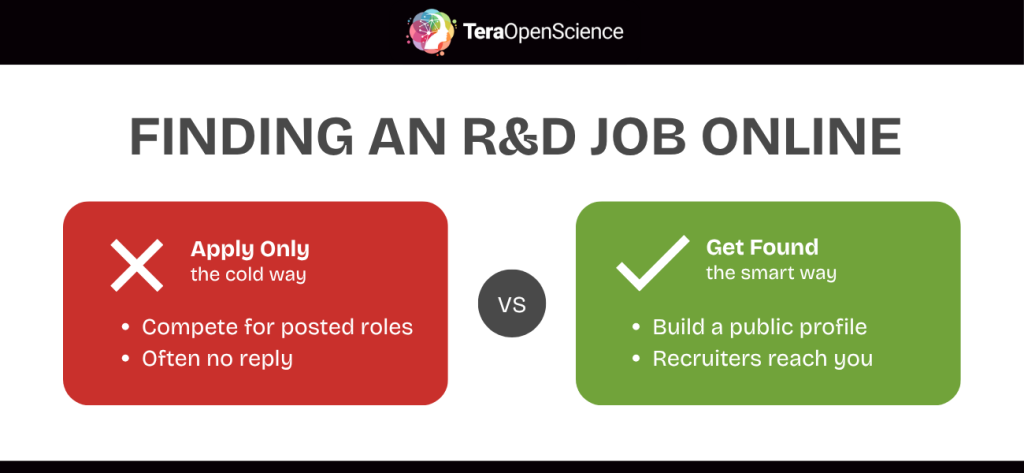
The best way to find research and development jobs online is to become visible to the people who hire, rather than relying only on applications. Referrals and connections drive a large share of hiring. One 2025 survey found that 54 percent of workers landed their job through a connection, far ahead of job boards.
Employee referrals tell the same story. Industry data shows referrals account for 30 to 50 percent of all new hires, even though referred candidates make up a small slice of the applicant pool. For job seekers, that gap is the whole game: most applicants compete for the minority of roles that get posted publicly, while connected candidates reach the rest.
This is why a public job posting should be only one part of your search. The stronger move is to build a visible record of your work so recruiters, collaborators, and hiring managers can find you. That is exactly the gap TeraOpenScience was built to close.
How TeraOpenScience Supports Your Search
TeraOpenScience helps you get found by putting your research and your profile in front of a global network of collaborators, funders, and recruiters. Instead of sending applications into a void, you build an open record of your work that the right people can discover. The platform connects students, researchers, and professionals across STEM, healthcare, and business.
Here is how that supports your search for career opportunities:
- Your profile and contributions are visible to potential co-authors, investors, and recruiters
- You can join a global team of researchers and show your skills through real work, not just a resume
- Sharing research builds a personal brand that signals your expertise to hiring managers
- An AI-powered ecosystem surfaces connections and opportunities you would not find on a job board
Recruiters increasingly look for candidates who show their work in public. By contributing on TeraOpenScience, you turn your research into a signal that reaches hiring teams long before a formal posting goes live.

What to Expect in an R&D Job Posting
Most research and development job postings in the United States follow a similar shape, and knowing it helps you apply with confidence. The listing describes the role, the development team, required skills, and benefits such as a retirement plan or credit union access. Many postings also attach standard legal language.
Near the bottom, you will usually find an equal employment opportunity employer statement. It confirms the company does not discriminate on the basis of national origin, sexual orientation, gender identity, gender expression, marital status, veteran status, or disability, and that it offers reasonable accommodation during the hiring process. Public companies may also include a forward-looking statement noting that future research efforts carry uncertainty.
Be mindful during the application process. A legitimate employer may reach out by email communication or a text message, but it will not ask you to send sensitive personal information through an unknown third party. If something feels off, verify the message against the company’s official career opportunities page.
How to Land the Role
To land a research and development job, pair a visible body of work with a focused application that shows scientific rigor. Hiring managers want evidence that you can do the work, so a track record of real projects often carries more weight than a polished resume alone. Show results, methods, and the thinking behind them.
A few steps that help:
- Keep a public, current record of your research and projects
- Connect with team members and collaborators in your field
- Tailor each application to the specific role and development team
- Be ready to discuss your methods and results with clarity and scientific rigor
Consistency matters more than any single application. The more you contribute and connect, the more often the right opportunity finds you.
Join TeraOpenScience and Get Seen
The strongest way to find research and development jobs online is to be visible where research happens. TeraOpenScience gives you that visibility by connecting your work to a global community of researchers, collaborators, and the recruiters who hire them.
On TeraOpenScience you can:
- Share your research and build a personal brand that recruiters notice
- Connect with a global team across STEM, healthcare, and business
- Access career opportunities through an open, AI-powered ecosystem
Be open. Be seen. Join TeraOpenScience and put your work in front of the people building the future of research.