Everything You Need to Know Before It Expires
Patent protection does not last forever, and the exact length depends on the type of patent, the fees you pay, and where in the world you filed.
At a Glance:
- A U.S. utility patent lasts 20 years from the filing date, subject to maintenance fees.
- A U.S. design patent lasts 15 years from the grant date, with no maintenance fees.
- A provisional application is not a patent; it holds your spot for 12 months.
- Patent term adjustment and patent term extension can add time; a terminal disclaimer can subtract it.
- Maintenance fees are due at 3.5, 7.5, and 11.5 years, or the patent lapses early.
- A U.S. patent does not protect you abroad; international filings follow their own rules.
The patent system trades a limited monopoly for public disclosure, so every patent is built to expire. Understanding that timeline helps inventors, businesses, and researchers plan around the moment an invention becomes free for everyone to use.
The Basics: What Is a Patent and Why Does Duration Matter?
A patent is a legal grant from a government patent office that gives an inventor the exclusive right to stop others from making, using, or selling an invention for a limited time. Duration matters because once that window closes, the patented invention enters the public domain and anyone can use it freely.
In the United States, patents are issued by the U.S. Patent and Trademark Office (USPTO). The exclusive right a patent confers is the right to exclude others from making, using, offering for sale, or selling the invention within the country. That right is the entire point of patent protection, and it has an expiration date by design.
There are three main filing categories inventors deal with. A utility patent covers how an invention works, such as a machine, process, or chemical compound. A design patent protects the ornamental appearance of a product rather than its function. A provisional patent application is a lower-cost placeholder that establishes an early filing date without starting a formal examination.
Standard Patent Terms in the United States
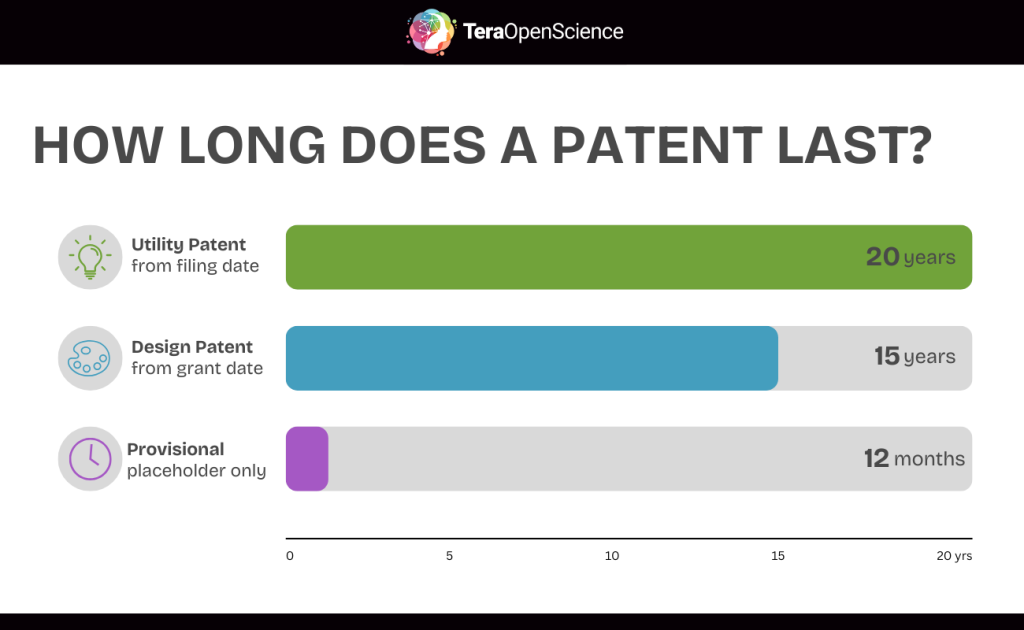
In the United States, a utility patent lasts 20 years from its filing date, while a design patent lasts 15 years from its grant date. A provisional application is not a patent at all; it holds your place for 12 months before a full application must follow.
For utility patents filed on or after June 8, 1995, the patent term runs 20 years from the earliest U.S. non-provisional filing date. Provisional applications and foreign priority filings do not count against that 20-year clock. This is why the filing date and the priority date can differ: the priority date marks your place in line for examination, but the standard term is generally measured from the non-provisional filing date.
Design patents work differently. Following U.S. accession to the Hague Agreement, design patents from applications filed on or after May 13, 2015 last 15 years from the date of grant, up from the earlier 14-year term. They carry no maintenance fees.
| Patent type | Term length | Measured from | Maintenance fees? |
| Utility patent | 20 years | Filing date | Yes |
| Design patent | 15 years | Grant date | No |
| Provisional application | 12 months | Filing date | No (it is not a patent) |
A common misconception is that a provisional application becomes a patent on its own. It does not. It buys an inventor up to a year of “patent pending” status to refine the invention before committing to the full patent application process.
Patent Term Adjustment and Patent Term Extension: Getting Extra Time
Two mechanisms can lengthen a patent beyond its standard term. Patent term adjustment adds days to compensate for USPTO processing delays, and patent term extension restores time lost to FDA regulatory review for products like drugs and medical devices. A terminal disclaimer, by contrast, can shorten a term.
Patent term adjustment (PTA) applies when the USPTO takes too long. If the office misses certain internal deadlines, such as exceeding three years to issue a patent, the lost time is added back to the term. PTA matters most for inventors whose applications sit in examination for years.
Patent term extension (PTE) is built for industries where regulatory approval eats into the effective patent life. Under the 1984 Hatch-Waxman Act, a pharmaceutical company can recover part of the time a drug spent in clinical trials and FDA review. The restoration is capped: a single patent can gain no more than five years, and the total term cannot exceed 14 years after FDA approval. Only one patent per approved product qualifies, and the application must be filed within 60 days of approval.
A terminal disclaimer moves in the opposite direction. A patent owner files one, often to overcome a double-patenting rejection, and in doing so agrees that the later patent will expire at the same time as a related one. It can shorten the term rather than extend it.

Maintenance Fees: The Cost of Keeping a Patent Alive
A U.S. utility patent does not stay in force on its own. The patent holder must pay maintenance fees at 3.5, 7.5, and 11.5 years after the patent is granted. Miss a deadline and the patent lapses early, sending the invention into the public domain ahead of schedule.
These payments are a deliberate filter. They ask patent owners to decide, at three points across the life of the patent, whether the protection is still worth the cost. An invention generating no revenue often gets abandoned at the first or second milestone, which is why valuable but dormant patents sometimes lapse by accident inside large portfolios.
The U.S. utility patent maintenance schedule:
- First fee: due by 3.5 years after grant
- Second fee: due by 7.5 years after grant
- Third fee: due by 11.5 years after grant
Design patents have no maintenance fees in the United States. In many European countries the structure is different again, with renewal fees paid annually rather than at set milestones, so the cost of holding a patent rises year over year.
International Patent Duration: The PCT, EPO, and Beyond
A U.S. patent only protects an invention inside the United States. International protection requires filing in each country or region, often through the Patent Cooperation Treaty or the European Patent Office. The standard term abroad is usually 20 years from filing, but renewal rules and fees differ by country.
The Patent Cooperation Treaty (PCT) does not grant a patent. A PCT application is a single international filing that buys time, giving applicants roughly 30 to 31 months from the priority date to decide which countries to pursue. After that, the applicant must enter the “national phase” in each chosen jurisdiction, and each patent office examines the application under its own patent law.
In Europe, the European Patent Convention lets applicants seek protection through the European Patent Office (EPO). A granted European patent runs up to 20 years from its filing date, but it must be validated and renewed country by country, with annual renewal fees due in each territory where it stays in force. The European Union also offers a supplementary protection certificate, a counterpart to U.S. patent term extension that adds time for medicines and plant-protection products delayed by regulatory approval.
The practical takeaway: patent rights are territorial. Securing global protection means managing multiple expiration dates, multiple fee schedules, and multiple sets of rules at once.
Patent Expiration and What It Means for Innovation
When a patent expires, the invention enters the public domain and anyone can make, use, or sell it without permission. In pharmaceuticals, this opens the door to generic manufacturers and lower prices. Patent infringement claims also end, because there is no longer an exclusive right to defend.
Expiration is less an ending than a handoff. The original bargain of the patent system was always limited exclusivity in exchange for public disclosure, and the public domain is where that disclosure finally pays off for everyone else. A generic manufacturer can launch a lower-cost version of a drug. A startup can build on a method that was off-limits a year earlier. A researcher can study, adapt, and improve technology without negotiating a license.
That handoff is uneven, though. Plenty of intellectual property goes dormant long before it expires, sitting unused in portfolios because the patent owner never commercialized it and competitors could not touch it. Expired and underused patents represent a deep reservoir of knowledge for anyone willing to mine it, which is where open science and open access become useful. Pooling expired and openly licensed work lets interdisciplinary teams move ideas toward real industrial application faster than any single patent holder could alone.
Managing this full lifecycle, from the provisional application through expiration, is the day-to-day work of a patent attorney. None of the above is legal advice; consult a qualified attorney for guidance on your specific situation.
Want to hear what this strategy looks like from someone who has lived it? Stay tuned for our upcoming interview series, where inventors, scientists, and industry leaders share their insights on building careers in innovation and what real collaboration between science and industry looks like. We’re kicking things off with Audrey Sherman, an inventor and scientist with over 173 patents to her name, coming soon to TeraOpenScience.
Plan Before the Clock Runs Out
So, how long does a patent last? In short: 20 years for a utility patent, 15 for a design patent, with maintenance fees, adjustments, extensions, and international rules all shifting the real number. The patent term is a countdown, and the value lies in knowing exactly where you stand on it.
At TeraOpenScience, we believe knowledge moves fastest when barriers come down, including the ones that expire. Whether you are protecting new work or building on what has already entered the public domain, our open innovation platform connects students, researchers, and professionals who want to turn ideas into impact.
- Explore open technologies and research tools at teraopenscience.com
- Collaborate with a global network of scientists and innovators
- Be open. Be seen. Join the world’s collective brain and put your work in front of co-authors, funders, and recruiters