Your Roadmap to Launching a Successful Venture
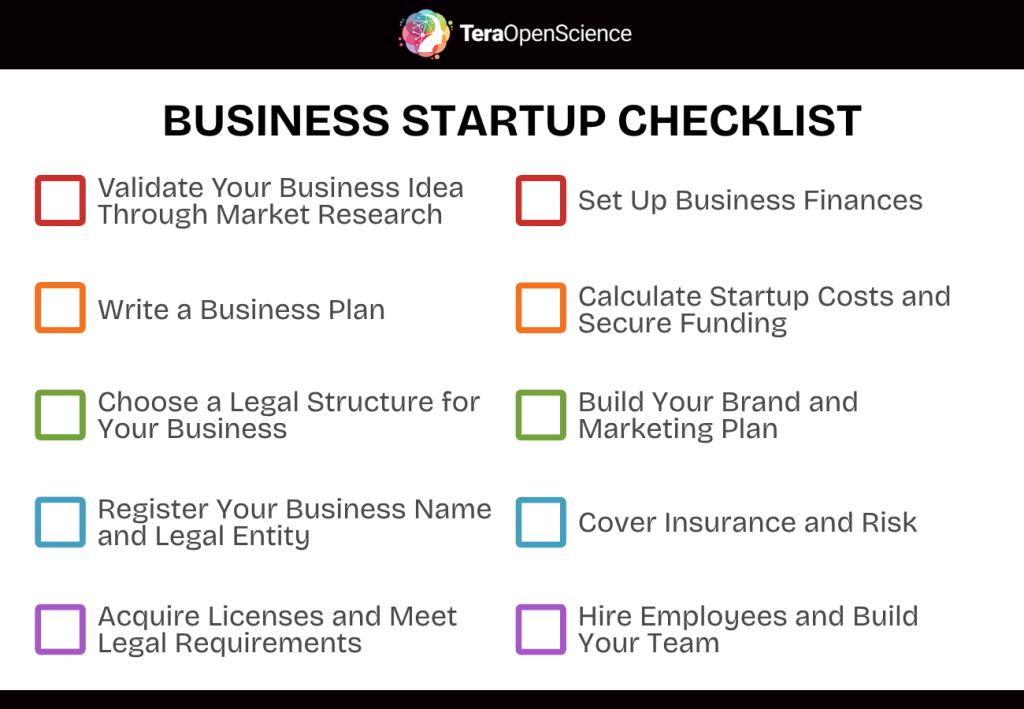
Starting a business requires careful planning across legal, financial, and operational fronts before opening day. This business startup checklist walks through every step a new business owner needs to complete, from validating your business idea to opening a business checking account and hiring your first team members.
At a Glance:
- Validate your business idea with market research before investing time or money
- Choose the right legal structure (sole proprietorship, LLC, partnership, or corporation)
- Register your business name and acquire licenses from federal agencies and your secretary of state
- Build a business plan with financial projections, marketing strategy, and operational details
- Separate personal and business finances with a dedicated bank account
- Plan for insurance, taxes, and ongoing compliance requirements
According to the U.S. Small Business Administration, there are roughly 34.7 million small businesses in the country, accounting for 99.9% of all U.S. firms. Yet about 20% of new ventures close within their first year, making preparation the single biggest factor separating success from failure.
1. Validate Your Business Idea Through Market Research
Before spending a dollar, confirm that potential customers actually want what you plan to sell. Market research uncovers demand, pricing tolerance, and competition gaps. Plan on 2 to 4 weeks talking with at least 25 to 50 prospective buyers, studying competitors, and analyzing industry reports before moving forward.
A solid validation phase includes:
- Interviews with 25+ target customers about pain points and willingness to pay
- Competitor analysis covering pricing, positioning, and product gaps
- Industry data from IBISWorld, Statista, or government databases
- A test offer or landing page to gauge real demand
The first step is replacing assumptions with evidence. If three out of four small business owners say they would never have launched without doing market research first, that signal is worth taking seriously.

2. Write a Business Plan
A business plan converts your business idea into a working document that guides decisions and attracts funding. Most lenders and investors require one, and research from the University of Edinburgh found that entrepreneurs with a written plan are roughly 16% more likely to achieve viability than those without.
Your business plan should include:
- Executive summary: A one-page snapshot of the company
- Vision statement and mission: What you are building and why
- Market analysis: Industry size, target customers, competitors
- Products and services: What you sell and how it is priced
- Marketing plan: How potential customers will find you
- Operations plan: Business location, suppliers, staffing model
- Financial projections: Startup costs, cash flow forecasts, break-even analysis
Keep the first draft short. A 10 to 15 page plan beats a 50-page document nobody reads.
3. Choose a Legal Structure for Your Business
Your legal structure affects taxes, personal liability, and your ability to raise capital. The four most common business entity types in the United States are the sole proprietorship, general partnership, limited liability company (LLC), and corporation. Each suits a different stage and risk profile.
| Business Structure | Liability Protection | Taxation | Best For |
| Sole Proprietorship | None (personal assets at risk) | Personal income tax | Solo home-based business with low risk |
| General Partnership | None (shared personal liability) | Pass-through to partners | Two or more co-founders, simple ventures |
| Limited Partnership | Partial (limited partners shielded) | Pass-through | Investors who want returns without management duties |
| Limited Liability Company | Strong (personal assets protected) | Flexible (pass-through or corporate) | Small businesses wanting limited liability plus tax flexibility |
| Corporation (C-Corp / S-Corp) | Strongest | Corporate or pass-through (S-Corp) | High-growth companies seeking outside investment |
Most small business owners choose the limited liability company because it combines liability protection with pass-through taxation. Talk to a CPA or attorney before finalizing your decision, since the wrong structure can cost thousands in taxes and legal exposure later.
4. Register Your Business Name and Legal Entity
Once you select a legal structure, register your business name with your state’s secretary of state office. Search the state database first, then check the U.S. Patent and Trademark Office for a federal trademark conflict. Skipping this step risks rebranding later or facing a lawsuit.
Registration tasks include:
- Filing formation documents with the secretary of state (Articles of Organization for liability companies, Articles of Incorporation for corporations)
- Getting an Employer Identification Number (EIN) from the Internal Revenue Service, free at irs.gov
- Filing a DBA (Doing Business As) if operating under a name different from the legal entity
- Registering for state and local tax accounts with your department of revenue
A federal trademark is optional but worth the $350 USPTO filing fee if your brand is central to your business model.
5. Acquire Licenses and Meet Legal Requirements
Most businesses need at least one business license to operate legally. Requirements vary by industry, location, and business structure. Federal agencies regulate sectors like agriculture, alcohol, aviation, firearms, and broadcasting, while states and cities handle general operating licenses.
Common legal requirements include:
- General business license from your city or county
- Industry-specific permits (food service, healthcare, construction, professional services)
- Zoning permits for your business location, including home-based business setups
- Sales tax permit from the department of revenue if you sell taxable goods
- Annual report filings with the secretary of state to keep your entity in good standing
Check the Small Business Administration license and permits tool for a state-by-state breakdown.
6. Set Up Business Finances
Separating personal and business money is one of the first steps every business owner should take after registration. Open a business checking account, apply for a business credit card, and choose accounting software before your first sale. Mixing funds can void liability protection for LLCs and corporations.
A clean financial setup includes:
- A business checking account at a bank that supports your business structure
- A bookkeeping system (QuickBooks, Xero, or Wave)
- A merchant account or payment processor (Stripe, Square, PayPal)
- A cash reserve covering at least 3 to 6 months of operating expenses
Cash flow problems contribute to 82% of small business failures, according to a widely cited U.S. Bank study. Building a cash reserve early prevents the most common cause of closure.

7. Calculate Startup Costs and Secure Funding
Most new businesses launch with $10,000 to $80,000 in startup costs, though service-based and home-based business models often run lower. Total your one-time expenses (equipment, real estate deposits, legal fees) plus six months of operating costs to set your funding target.
Funding sources worth considering:
- Personal savings, the most common source for first-time founders
- Small Business Administration 7(a) and microloans
- Bank loans backed by collateral or a personal guarantee
- Friends, family, and angel investors
- Grants from federal agencies, foundations, or industry associations
- Crowdfunding through Kickstarter, Indiegogo, or equity platforms
Track every expense from day one. The Internal Revenue Service lets you deduct up to $5,000 in startup costs in your first year of operation, with the rest amortized over 15 years.
8. Build Your Brand and Marketing Plan
A marketing plan turns your business name into a recognized brand that draws potential customers. Start with three or four channels you can manage well rather than spreading across ten. Email, content marketing, and social media remain the lowest-cost, highest-return options for most small business owners.
Brand and marketing checklist:
- Logo, color palette, and basic brand guidelines
- A website with clear messaging and contact information
- Google Business Profile listing for local visibility
- Social media accounts on platforms where your customers spend time
- Email marketing service (Mailchimp, Klaviyo, or ConvertKit)
- Content calendar covering the first 90 days
9. Cover Insurance and Risk
Insurance protects your business assets, your team, and your personal finances. Talk to an insurance agent who works with small business owners in your industry. Most insurance company quotes are free, and policies start at a few hundred dollars a year for a home-based business.
Common policies include general liability, professional liability (errors and omissions), commercial property, workers’ compensation (required in most states once you hire employees), and cyber liability for any business handling customer data.
10. Hire Employees and Build Your Team
Before you hire employees, register with the IRS for federal employment taxes, get a state employer ID, and set up payroll software. Federal law requires Form I-9 verification, Form W-4 collection, and posting workplace rights notices visible to employees.
Hiring milestones:
- Workers’ compensation insurance policy in place
- Payroll service or software (Gusto, ADP, or QuickBooks Payroll)
- Employee handbook covering policies and benefits
- Job descriptions and a structured interview process
Many founders start with contractors or part-time help from a service provider before committing to full-time hires.
Move Forward With Confidence
This startup checklist covers the operational basics, but launching a business idea that lasts also takes outside perspective, expert input, and access to research that goes beyond what one founder can gather alone. That is where TeraOpenScience fits in. Our AI-powered open innovation platform connects founders with researchers, professionals, and subject matter experts across STEM, healthcare, and business, giving you a worldwide network to validate ideas, refine your business plan, and find collaborators.
From market data to technical expertise and grant funding leads, TeraOpenScience opens doors that traditional channels keep closed. Join the platform today and bring your business idea to a community built for innovation. BE OPEN. BE SEEN.