Two Gates Before Software Ships
Alpha and beta testing are two sequential stages that catch different problems before software reaches the public, and knowing which does what saves teams from shipping broken products. Here is the difference at a glance:
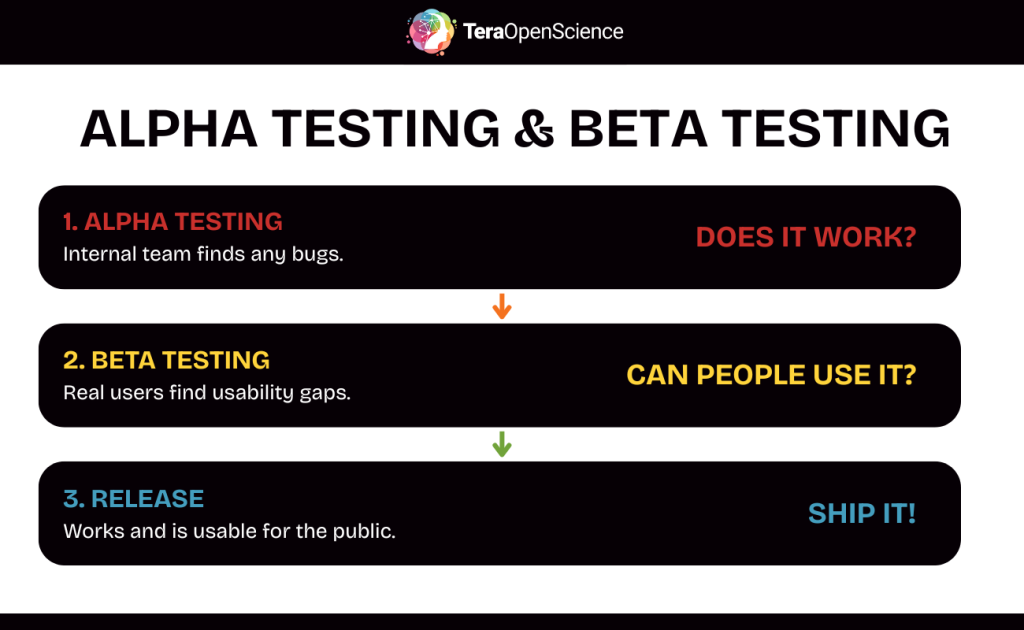
- Alpha testing happens first, run by internal employees inside a controlled environment to catch critical bugs early.
- Beta testing happens second, run by real users in real-world conditions to surface usability and experience problems.
- Alpha focuses on whether the software works; beta focuses on whether people can actually use it.
- Alpha uses internal testers who know the product; beta uses external users who do not.
- Both feed into the final release, but they answer different questions and cannot replace each other.
Every reliable piece of software passes through testing stages designed to catch faults a development team cannot see on its own. Alpha and beta are the two most important of these, and confusing them leads to products that either ship too early or never ship at all.
What Is Alpha Testing?
Alpha testing is the first phase of end-to-end software testing, performed internally by employees before any outside user sees the product. During the alpha phase, the QA team and software developers run the product in a controlled environment to find critical bugs, broken features, and technical issues while they are still cheap to fix. It answers one question: does this actually work?
The alpha test is deliberately artificial. Internal testers follow scripts, push features to their limits, and often test on machines set up specifically for the purpose rather than typical end-user hardware. Because the people running the alpha test know the software well, they find deep functional and structural problems that a casual user would never reach. This is also where fixing a defect costs the least, since the National Institute of Standards and Technology has documented that bugs caught early cost a fraction of what they cost after release.
What Is Beta Testing?
Beta testing is the second phase, where a limited group of real users tries the software in real-world conditions before general availability. The beta release goes out to external users, sometimes called public beta testers, who use the product on their own devices, in their own settings, for their own purposes. It answers a different question: can real people use this well?
The beta phase surfaces problems no internal team can predict. A beta tester uses the software in ways the development team never imagined, on hardware and network conditions the QA team never configured, which exposes usability issues, confusing workflows, and edge-case technical issues that only appear at scale. This is why a beta test doubles as a form of user acceptance testing, giving product managers direct user feedback on whether a new feature lands before the final version is locked.
The Key Differences Side by Side
The core distinction is who tests, where, and what they are looking for. Alpha testing is internal testing focused on function; beta testing is external validation focused on experience. The table below lays out the key differences.
| Factor | Alpha Testing | Beta Testing |
| When | First testing phase | Second, before final release |
| Who | Internal employees, QA team | Real users, external users |
| Where | Controlled environment | Real world conditions |
| Goal | Find critical bugs and technical issues | Find usability issues and gather feedback |
| Knowledge level | Testers know the product | Testers are the target audience |
| Main output | A working product | A usable, validated product |
Reading across the table shows why both stages are needed. Alpha proves the software runs; beta proves the software works for the people it was built for. Skipping alpha sends broken code to real customers, and skipping beta ships a technically sound product nobody finds intuitive.
Why the Order Matters
The sequence is fixed for a reason: you cannot get useful beta feedback on software that still crashes. Alpha testing clears out the critical issues that would otherwise dominate a beta tester’s attention, so beta feedback focuses on experience rather than on defects the team already knew about. Running them out of order wastes the goodwill of your earliest external users.
Think of it as two filters with different mesh sizes:
- Alpha catches the large, structural failures, such as features that do not function or data that does not save.
- Beta catches the fine problems, such as a confusing button, a slow screen, or a workflow that makes sense to engineers but not to a potential customer.
- Alpha protects the beta phase from noise, and beta protects the final release from real-world surprises.
What Alpha and Beta Testing Mean for Open Science
Open science platforms benefit from the same two-stage logic, and being online makes the beta stage more powerful. When research tools, datasets, and methods are developed in the open, the “beta testers” become a global community of researchers who stress-test the work under conditions the original team could never replicate. Transparency turns testing from a private step into a shared one.
This mirrors how peer review already works in research. A first internal check by close collaborators resembles an alpha test, catching obvious errors before wider circulation. Open peer feedback from the broader community then acts like a beta phase, exposing the work to real users with different expertise, different data, and different assumptions. Studies of open peer review have found it can increase the thoroughness of feedback by widening the pool of reviewers, which is the same principle that makes public beta testing so effective for software.
- Internal validation, like an alpha test, catches errors before work goes public.
- Open community feedback, like a beta test, tests findings against diverse real-world use.
- Both stages together produce research that holds up better than either alone.
For anyone building tools or publishing methods in an open ecosystem, treating the community as beta testers rather than a passive audience produces stronger, more reproducible results.

Common Mistakes to Avoid
The most frequent errors come from blurring the line between the two stages. Teams that treat beta as a second alpha waste real user attention on bugs they should have caught internally, and teams that skip alpha entirely burn their earliest adopters. Clear separation keeps each stage doing its job.
- Releasing a beta with known critical bugs, which drives away the real users whose feedback you need most.
- Using internal team members as your only beta testers, which defeats the purpose of external validation.
- Ignoring beta feedback because the final release date is fixed, which ships known usability issues to real customers.
- Ending the alpha phase too early, before the QA team has cleared the technical issues that block honest beta use.
From Testing to Publishing in the Open
The same discipline that makes software testing work- internal checks first, then open validation by real users- is what makes research stronger when it is shared openly. TeraOpenScience is an open science platform where students, researchers, and professionals across STEM, healthcare, and business put their work in front of a global community for exactly this kind of feedback. Share a method, a dataset, or a manuscript, gather valuable feedback from people testing it against real-world conditions, and refine it before it reaches its final form. Join TeraOpenScience, open your work to the community, and be seen. Be open. Be seen.