The Preview You Read Before the Paper
When you click into a research paper, the first block of text below the title and authors is the abstract, and this short research abstract usually decides what you do next.
At a Glance:
- An abstract is a standalone summary of a research paper, usually 150 to 300 words long.
- It appears just after the title page, before the introduction, and it often determines whether a reader continues.
- The main types of abstracts are descriptive, informative, critical, and graphical abstracts, and each one serves a different purpose.
- You can cite an abstract in most citation styles, though citing the full journal article is almost always the better call.
- Search engines, databases, and AI tools lean heavily on abstracts to index and surface research, which makes a well-written abstract more valuable than ever.
An abstract is one of the most-read parts of any scientific paper, even though it is one of the shortest. Learning how it works helps you scan the literature faster and write summaries that get your own scientific work noticed.
What Is an Abstract in a Research Paper?
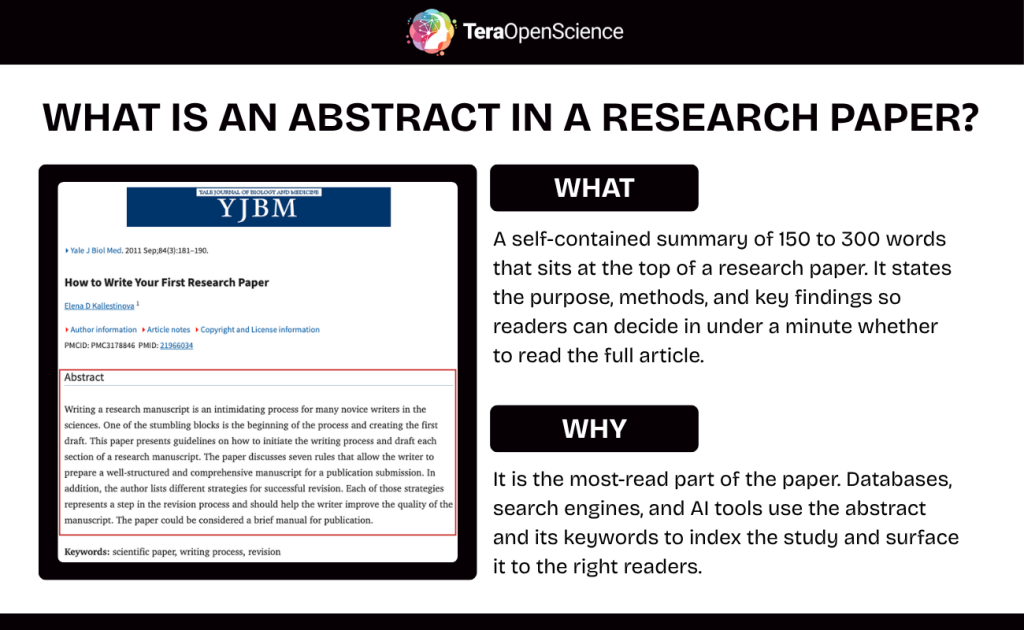
An abstract in a research paper is a concise, self-contained summary of the entire study, usually one paragraph of 150 to 300 words. It states the research question, the research methods, the key findings, and the conclusions. Readers use it to decide, in under a minute, whether the full paper is worth their time.
The abstract sits in a fixed spot, just after the title page and before the introduction, which makes it the gateway to the rest of the work. USC’s writing guide notes that a research abstract follows a prescribed sequence: the purpose and research problem, the research design, the major results, and a short interpretation of what they mean.
Style matters as much as sequence. The function of an abstract is to describe the paper, not to evaluate or defend it. Most writing center guides also note that an informative abstract is usually written in the past tense and the third person and can stand entirely on its own, while a shorter descriptive abstract often uses the present tense. A good test is whether you can condense your background information into a single sentence that still makes sense with no surrounding context.
Why Every Research Paper Needs One
Abstracts exist for two reasons: they help readers filter, and they help machines find. Abstracts let potential readers preview the paper and decide whether to read it, and many databases use abstracts to index longer works, so they carry the relevant keywords that make searching easier. Both jobs happen before anyone reads a line of your introduction.
Consider how researchers actually work. A literature review or systematic review can involve scanning dozens or even hundreds of results, and few people read every paper in full. The abstract is the screening tool. A reader skims it, judges it against their own research question, and then moves on or commits to the full text.
The abstract also drives discovery through search engines and scientific journals. If your summary omits the terms people actually search, your research project becomes harder to find, no matter how strong the results are. A precise abstract with the right relevant keywords is what pulls the correct audience toward your scientific research.
The Main Types of Abstracts
The four main types of abstracts you are most likely to meet are the descriptive abstract, the informative abstract, the critical abstract, and the graphical abstract. The right choice depends on the field, the journal, and whether you are summarizing original research or reviewing existing literature. You will also see abstracts prepared for an oral presentation, a poster session, or a late-breaking abstract submitted close to a conference deadline.
| Type | What it includes | Typical word count | Common use |
| Descriptive abstract | Purpose, scope, and research methods, but no results or conclusions | Around 100 words | Humanities and social sciences |
| Informative abstract | Research question, methods, key findings, and the main argument | 150 to 300 words | Most scientific journals and original research |
| Critical abstract | Adds the writer’s judgment on the study’s validity and reliability | 400 to 500 words | Rare, used in some review contexts |
| Graphical abstract | Presents the main point as a single image instead of text | One image | Journals, oral presentations, and poster sessions |
An informative abstract carries the most weight, because it delivers the study’s main point and key findings rather than a preview alone. The graphical abstract, also called a visual abstract, deserves a closer look: it is a single pictorial summary of the main findings, and articles that include one see roughly double the average annual use compared with articles without a visual abstract.

Can You Cite an Abstract?
Yes, you can cite an abstract, and major citation styles include specific formats for it. In APA, you cite only the abstract of a conference presentation by adding the word “abstract” to the bracketed description, such as “[Conference presentation abstract].” That label tells your reader you drew on the summary rather than a full journal article.
One caveat is worth respecting. Conference abstracts often report preliminary findings that have not gone through full peer review, which is why researchers running a systematic review weigh carefully whether to include studies published only as abstracts. For example, a conference abstract on a new treatment for an upper respiratory infection might share early results months before the original research reaches a journal.
The practical rule is simple. Cite the abstract only when it is the sole available form of the research. Once the full paper exists, read it and cite that version instead.
Why Abstracts Matter More in the Age of AI
Abstracts have quietly become one of the highest-value pieces of text in academic writing, because AI systems read them first. Large language models and AI search tools pull from concise, keyword-rich summaries. A well-written abstract is exactly that, which makes it prime material for machine extraction and citation.
The data backs this up. Princeton’s foundational research on generative engine optimization found that adding statistics and quotations to content improved its visibility in AI-generated answers by up to 41% across a 10,000-query benchmark. An informative abstract packed with specific numbers and clear key findings gives an AI model concrete material to surface and attribute back to you.
A feedback loop follows. Well-structured abstracts get indexed more accurately by search engines, appear more often in AI answers, and drive more readers to the full paper. A vague abstract built on general categories instead of specific results does the opposite and buries good work.
What a Well-Written Abstract Includes
A well-written abstract answers four questions in order: what problem you studied, how you studied it, what you found, and what it means. A written abstract should be drafted after the full paper is complete and should state what the study found rather than what it set out to explore. Writing it last keeps the summary honest to the finished research.
Strong abstracts share a few habits:
- They report specific results and numbers rather than vague phrases like “important results.”
- They compress the background information into a single sentence so the study’s context lands fast.
- They include the relevant keywords a searcher or database would use to find the topic.
- They match the word count limits of the target journal, which in the United States and abroad commonly fall between 150 and 300 words.
- They leave out citations, figures, and abbreviations that need the full paper to make sense.
Follow those habits and one scientific abstract works for every audience at once: the reader skimming a literature review, the database building an index, and the AI model deciding what to cite.
Put Your Abstract to Work Where People Will See It
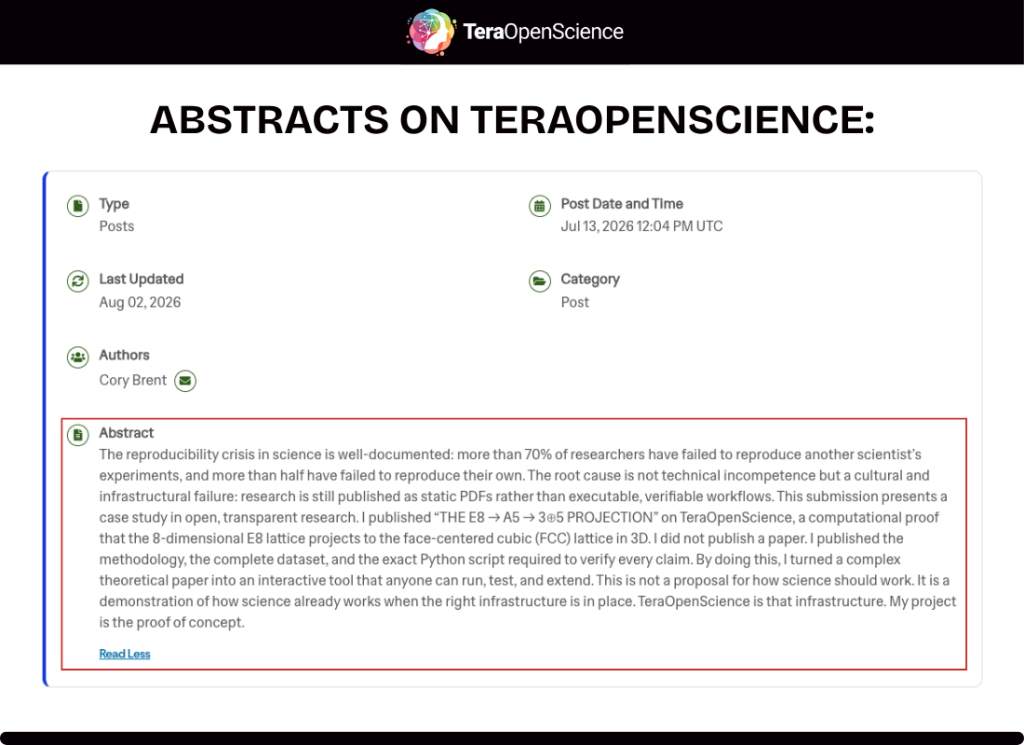
An abstract only matters if the right people read it. Writing a clear, keyword-rich journal abstract is step one. Getting that summary in front of collaborators, funders, and readers is step two, and that is where an open platform changes the equation.
TeraOpenScience is an AI-powered open science platform that connects students, researchers, and professionals across STEM, healthcare, and business. Sharing your research project in an open ecosystem means your abstract reaches potential co-authors, grant funders, and recruiters instead of sitting behind a paywall. The platform sums it up in four words: BE OPEN. BE SEEN.
Ready to make your research visible? Join TeraOpenScience and share your work with a global community built for collaboration.