Getting Past the Bots and the Humans
Making a resume stand out now means clearing two very different readers in sequence, and this article walks through both in the order they happen. Here is what it covers at a glance:
- Most large employers screen resumes with an applicant tracking system before a person ever sees them, so keyword matching comes first.
- Mirroring the exact language of the job description is the fastest way to pass that initial AI screening.
- Once a human takes over, quantified achievements and strong action verbs are what hold a hiring manager’s attention.
- Clean formatting and a tailored skills section decide whether you survive the six-second first impression.
- Maintaining your resume between job searches keeps it accurate and ready when the right role appears.
The resume review process has changed more in the last five years than in the previous twenty. A modern job application usually passes through software before a human, which means a standout resume has to satisfy a machine and a person without contradicting itself.

First, Understand the Review Process
A resume today typically clears two gates. The first is an applicant tracking system, or ATS, that scans, sorts, and ranks applications by how well they match the job posting. The second is a human hiring manager who reads only the resumes the software surfaces. Knowing this order tells you what to fix first.
The scale explains the setup. Corporate job openings attract an average of 250 applicants each, according to widely cited recruiting figures, and a hiring manager cannot read them all. Software does the first cut, which is why a resume that reads beautifully but ignores the software rarely gets seen. The tricks below follow the same chronological order a resume travels, from the ATS to human eyes to long-term upkeep.
Trick 1: Mirror the Job Description’s Keywords
Start by matching the exact words in the job description, because the applicant tracking system ranks you on keyword overlap. If the job posting asks for “data analysis” and your resume says “analyzing datasets,” some systems miss the match. Use the employer’s phrasing for each specific skill and job requirement you honestly meet.
A practical way to do this:
- Paste the job description into a word counter and note the terms that repeat most.
- Work the specific keywords that genuinely apply to you into your skills section and work experience.
- Match both the hard skills and the soft skills the posting names.
- Use the spelled-out term and its acronym together, such as occupational therapist and OT.
One caution. Never paste keywords in white text or stuff terms you cannot back up, since human readers and newer systems both catch it. The goal is honest alignment between your relevant qualifications and the role, not deception.
Trick 2: Use a Clean, Machine-Readable Format
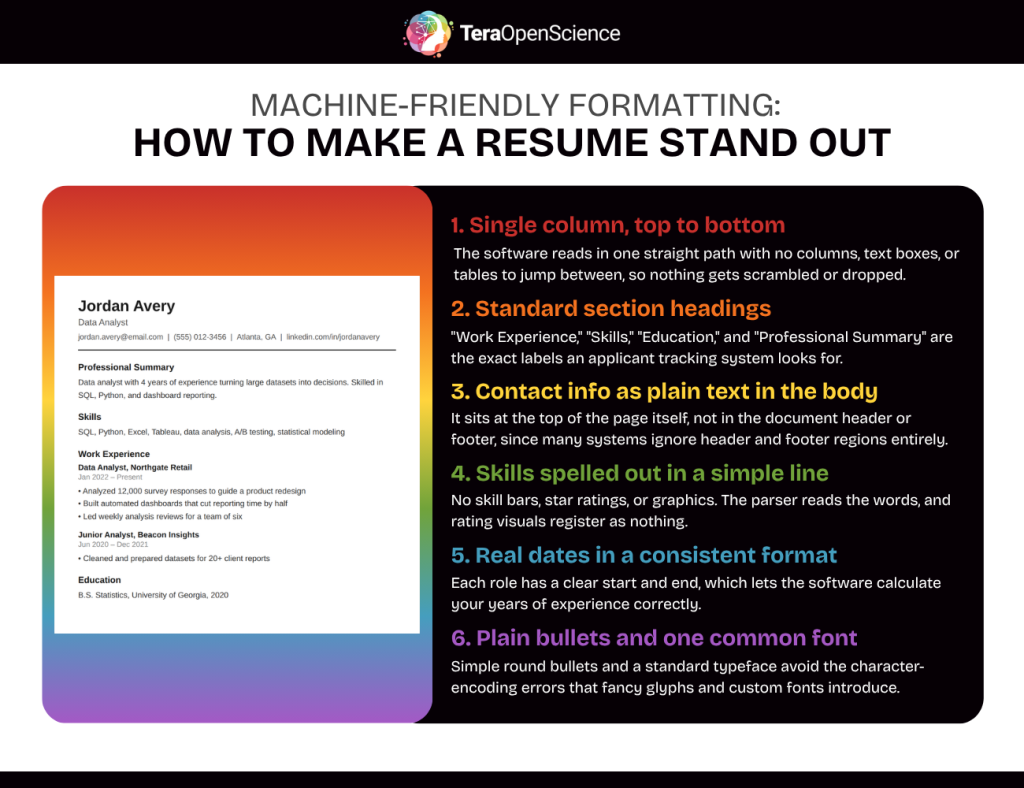
Format your resume so software can parse it, because a design an ATS cannot read gets your relevant experience discarded no matter how strong it is. Stick to a standard resume template with clear headings, a common font, and a single-column layout. Skip tables, text boxes, headers, and graphics that confuse the parser.
The safest structure keeps your contact information at the top as plain text, uses conventional section titles like Work Experience and Education, and saves the file as a .docx or PDF exactly as the job application specifies. A clean format also serves the human reader, who spends an average of about seven seconds on a first pass, according to eye-tracking research from Ladders. A cluttered page burns those seconds fast.
Trick 3: Lead Bullets With Action Verbs and Numbers
Once a person is reading, quantified results are what separate you from the field. Begin each bullet point with a strong action verb and attach a number wherever you can. “Managed a budget” tells a hiring manager little; “Managed a $40,000 project budget across three teams” gives them evidence they can picture.
| Weak bullet | Standout bullet |
| Responsible for social media | Grew Instagram following 60% in six months through weekly content |
| Helped with data analysis | Analyzed 12,000 survey responses to guide a product redesign |
| Worked on customer service | Resolved 40+ support tickets daily with a 95% satisfaction rating |
Power words carry weight because they signal ownership. Verbs like built, led, launched, cut, and delivered read as accomplishments rather than duties. Keep previous roles in past tense and your current role in present tense, and describe professional experience in the results it produced, not the tasks it involved.
Trick 4: Tailor the Top Third to the Specific Role
Rewrite the top third of your resume for each specific role, since that is what a hiring manager sees before scrolling. A short professional profile of two or three lines, followed by a skills section aimed at the job requirements, tells the reader within seconds that you fit. A generic summary wastes your most valuable space.
This matters most for anyone changing direction. A recent graduate or new grad can lead with relevant coursework and projects, while someone in a career change can foreground transferable skills that connect old professional experience to the new job description. Tailoring is the easy way to make a general background look purpose-built for one job.
Trick 5: Keep One Master Resume, Then Cut It Down
Maintain a single master document with everything you have ever done, then trim it for each application. Keeping one running curriculum vitae means you never lose track of an accomplishment, and building a targeted resume becomes a matter of deletion rather than memory. This is the upkeep step most job seekers skip.
Set a simple maintenance habit:
- Add new responsibilities and wins to the master file every few months, even when you are not job hunting.
- Record numbers while you still remember them, since results are hard to reconstruct a year later.
- Keep a list of new skills and certifications as you earn them.
- Save a plain-text version for quick copying into any job application portal.
A maintained resume also means you can respond to an unexpected opening within a day instead of scrambling for a week. Opportunities rarely wait for you to update your work history.

Trick 6: Prove Your Skills Beyond the Page
Give a prospective employer a way to verify what you claim, because a resume asserts and a portfolio demonstrates. A link to published work, a project repository, or a professional profile lets a hiring manager confirm your technical skills rather than take them on faith. This is where you turn a good resume into a memorable one.
Where a resume lists data analysis as a skill, a linked project that walks through a real analysis proves it. For researchers, students, and professionals, visible output does more than any adjective can, and it gives your application a dimension a single page cannot hold.
Turn Your Work Into Something Employers Can See
Every trick above points to one idea: a resume opens the door, but visible, verifiable work is what convinces a potential employer to keep reading. That is where being active in a public professional community pays off. TeraOpenScience is an open platform where students, researchers, and professionals share work, collaborate across STEM, healthcare, and business, and build a public profile that recruiters, co-authors, and funders can actually find. Your contributions become proof of the skills your resume claims. Join TeraOpenScience, put your work where prospective employers can see it, and be seen. Be open. Be seen.