Start With the Acronym
FAIR data principles are a set of guidelines that make research data easier for both people and machines to find and use.
Here is what the FAIR data principles cover at a glance:
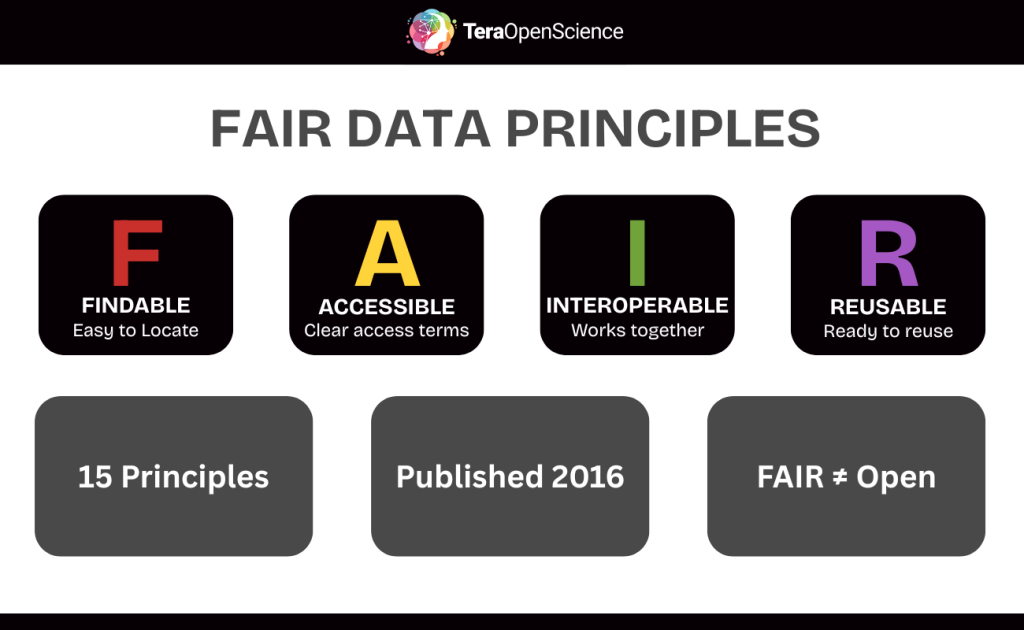
- FAIR stands for Findable, Accessible, Interoperable, and Reusable.
- The framework is made up of 15 guiding principles, first published in 2016.
- FAIR puts heavy emphasis on machine actionability, so computers can work with data with minimal human intervention.
- FAIR data is not the same as open data, since access can sit behind clear conditions.
- Major funders, including bodies tied to the European Commission, now expect FAIR data.
Research data loses value when no one can locate it, open it, or combine it with other work. The FAIR data principles describe the qualities that keep data useful long after a project ends.
What Are the FAIR Data Principles?
The FAIR data principles are 15 guiding principles for scientific data management and stewardship that make digital objects Findable, Accessible, Interoperable, and Reusable. A group of researchers, publishers, and funding agencies published them in 2016 in the journal Scientific Data. They describe what good data should do, rather than prescribing one fixed method for getting there.
The idea took shape at a 2014 workshop in Leiden, Netherlands, called “Jointly Designing a Data FAIRport,” then circulated through the FORCE11 community before publication. The authors set the FAIR guiding principles apart from earlier efforts by focusing on machine actionability, the capacity of computational systems to find, access, interoperate, and reuse data with none or minimal human intervention. That focus matters because the volume and speed of scientific data now outpace what people can sort by hand.
FAIR is a set of best practices, not a standard or a certification. Two datasets can both be FAIR while using different tools, file formats, or repositories. The four letters group the 15 principles into goals that build on each other, starting with the ability to find data at all.
Findable
Findable means data and metadata carry enough identity and description for humans and computers to locate them. This is the first principle because nothing else works if the data cannot be found. Findability rests on persistent identifiers and rich metadata that a search system can index and return.
The Findable principles cover four points:
- F1: data and metadata receive a globally unique and persistent identifier, such as a DOI
- F2: data are described with rich metadata
- F3: metadata clearly include the identifier of the data they describe
- F4: data and metadata are registered or indexed in a searchable resource
Machine-readable metadata sit at the center of this work. When a dataset carries a persistent identifier and detailed metadata, a researcher on the other side of the world, or an automated tool, can surface it without guesswork.
Accessible
Accessible means that once someone finds data, they can retrieve it through a clear, standardised communication protocol. The data itself does not have to be public. The principle asks that the method of access be open and well-defined, with authentication applied only where the data calls for it.
The Accessible principles read as follows:
- A1: data and metadata are retrievable by their identifier using a standardised communications protocol
- A1.1: the protocol is open, free, and universally implementable
- A1.2: the protocol allows for an authentication and authorisation procedure where necessary
- A2: metadata stay accessible even when the data are no longer available
This is where FAIR data and open data part ways. FAIR does not require that everyone gets full access to everything. Sensitive data, such as patient records in the life sciences, can stay protected behind an authorisation procedure while its metadata remain visible and the access terms stay clear. FAIR asks for transparency about how to reach data, not unconditional release.

Interoperable
Interoperable means data can combine with other data and feed into applications or workflows without heavy manual effort. To work together, datasets need a shared language and shared vocabularies so a computer reading one dataset can correctly relate it to another. This is what lets separate studies connect into something larger.
The Interoperable principles are:
- I1: data and metadata use a formal, accessible, shared, and broadly applicable language for knowledge representation
- I2: data and metadata use vocabularies that follow FAIR principles
- I3: data and metadata include qualified references to other data and metadata
Qualified references are the link that gives context. Rather than naming a related dataset in passing, interoperable data states the nature of the relationship, so both a person and a machine understand how two digital objects connect.
Reusable
Reusable is the end goal of FAIR, where well-described data can be replicated or combined in new settings. Reuse depends on clear documentation: a usage license, a record of where the data came from, and adherence to the norms of the field. Without these, others cannot trust the data enough to build on it.
The Reusable principles cover:
- R1: data and metadata are richly described with a plurality of accurate and relevant attributes
- R1.1: data and metadata are released with a clear and accessible data usage license
- R1.2: data and metadata are associated with detailed provenance
- R1.3: data and metadata meet domain-relevant community standards
Provenance, the documented history of how data was produced and processed, carries weight here. A dataset that records its own origins and meets community standards can move into a new project and still hold up.
FAIR Data Is Not the Same as Open Data
FAIR data and open data are related but distinct. Open data is free for anyone to access and reuse. FAIR data must be findable and carry clear access terms, but those terms can include specific conditions. Data can be FAIR and still restricted, which is what makes the framework workable for sensitive information.
| Question | FAIR data | Open data |
| Must anyone be able to access it? | No, access can require authorisation | Yes, available to all |
| Are clear access terms required? | Yes | Yes |
| Is rich metadata required? | Yes | Not necessarily |
| Built for machine actionability? | Yes | Not by definition |
| Can sensitive data qualify? | Yes, with protected access | Rarely |
Why the FAIR Data Principles Matter
FAIR data principles matter because they make research more transparent, reproducible, and reusable, which raises the return on every study. Funding agencies have noticed. Programs linked to the European Commission, including Horizon Europe, now expect funded projects to manage data along FAIR lines, and many publishers ask for the same.
There is also an artificial intelligence angle. Data that is machine-actionable and stored in a trusted repository is the kind of data that AI systems and automated analysis can use directly, which turns scattered research data into fuel for knowledge discovery. The payoff shows up in several ways:
- Greater visibility and citation for the researchers who practice good data sharing
- Less duplicated effort across teams and institutions
- Data that is ready for artificial intelligence and automated analysis
- A clearer path to meeting funder and publisher requirements
Good data stewardship, in other words, is no longer a nice extra. It is becoming the price of admission for funded, citable, reusable research.
How TeraOpenScience Puts FAIR Into Practice
TeraOpenScience is built around the same goals the FAIR data principles describe: research that people and machines can find, access, combine, and reuse. The platform connects students, researchers, and professionals across STEM, healthcare, and business so their work does not sit unseen in a silo.
On TeraOpenScience you can:
- Share research and data so collaborators worldwide can find it
- Connect your work to others through an open, AI-powered ecosystem
- Build a visible personal brand while keeping control of how your work is used
Be open. Be seen. Join TeraOpenScience and give your research the reach that FAIR data is meant to deliver.