Technology Title
3d printing
3d printing
Project Title
CraftFidgets: Engineering and Validating a Modular Low-Noise Sensory Tool Platform
CraftFidgets: Engineering and Validating a Modular Low-Noise Sensory Tool Platform
Category
Wireless Communication
Wireless Communication
Authors
anujmalik0815@gmail.com
anujmalik0815@gmail.com
Short Description
A five-month R&D project to engineer and validate a modular, low-noise sensory tool through acoustic testing, material trials, user pilots, and scalable manufacturing analysis.
A five-month R&D project to engineer and validate a modular, low-noise sensory tool through acoustic testing, material trials, user pilots, and scalable manufacturing analysis.
Long Description
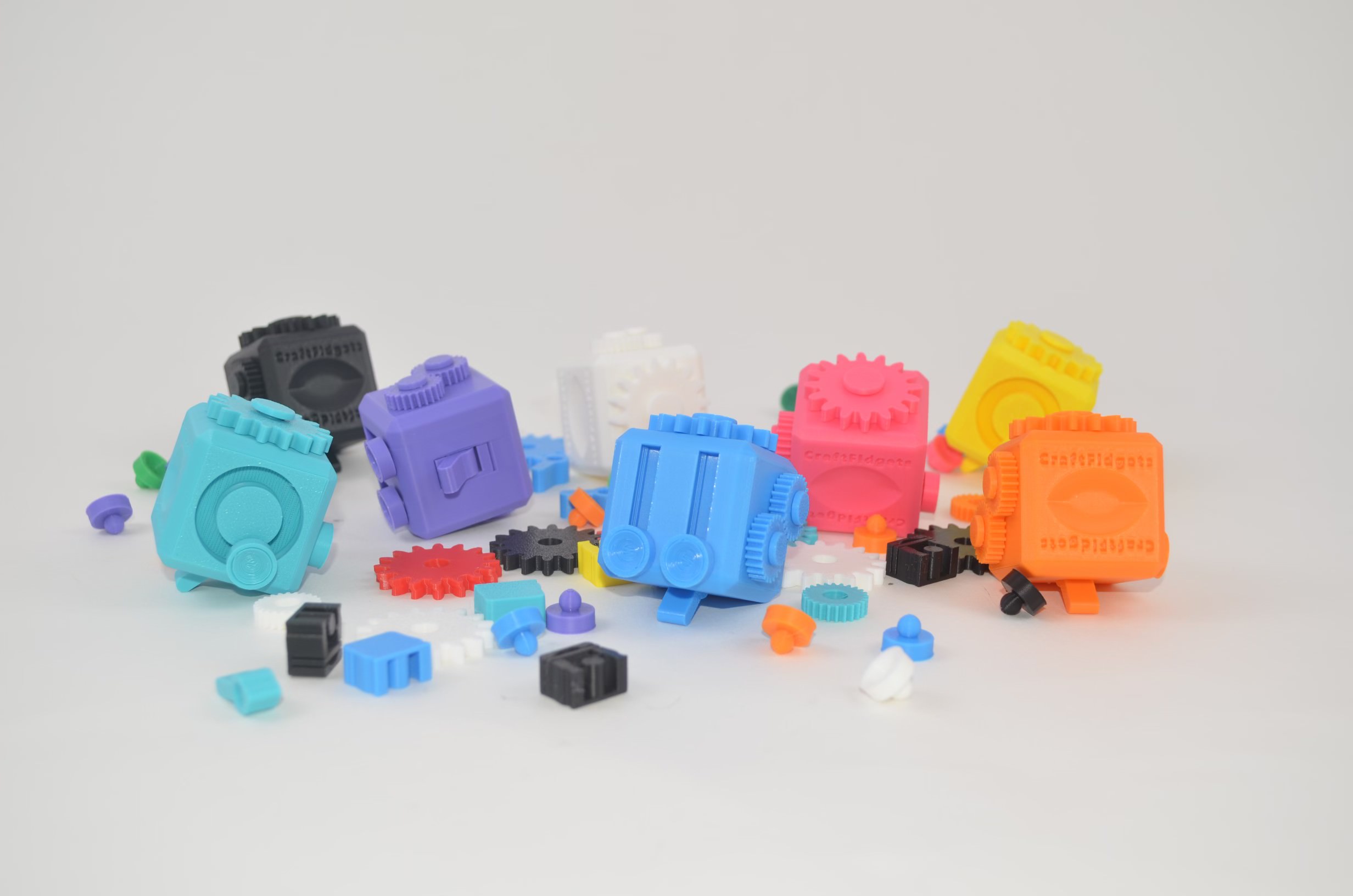
CraftFidgets is developing a modular, low-noise sensory tool for classrooms, therapy settings, and other shared environments where conventional fidgets can become distracting. The current product is a functioning PETG cube made through fused-deposition 3D printing. Its interchangeable gears, textures, colors, and seasonal attachments allow users to personalize the tactile experience while reusing one core platform. The proposed five-month project will turn the current commercial prototype into a technically validated product system. We will study how material choice, component geometry, clearances, print orientation, infill, and attachment design affect sound, tactile resistance, durability, manufacturability, and cost. The objective is not to claim that quiet fidgets are new. The innovation is a testable combination of low-noise mechanical design, modular sensory components, group-use packaging, and a hybrid manufacturing strategy that preserves customization while improving production capacity. Our baseline is stronger than a concept. Since September 2024, CraftFidgets has completed at least six design milestones, launched ecommerce and in-person sales, received more than 30 TikTok Shop orders, generated $1,479 in lifetime revenue, secured $6,500 in non-dilutive awards, and collected educator feedback. Those results establish that the team can build and sell the product, but they do not yet prove the best acoustic design, buyer, price, channel, or manufacturing method. The project will proceed in five workstreams. 1. Acoustic and mechanical testing. We will create a repeatable test fixture and compare prototype configurations using peak sound level, average sound level, frequency profile, actuation force, dimensional tolerance, and user-rated distraction. 2. Materials and durability. We will compare selected printable polymers and geometries, run repeated actuation-cycle tests, record wear or failure, and evaluate cleaning, surface quality, and part replacement. 3. Human-centered validation. We will conduct documented interviews and controlled pilots with special-education teachers, occupational therapists, classroom teachers, counselors, students, and parents. We will measure perceived noise, usability, preferred textures, willingness to pay, classroom acceptance, and reorder interest. We will avoid medical treatment claims and evaluate CraftFidgets as a sensory and focus-support tool. 4. Manufacturing and supply chain. We will compare founder production, outsourced print farms, and a future hybrid model in which a standardized core may be molded while customizable attachments remain 3D printed. Tooling will be considered only after demand and volume thresholds are supported by evidence. 5. Commercial validation. We will test a higher-value core cube, attachment packs, 25-unit classroom or therapy packs, and sponsor-funded access programs. Channel-level economics will include materials, packaging, shipping, fees, labor, returns, and donation costs. Anuj Malik will lead finance and unit economics; Jonah Macaluso, strategy and external relationships; Sujit Pai, production and supply chain; Amogh Mahadar, product design and testing; and Pamir Sanyal, marketing and customer research. By April 2027, the team aims to deliver a validated prototype specification, acoustic and durability results, at least three paid bulk pilots, documented customer research, supplier and print-farm comparisons, a manufacturing decision framework, and a commercialization-ready business plan. All work will follow applicable university, platform, consumer-safety, consent, and privacy requirements.
CraftFidgets is developing a modular, low-noise sensory tool for classrooms, therapy settings, and other shared environments where conventional fidgets can become distracting. The current product is a functioning PETG cube made through fused-deposition 3D printing. Its interchangeable gears, textures, colors, and seasonal attachments allow users to personalize the tactile experience while reusing one core platform. The proposed five-month project will turn the current commercial prototype into a technically validated product system. We will study how material choice, component geometry, clearances, print orientation, infill, and attachment design affect sound, tactile resistance, durability, manufacturability, and cost. The objective is not to claim that quiet fidgets are new. The innovation is a testable combination of low-noise mechanical design, modular sensory components, group-use packaging, and a hybrid manufacturing strategy that preserves customization while improving production capacity. Our baseline is stronger than a concept. Since September 2024, CraftFidgets has completed at least six design milestones, launched ecommerce and in-person sales, received more than 30 TikTok Shop orders, generated $1,479 in lifetime revenue, secured $6,500 in non-dilutive awards, and collected educator feedback. Those results establish that the team can build and sell the product, but they do not yet prove the best acoustic design, buyer, price, channel, or manufacturing method. The project will proceed in five workstreams. 1. Acoustic and mechanical testing. We will create a repeatable test fixture and compare prototype configurations using peak sound level, average sound level, frequency profile, actuation force, dimensional tolerance, and user-rated distraction. 2. Materials and durability. We will compare selected printable polymers and geometries, run repeated actuation-cycle tests, record wear or failure, and evaluate cleaning, surface quality, and part replacement. 3. Human-centered validation. We will conduct documented interviews and controlled pilots with special-education teachers, occupational therapists, classroom teachers, counselors, students, and parents. We will measure perceived noise, usability, preferred textures, willingness to pay, classroom acceptance, and reorder interest. We will avoid medical treatment claims and evaluate CraftFidgets as a sensory and focus-support tool. 4. Manufacturing and supply chain. We will compare founder production, outsourced print farms, and a future hybrid model in which a standardized core may be molded while customizable attachments remain 3D printed. Tooling will be considered only after demand and volume thresholds are supported by evidence. 5. Commercial validation. We will test a higher-value core cube, attachment packs, 25-unit classroom or therapy packs, and sponsor-funded access programs. Channel-level economics will include materials, packaging, shipping, fees, labor, returns, and donation costs. Anuj Malik will lead finance and unit economics; Jonah Macaluso, strategy and external relationships; Sujit Pai, production and supply chain; Amogh Mahadar, product design and testing; and Pamir Sanyal, marketing and customer research. By April 2027, the team aims to deliver a validated prototype specification, acoustic and durability results, at least three paid bulk pilots, documented customer research, supplier and print-farm comparisons, a manufacturing decision framework, and a commercialization-ready business plan. All work will follow applicable university, platform, consumer-safety, consent, and privacy requirements.
Potential Applications
CraftFidgets has potential applications wherever users benefit from discreet tactile stimulation but the surrounding environment requires low noise, durability, and adult-controlled distribution.
1. Special-education classrooms. Teachers and support staff could use 25-unit classroom packs as shared sensory resources rather than relying on students to bring personal toys. Interchangeable components could support different tactile preferences while keeping the core product consistent.
2. Occupational-therapy and sensory-support settings. Occupational therapists could evaluate different textures, resistance levels, and attachments as non-clinical tools for engagement, self-regulation routines, and fine-motor activity. CraftFidgets would not replace professional care or claim to treat a condition.
3. General classrooms, testing centers, libraries, and study spaces. Low-noise configurations could provide students with a discreet option in settings where audible clicking, popping, or rattling is disruptive.
4. School counselors, student-support offices, and after-school programs. Small group packs could be stored and distributed by adults who can set expectations for appropriate use.
5. Workplace and professional environments. Modular low-noise tools may also serve adults who want tactile movement during meetings, desk work, travel, or other shared settings.
6. Modular consumer product platform. A reusable core with interchangeable textures, gears, colors, and seasonal attachments creates opportunities for repeat purchases, replacement parts, collectible releases, and personalized bundles without requiring customers to replace the entire cube.
7. Institutional and sponsored access programs. PTAs, local businesses, nonprofits, and corporate-giving programs could sponsor classroom or therapy packs. This model could preserve CraftFidgets' social-impact mission without requiring the company to absorb the cost of a donated unit on every retail sale.
8. STEM and design education. The platform could be used to demonstrate additive manufacturing, mechanical tolerances, acoustics, materials selection, user-centered design, and iterative prototyping. Students could compare how geometry and materials affect sound and tactile performance.
9. Research and product-development toolkit. The modular architecture can support controlled studies of texture preference, actuation force, perceived distraction, durability, and cleaning. Findings may inform future sensory components and broader assistive consumer products.
The first commercial focus will be special-education teachers and occupational therapists because they purchase for groups, can evaluate classroom or therapy fit, and may generate larger and repeat orders. Secondary markets will be pursued only after the project identifies evidence of need, willingness to pay, and viable channel economics.
Open Questions
The project is designed to answer the following technical, user, manufacturing, and commercial questions.
1. Which combination of material, geometry, component clearance, print orientation, and infill produces the lowest measured noise while preserving satisfying tactile resistance?
2. How should sound be measured consistently across prototypes and competing products? What microphone distance, actuation method, background-noise limit, and metrics will produce repeatable comparisons?
3. Which noises matter most to users and surrounding adults: peak loudness, average loudness, frequency, repetition, or unpredictability?
4. How do PETG and alternative printable polymers compare in sound, durability, surface quality, cleanability, print time, dimensional stability, and cost?
5. How many actuation cycles can each mechanism and attachment withstand before wear, loosening, increased noise, or failure occurs?
6. How can interchangeable attachments remain secure and easy to replace without introducing rattling, choking hazards, difficult cleaning, or excessive manufacturing complexity?
7. Which textures, resistance levels, motions, colors, and attachment types are most useful to students and adults, and how much preference varies across users?
8. Do special-education teachers and occupational therapists experience a stronger need and greater willingness to pay than individual students, general classroom teachers, counselors, parents, or workplace users?
9. Does adult-controlled distribution improve acceptance in schools that restrict personal fidgets? What usage rules, storage systems, and training make the product more likely to be treated as a tool rather than a toy?
10. What evidence is appropriate for describing benefits without making unsupported medical or therapeutic claims? Which outcomes can be measured responsibly during a five-month field test?
11. What are the complete contribution margins for single-unit ecommerce, attachment packs, 25-unit classroom or therapy packs, and sponsor-funded programs after materials, packaging, shipping, platform fees, labor, returns, and donation costs?
12. What core-product and bundle prices maximize willingness to pay, accessibility, and sustainable margins?
13. Do customers reorder attachments or packs? Which designs create genuine repeat value rather than novelty-driven interest?
14. At what monthly volume should CraftFidgets remain in-house, use an outsourced print farm, or invest in tooling? What minimum order quantities, lead times, quality controls, and working-capital requirements apply to each option?
15. Can a hybrid manufacturing model, with a standardized molded core and 3D-printed attachments, lower costs without eliminating customization?
16. What applicable U.S. consumer-product safety, labeling, material, age-grading, and testing requirements must be satisfied before broader school or retail distribution?
17. Can sponsor-funded classroom packs preserve the one-for-one mission more sustainably than automatically donating a unit with every retail sale?
18. Which technical and commercial results would justify continued development after Phase 2, and which results would indicate that the product, buyer, or channel should change?
AI Assistant
Create a rigorous five-month R&D and commercialization plan for the CraftFidgets project described above. Do not invent test results, customers, partnerships, costs, or technical performance. Clearly separate existing facts from hypotheses and proposed experiments.
The plan should include:
1. A concise technical hypothesis for a modular, low-noise sensory tool.
2. A design-of-experiments matrix covering material, geometry, clearances, print orientation, infill, attachment type, and actuation force.
3. A repeatable acoustic test protocol with suitable sound metrics, equipment, controls, competitor comparisons, and data-analysis methods.
4. Mechanical durability, wear, cleanability, dimensional-tolerance, and safety testing.
5. A human-subject research approach for teachers, occupational therapists, students, parents, and counselors that avoids unsupported medical claims and addresses consent and privacy.
6. Monthly milestones from November 2026 through April 2027, with measurable deliverables and go or no-go decisions.
7. Roles for a five-person team covering finance, strategy, operations, product design, marketing, and customer research.
8. A supply-chain comparison of in-house printing, outsourced print farms, and hybrid molding plus printed attachments.
9. Budget scenarios for a $5,000 grant and a $7,500 grant.
10. Channel-level unit economics for single products, attachment packs, classroom or therapy packs, and sponsor-funded programs.
11. A risk register covering technical failure, weak demand, school restrictions, safety, copying, supplier risk, team capacity, and schedule risk.
12. A business-plan outline, commercialization roadmap, field-test plan, and metrics needed for a 10-year financial model and NPV analysis.
Optimize the plan for the challenge's scoring criteria: innovation, technical feasibility, execution realism, team capacity, and real-world impact.
Keywords
#IdeaInnovationBusiness
#IdeaInnovationBusiness
Email
anujmalik0815@gmail.com
anujmalik0815@gmail.com