Research rarely stalls for lack of ideas. More often it stalls in the gap between the lab and the market, or because the people working on the same problem never meet. That gap is why TeraOpenScience exists, and it is the thread running through our first conversation.
H.C. Shin began his career as an engineer in Korea and spent more than three decades at 3M, rising to Vice Chair before serving as Chairman and CEO of LG Chem. In this conversation, he reflects on stepping into a role outside his engineering background, how 3M chose which ideas to fund, why companies should approach AI without panic, and why the next decade of research will be shaped globally.
Open Questions with TeraOpenScience is an interview series with the leaders shaping science and industry. Watch the conversation above, or read the full transcript below. This interview has been edited for length and clarity. Questions appear as they did on screen.
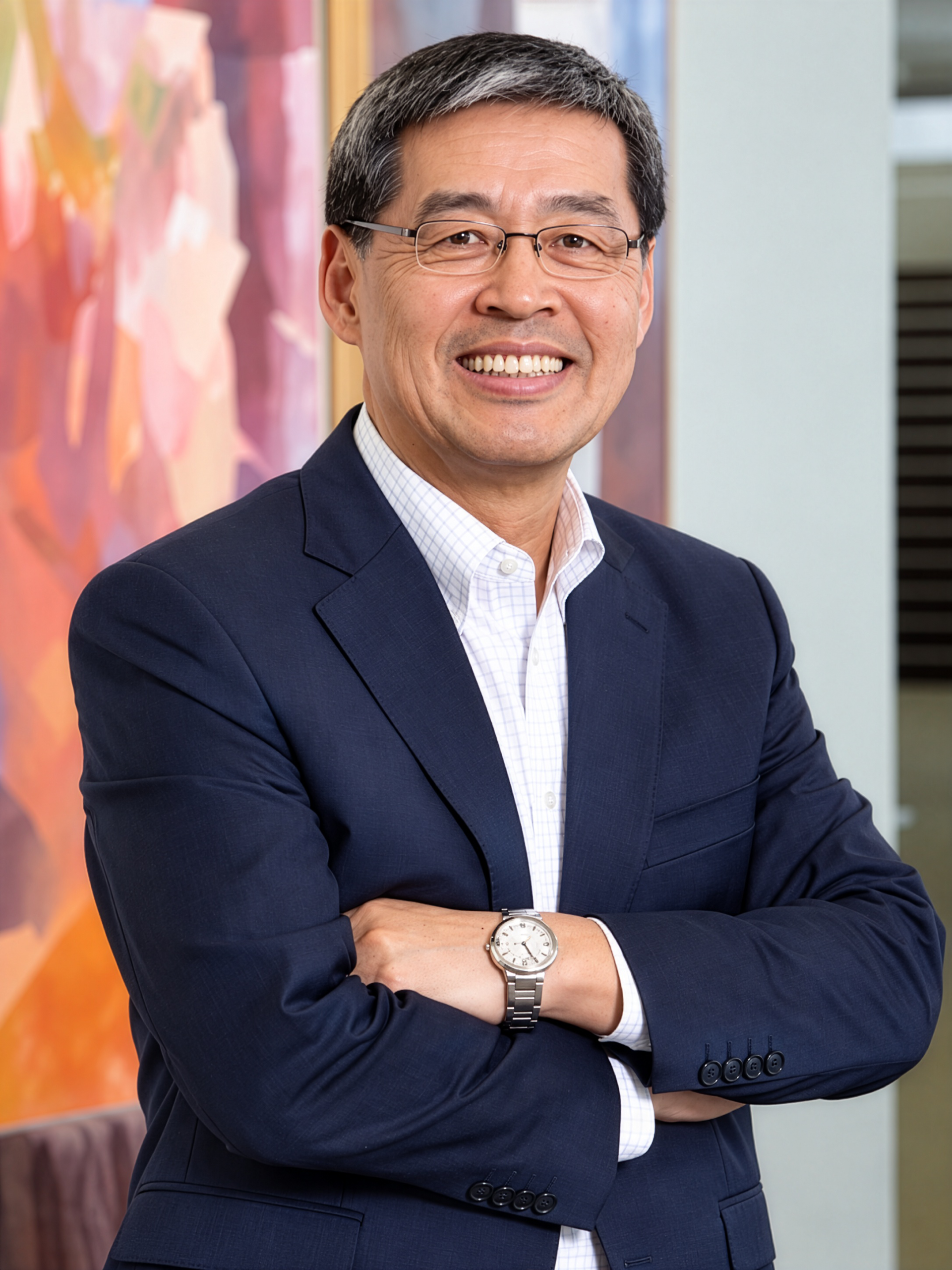
H.C. Shin
Hello everybody, my name is H. C. Shin. I’m currently residing in Korea temporarily, because I’m originally from Korea — stayed here until I was 37. I went to Seoul National University in Korea — a mechanical science and material science major — and actually joined a 3M company in Korea, worked in Korea for a while, and then eventually ended up in headquarters in Minnesota, USA, at 3M; and worked there for a good part of my 30-plus years, and retired in 2018 as a vice chair of the company. And then, somehow, the LG company in Korea — and I’m sure you heard of this LG group — invited me to take over LG Chemical (or they call it LG Chem) to be a CEO and the chair of the board of the company.
You studied engineering at Seoul National University but ended up in business. Did you have a career path in mind back then?
H.C. Shin
No, I did not. I didn’t have any slightest idea of what I will eventually do — less you know, position that I was asked to hold. So I was never, in my even wildest dream, to think about the path that I went through. But I was basically interested even in high school — I was interested in maths and science, physics, particularly maths and physics and a little bit of chemistry too. So I consider myself engineer since high school. I read a lot of engineering-related books, getting ready for engineering school of Seoul National University. I was class of 1979 — if you believe there was a year like 1979. That’s a long time ago.
But at this time still Cold War was going on. Margaret Thatcher just became the Prime Minister of the UK. Iranian Revolution was in full swing at the time — the hostage crisis and all that. I still remember Three Mile Island — the nuclear incident — happened in 1979. Sony Walkman had just been introduced, and actually Microsoft Company was established at that time — about 1976, 77. So this was the era of technology, innovation, and particularly entrepreneurship.
So with my engineering background, I was really drawn into the mechanical and science and all that. That’s what led me to apply for Seoul National.
Microsoft eventually turns into business — setting up the company, startup, and eventually becoming a big business. I was curious about the entire ecosystem, if you will — starting from research all the way to becoming a big company. So that’s how I decided to build my career around technology, innovation, and eventually commercialization success — not just technology and development. So right after college, I joined defense-industry company. I was a project engineer for projectiles — the warheads and all that. So I worked there for five years, and then I joined 3M again as a technical engineer.
I quickly moved into marketing from technical, and then eventually sales and marketing.
So that was kind of my progression: from R&D into technical service, into marketing, and eventually to business management. So little did I know that the rest of my work at 3M — good part of my maybe 25 years of 3M — has to do with general management, business management. I was a VP for several divisions as a general manager and vice president, became executive vice president or EVP, for one-third of the company, called Industrial, and then EVP of International Operations, which was about 70% of the company, and eventually vice chair of 3M.
In his words
So that’s how I decided to build my career around technology, innovation, and eventually commercialization success — not just technology and development.
H.C. Shin on choosing his path
Moving from engineering into running 3M’s international operations, was that transition hard? Any moments where you had to learn a completely new playbook?
H.C. Shin
For me, there was trepidation in the beginning, when I was asked to do marketing. I mean, all my life has been keeping my head down and working on math, science and engineering, and process engineering — even in 3M. I mean, I was a techy guy, I was engineer, and all of a sudden I was asked to do marketing. What do I know marketing? I mean zero. So there was trepidation. I didn’t know what I was going into. In fact, I was wondering whether or not I’m giving up on all those accomplishments that I cherished so much until that time — as far as engineering and science — and my skill sets were clearly there.
Like Robert Frost poem: “one of my paths that I haven’t traveled” — but I decided to say yes.
I tried tech service. I like interfacing with customers — so why not? So that’s a little bit of courage. In fact, looking back — a defining moment.
There are several defining moments in everybody’s lifespan. And making the right decision — or the decision that you feel comfortable knowing what you want to do eventually — because I really wanted to know how technology turns itself into business. And I knew at the time — I didn’t know about marketing — but without marketing element, it’s not gonna happen. At least I know that much.
So that was kind of trigger point for me to say yes. And the rest was a lot easier and a lot more exciting than I thought, because I’m not studying marketing from zero. What I didn’t know is: I was already doing a lot of marketing — being an engineer, really understand product, understand application, understanding the market — especially understanding customers and how they use it, what kind of pain they have, what type of other solutions they might think about other than 3M solutions. So little did I know that I was doing a lot of marketing without knowing that I was doing marketing. The terminology sometimes sounds, you know, like threatening — like marketing. Sales, for example! But actually getting into the position and really driving the best you can — I really liked marketing with my strong engineering and technical background. Actually, it was a lot easier than I thought.
I really wanted to know how technology turns itself into business.
So it was trepidation, but indeed probably the best thing that happened in my life. But what I realized is that my engineering background is the key, and what I believed as a personal belief, about technology and particularly innovation. So that’s one axis, which I call X axis, technology and innovation. Y axis actually is linking those technology and innovation with customers to solve their current and future problems.
Problems could be currently known to them or even unknown to them; they don’t even know that they have problems unless we deploy this solution. So I simplified my management into those two: X-axis, Y-axis.
In 3M I applied that logic: we developed a lot of groundbreaking, new-to-the-world technology, like Cubitron for abrasives. This is a different kind of abrasives that change the dynamics of the industry.
But having that clear mindset and also really having customers in mind around the world — not only in the United States. I was looking at global market because some of this technology might find a little use in the United States, but if you go to China or Korea or Japan, it’s a huge success there. So having this global mindset from the get-go always helps me — it greatly helped me in my career.
What’s your advice for young scientists and engineers who are curious about the business side but intimidated by it?
H.C. Shin
My recommendation is not to be intimidated with some of this nomenclature or terminology that people really would like to kind of functionalize — I mean marketing, sales and all that. But when it comes to business, it all mixed together. My recommendation for young scientists and engineers: give it a try. What do you lose? Maybe you may not like it; maybe in six months, a year — well, you can always go back to engineering. So, try these new things. Don’t be intimidated by some of this terminology, or particularly the nomenclature or function. Try that and see what happens — what it feels like. A little bit of courage, I think, is always needed.
As Vice Chair overseeing R&D at 3M’s scale, how did you decide which areas of science got investment? What stood out about the ideas that made the cut?
H.C. Shin
So my last job at 3M was vice chair of everything — pretty much everything, you know. All R&D; in fact, the CTO was reporting to me. So, I had technically the entire technical organization of 3M. I had marketing, corporate development, even IT. So, there’s no way that I can be an expert on everything. Even just focusing on technology side of it — or the technical organization or R&D — about 40% of all 3M employees around the world are in that organization, and there’s so many programs, so different, so there is no way I thought that I can dig into all the details.
And in that case, I had my own way of sorting things out, and really, I focused on what I can contribute versus what I can interfere with other people’s matter. So my thought at the time was to set a game plan — set the rules for the entire organization — because many ideas are there. How would you pick the right ideas? How would you know if one program that’s not accepted or funded versus others — is there fairness in making those selections? Is the rules of the game fair? And then everybody can buy into? Does everybody understand the rule of the game? — was my thinking.
So I had an analogy of funnel out and funnel in. In other words, in case of getting the ideas, I’d like to expand the funnel wide enough so that all kinds of idea generation, as wide as possible, comes into this funnel. “There’s no bad ideas,” was the expression that we got; in fact, there’s no bad ideas. Ideas are all good. It provides opportunities for as much innovative ideas as possible coming into this funnel. Then the real work begins, as far as prioritization, because you cannot fund all ideas. The process of prioritizing those ideas and going into funnel in. So funnel-out and funnel-in process is the key. It has to be fair. It should have some process definition: some rules, some numbers, some judgment that people can actually understand and agree on.
Is the idea really worse? Is the market big enough? Can it create some kind of commercialization success? What’s the final goal? And what’s the technology assessment? What about customers? What’s the value proposition of this particular product? Eventually, what’s the financial return? So, turn those all into this one rule of the game, that we used to call RWW, or Real-Win-Worth tool. It’s one page tall. That’s very, very clear, and has all the elements of these things that we just talked about. Although it’s one page, there may be hundreds of pages detailing all the elements of market study and technology assessment and competitive dynamics, financial judgment and all that — but it was A4 — just one page — that people bought into.
So, it is very important for organizations to leave the door open for those lone players — I mean, lone researchers, just keeping their head down.
So, once you put this in place, after several months, there’s no noise. People understand the game: “I know, I can bring as many ideas as possible. There’s no bad ideas. However, I also understand how these ideas are prioritized and eventually funded. You know, I may sometimes feel a little, you know, slighted — my idea — but I understand the rule of the game. I think it’s generally fair.” You cannot have 100% satisfaction but if people have a general satisfaction of the fairness of the game, then I think that’s really, really critical. However, that’s the “man-made system, man-made rules.”
There has always some elements of lone players: you know, “I don’t want to go through bureaucracy. But you know what? I know my idea is better than thousands out there.” So, it is very important for organizations to leave the door open for those lone players — I mean, lone researchers, just keeping their head down. And sometimes a great innovation comes from that.
We added this lone player element to the system. We created angel funding on the different name — we used to call it NGV or New Growth Venture Funding — so that people who thought they got missed out through this corporate-wide prioritization process — but they still believe so strongly — “I wanna go through NGV; I want to make my own pitch. I may not have guaranteed that my idea will be accepted, but I know I have this route; I have this path.” So, with RWW and this NGV process that I just mentioned, I think the whole thing really blossomed into many, many great inventions and products and technologies at the time.
You led through economic downturns, political shifts, and cultural change. How do you steer a company through hard times while keeping your people reassured?
H.C. Shin
I understand the AI — almost frenzy — going at the moment. Everything seems to be AI, and unless you are in AI wave, you may feel behind. Well, in my career I had several of those; two waves that clearly came to mind: the internet revolution, maybe sometime in 1980s and then the financial crisis in 1990s. So it was like the whole world is going to internet at the time: unless you are in the new economy side, you get behind — was the feeling that swept through people, companies, organizations.
And 3M was there, and then we survived the internet. In fact, in early — maybe 10 years — of internet revolution, who collected all the money? The hardware companies like Cisco — routers and switches and all that — and then Corning and JDS Uniphase and Lucent Technologies making all the fiber optics. So they collected all the money. They were the darlings of Wall Street — they are more like Nvidia and all the semiconductor companies now. Now, after 20 years of internet revolution — maybe after 30 years — things are very different. Google is there — they don’t make anything, but they are there. Meta is there — they don’t make any internet routers and switches; they are there. So I think we should take some longer-term view of all this zeitgeist or frenzies coming in, but without actually getting behind. At that time, we actually asked people just to dig into internet: don’t get behind.
We don’t know eventually what this will turn into, but don’t get behind. That’s the last thing I want you to do — to get behind. So I ask two things, people: don’t panic, and don’t get behind. And then be careful about what this will all mean to us, to our lives, to my future, even personally.
So I ask two things, people: don’t panic, and don’t get behind.
If you don’t panic and learn about it — the more you learn, the less panicking you get — and it’s a virtuous cycle.
So that will be the same advice that I have around AI, or any other major global technology or zeitgeist shift sweeping through individuals and organizations, even personally. People talk about maybe most of people are losing their job. Well, eventually that may happen — maybe 10, 30 years from now. You cannot reverse that trend if that’s the outcome. But don’t panic; you still have time.
Adopting new tools like AI is one thing. Getting your team on board is another. How do you bring along people who’d rather stick with the old ways?
H.C. Shin
I think it’s a lot less intimidating than it sounds — just like me getting from engineer to marketing. Same thing. In my LG Chem company, we decided to deploy agentic function into the organization three years ago. It was daunting. I mean, people were scared; there was a lot of intimidation. And what does that mean? And we are the first here, and it may take away some people’s job and all that. This was three years ago when agentic AI was just beginning to even introduce as a concept.
This was like me having a little trepidation going from engineering to marketing. My stance at the time was a little bit like: “Hey, I don’t exactly know the algorithm and everything else, but I like what I’m hearing from AI experts. So let’s try this. Let’s try to apply agentic AI into one of our functions and see how that happens — what it is and what it feels like.” And after deploying it the first time in the industry in Korea — at least in Korea, maybe in Asia or even in the world — it was a lot less difficult, a lot less complex than I thought. We don’t want to understand all the algorithms, for we knew what it was; we knew what it does. And then we almost gave instruction: “Okay, I want that function to be deployed as an agentic AI.”
So people learn from it, people listen from it. So I think the same thing applies: a little bit of courage is required to try these new things and see what it feels like. To me, the probably not so desirable attitude on the part of the companies is to ignore them: “You know, I mean all these things will pass by, okay? You know, leave me alone.” kinda attitude — as an organization, as an individual — may not be the ideal, especially this fast-moving world.
The more you understand AI, and especially data centers, the more you realize that it’s a lot more than software. You need technology to cool down — it’s a huge issue. You need technology to efficiently provide electricity — it just consumes a lot of electricity — and then you need a way to store energy, like energy storage device. All of a sudden, you find out that there’s new opportunities everywhere for materials science and engineering. All of this requires engineering and science and material solutions. It is much more than software.
In 2019 you became CEO of LG Chem, a company that was already strong. Where did you and your team focus first, and how do you set a new direction from strength?
H.C. Shin
When I came to Korea to become a CEO of a forty-billion-dollar company — now it’s a lot larger, about twice in size — but I really want to understand the company: what it does well and what’s the history and the people, and which area they have to improve on. So, maybe first three months, even six months, I just talked to a lot of people; I dug into every bit of details of the company history, technology and everything else. So that self-analysis to me is the first step. Whether you go to any new organization — not only as a CEO, but even as the person in charge of maybe small department, five people — you need to understand thoroughly about that particular organization: past history and current and what it intends to do in the future. So, in the first maybe three, four months, I studied maybe 18, 20 hours a day. I just read a lot of things. I talked to so many people here. After doing that for three, four months, I had my one conclusion: this is a very strong company, has great potential.
That’s vague wording which I used for general employee communication, but to me it cannot be vague. So, strengths — particularly what strengths — was what I was working on. So I identify 3 areas: very high human-capital quality. Second was the technology, and number three was execution capability.
And then I decided to identify weakness areas. So, what areas are weak? Number one is global: this company has to be global. It’s a very large company operating in Korea, pretending they are global. So it’s a huge element of weakness in globalizing the business. Second area of weakness is: despite great technology, the method of turning those technologies into business — what I call commercial process — was very, very weak. And the third thing was a silo.
I was trying to promote these strengths to the people, so that they can feel proud of the company. But at the same time, I want to have a specific plan to work on globalization, commercialization, and functional silo areas. So we made all programs — research programs and marketing programs — by default global. It was not like that for 50 years.
And when I talk about human capital and technology execution as a strength, people are surprised: “First time actually we hear that we have great technology. Especially you coming from 3M, vice chair — I mean, we didn’t realize we are such a strong company technology-wise.” We have great technology that just sits on the shelf — just cannot happen. We have to commercialize it, and we have two functional silos. Actually people applauded my observation of weakness because I started from strength.
I had my one conclusion: this is a very strong company, has great potential.
Then when I declared that we’re gonna deploy this process, it just runs so smoothly; so the company really started to change — almost in six, seven months. Now, I also wanted to inject my own personal philosophy, which is sustainability and diversity. So I actually forced — there are not many things that I forced through organization, but this one: we have to be more sustainable than any other chemical company in the world. Sustainability is a new value system. So we became first RE100 (renewable energy 100) company in some of our plants, and we declared carbon neutrality by 2035 — first in the industry in Korea and probably in Asia — with all the plants behind it.
Same goes with the diversity issue. That’s how I decided to transform the company, and then came many good things, like new market expansion to battery materials and semiconductor materials. So that’s generally how I was trying to manage LG Chem, coming from 3M.

The research that matters today doesn’t happen in one lab. It’s spread across universities, companies, and countries. What makes that kind of collaboration actually work?
H.C. Shin
I think it’s another example of people kind of doing their own things, believing that that’s their world. So, a little bit siloed in many areas of research: academia doing their own thing; institutions, institutes, government — everybody spending money and doing their own thing. But I think there’s a lack of a total ecosystem — all the way from science, technology, process, all the way to commercialization — because it’s mixed all over, scattered all over — in academia, institutes, even in government. So I think that we have to work together, through organization like I talked about — National Academy of Engineering.
A lot of what we are trying to do is exactly in this matter: how we can connect dots between academia, institutes, and the government in terms of R&D. So, as a chair, we proposed many things to the government, to different academia, and then we are getting some success — not entire success, but getting some success. But I think the key is not stepping on each other’s toes: have a role allocation and resource allocation, between different parties: government research institutes and academia and companies too. There is so much overlapping going on. So much waste of money doing the same thing. It’s just unbelievable: if you expand it throughout the globe, there’s a huge amount of wasted money — waste of energy — in this particular matter that we are just discussing.
So we cannot solve all the problems overnight, even in closely knit society like Korea, even through organizations like NAEK or National Academy of Engineering of Korea; but we proposed some scheme — some framework — and we call it Horizon 1234. So any research project can be divided into long term — these are like nuclear fusion thing — some product, some project that has to come into market next spring. So with the government, with academia, with the companies, in those selected areas, that’s strategic — like battery, semiconductor, energy, renewable energy, even some of the AI data centers — and in those selected areas, we are actually using the same language. The program is Horizon One, meaning 10-15 years; and then number four: Horizon four is mostly for the companies to develop their own product. Lithium-ion battery next-generation, that could be Horizon two or three. Not only the R&D, but all the way to commercialization.
And then what we are really intending to do is a little bit of role allocation: “Yeah, this is what government institutions should do.” And with all due respect, maybe companies should not do direct air capture study. Maybe they should be done by research institute. So, a little bit of traffic control is what we are trying to do, with the same goal: these entities should work together, not in opposite direction or stepping on each other’s toe. A difficult proposition. It is a complex thing to do, but without certain level of that traffic control, it tends to be all over.
TeraOpenScience connects students and early researchers with industry, two worlds that can clash. What would help them collaborate, and what’s your advice for someone starting out today?
H.C. Shin
First thing is curiosity, which is a basis of all the sciences; your level of curiosity. If you don’t have curiosity, then you won’t achieve much.
The second word that comes to my mind is courage; just try new things, don’t be afraid of failing, especially in young ages. So try new things and learn from it. The third thing is your own homework; study, digging into it — just keep digging into your areas of interest, your areas of curiosity. If there’s only other thing that I want to recommend: networking. People — especially engineering people, engineers — tend to be living in their own world, believing that that’s the whole world; nothing is further from the truth.
Who you know sometimes is more important than what you know and how much you know.
Expand your horizon, meet other people, meet even sales people, meet the people in other companies, other field — and expand your horizon, and just keep networking. Who you know sometimes is more important than what you know and how much you know. So keep networking; and then eventually you will select your areas that you’re gonna invest your whole life.
You cannot continuously boil the ocean even with curiosity. Eventually there has to be a point: “Okay, I’m gonna bet my career, bet my life on this…” but it just doesn’t happen overnight. It comes from the previous things that I mentioned. Your curiosity, your study and your networking — talking to other people. So, hopefully you will come up with something that you have no regrets of betting your life, your career. But there’s no guarantee for success. Don’t be afraid of it. Try it and correct the course. If that’s not the area — that’s not the thing that you had in mind — adjust your course. Participate in internship, seminars, network — TeraOpenScience is a great vehicle for such activities.
One last thing: where is business and R&D headed in the next decade? What should we keep our eyes on?
H.C. Shin
Although, by default, the scope of TeraOpenScience is global, we are sitting in the United States, and our world tend to be in the US. However, after living here for eight years — making numerous trips to China — especially China, Korea, and Japan and many other Asian countries: the amount of science, research, investment here, compared to what I used to see in the United States. Even though US is still the largest, the most powerful country in the world, we really have to keep our eyes on what’s happening in Asia.
In that sense, I also recommend people to spend a lot more time here. You know, people say, well, “you want to shun China away from getting the best of new world.” If you want to do it, you gotta know what they do. Without knowing it, you just cannot have a blanket refusal of whatever is coming from China. The more you know about your counterparty, the biggest chance of success you have.
This is probably my role to the entire US — as a country, as a citizen, and US companies too; just learn more about China; dig into China, dig into Korea — what they do and what they don’t do. Don’t assume that whatever you do in the United States is the global standard — times have long gone. Now it’s a different world. There are so many things happening without even US knowing it. So, just keep your eyes global.
Even though US is still the largest, the most powerful country in the world, we really have to keep our eyes on what’s happening in Asia.
More conversations are on the way.
Subscribe on YouTube to catch new episodes, or create a free TeraOpenScience account to get updates by email and connect with researchers and industry.
Glossary
Terms mentioned in the conversation.
- RWW
- Short for “Real, Win, Worth It,” a one-page screening framework 3M used to decide which R&D ideas to fund: is the opportunity real, can we win, and is it worth doing?
- NGV
- New Growth Venture funding, the separate route H.C. Shin describes at 3M for researchers to pitch ideas that fell outside the company-wide prioritization process.
- Cubitron
- 3M’s line of precision-shaped ceramic abrasive grain, which he cites as new-to-the-world technology.
- Agentic AI
- AI systems that can plan and carry out multi-step tasks with some independence, rather than only responding to a single prompt.
- RE100
- A global initiative of companies committed to sourcing 100% of their electricity from renewable sources.
- Carbon neutrality
- Balancing the greenhouse gases a company emits with the amount it removes or offsets, for net-zero emissions.
- NAEK
- The National Academy of Engineering of Korea, which brings together engineering leaders from industry, academia, and government.
- Horizon 1234
- A framework proposed through NAEK that sorts research by time to market, from Horizon 1 (long-term work, 10 to 15 years out) to Horizon 4 (companies developing their own products).