The Short Version
The Idea, Innovation, Business Science Challenge gives student teams a five-month runway to turn a scientific or technical concept into a working, market-ready project.
At a Glance:
- Entry is free and open to student teams worldwide, and every member needs a free TeraOpenscience account.
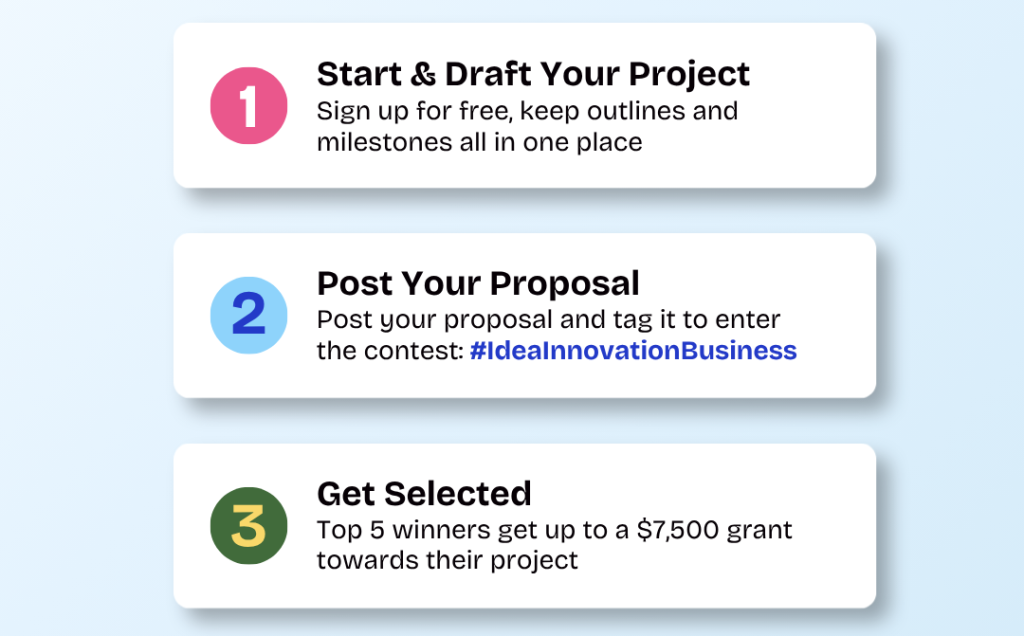
- You choose or draft a technology, write a project plan, post it in the PROJECT section, and tag it #IdeaInnovationBusiness by October 31, 2026.
- The five top-scoring Phase 1 teams earn grants of either $5,000 or $7,500, depending on their jury score.
- Teams that reach a qualifying commercial deal in Phase 2 keep 75% of the net proceeds.
- Winners of the Grand Prize, Best Project Defense, and Best Business Plan each receive a lifelong free platform subscription.
The challenge runs in two phases, starting with a written project plan and moving into a funded, mentored build period. Everything happens on the platform, which keeps your work visible to jurors, potential collaborators, and industry partners the whole way through.
How the Challenge Works
The challenge has two phases with separate selection rounds. In Phase 1, teams submit a written execution plan, and a jury selects the strongest projects. In Phase 2, the selected teams spend five months building, testing, and defending their project, with grants and commercialization rewards on the line.
Phase 1 opens on October 1, 2026 and closes on October 31, 2026. The jury reviews entries during the first half of November, and results arrive on November 15, 2026. The Phase 2 build period then runs from November 16, 2026 through April 23, 2027, with final awards announced on April 30, 2027. Every stage stays on the platform, which keeps your project in front of jurors and potential partners as it develops.
Who Can Enter
Any student team can enter, as long as members meet a few requirements. Participants must be at least 18, or have consent from a parent or legal guardian. Each person joins one team only, each team submits one entry, and every member holds a free account. Team composition must be final by October 31, 2026.
Every team has a Team Lead who starts the project, recruits members, submits the entry, and acts as the main contact. The Team Lead can already belong to the platform or create a free account to join. Employees of TeraOpenScience, jury members, and their immediate families cannot take part.
Phase 1: Draft Your Project
Phase 1 asks each team to submit a written execution plan that shows how the project will move forward over the five-month build. This is not the final business plan. It is the roadmap your team commits to following if the jury selects you for Phase 2.
What to include
Your Phase 1 entry needs to cover the idea itself and the plan behind it. Include the following:
- Describe the proposed innovation or new application.
- Write an executive summary of the project.
- Add a short resume or LinkedIn profile for each team member.
- Lay out a project plan that covers team roles, milestones, a technical development strategy, a supply chain roadmap, and a business plan outline.
- Confirm in writing that your team follows your university or institution policies.
How to submit
Two important steps decide whether your entry counts, and both matter.
Entries are visible to the jury and, by default, to the community. Teams that want to protect a patentable idea can create the project in private mode and invite the jury directly. This matters because public posting counts as public disclosure, and the United States gives inventors only a one-year grace period to file afterward. Review the intellectual property terms before you choose, and note that many universities claim rights in inventions made with their resources.
How Entries Are Judged
A jury of researchers, industry leaders, and innovation experts scores every eligible entry against five weighted criteria. Each juror rates each project independently with a Six Sigma Cause and Effect Matrix, and the average of those scores sets the final result. Jury decisions are final, and any juror with a conflict of interest steps aside.
| Criterion | Weight |
| Innovation and originality of the proposed application | 25% |
| Technical feasibility and quality of the development strategy | 25% |
| Quality and realism of the execution plan | 25% |
| Team composition, skills, and capacity to deliver | 15% |
| Potential for real-world scientific, societal, or commercial impact | 10% |

Phase 1 Grants and Prizes
Every eligible entry gets featured on the platform and promoted across the platform’s social channels, which puts your work in front of a wide audience right away. The five highest-scoring teams also receive a grant, with the amount tied to their average score.
| Average score | Grant amount |
| 85% or higher | $7,500 |
| 60% to 85% | $5,000 |
Grants are paid to the Team Lead in installments, with 50% at kickoff, 25% after the two-month report, and 25% after the four-month report. Funds cover project costs such as materials, prototyping, testing, and travel needed for the project. Teams that score at least 50% but miss the top five still advance to Phase 2 without a grant, and any team may add an approved sponsor.
Phase 2: Build, Test, and Defend
Phase 2 turns the plan into a working project over five months. Selected teams carry out their research plan, run a proof-of-concept or field test, and prepare a full business plan. Staff provide mentorship check-ins and help teams approach potential industrial buyers along the way.
Core deliverables are required of every team, while extended deliverables are encouraged and score favorably. The jury understands that a five-month student project may not finish every item.
- Every team must complete the core deliverables, which include an executive summary, a market research summary, execution of the research plan, a field test or documented proof-of-concept, a full business plan with 10-year financial projections and a 10-year Net Present Value calculation, two progress reports, and a final defense during the week of April 19, 2027.
- Teams are encouraged to add extended deliverables, such as a manufacturing and supply chain strategy, a commercialization and global go-to-market plan, and any extra material that strengthens their case.
The written plan borrows the same backbone lenders expect, starting with an executive summary and market analysis. Interdisciplinary teams tend to produce higher-impact results, which makes mixing skills across science, engineering, and business worth the effort.
Phase 2 Rewards
Phase 2 pays off in two ways. First, if a project reaches a qualifying commercial deal within 12 months of the build period, the team keeps 75% of net proceeds and TeraOpenScience keeps 25%. Second, three awards recognize standout work regardless of any commercial outcome.
The three top awards, announced April 30, 2027, are the Grand Prize for Best Overall Execution, Best Project Defense, and Best Business Plan. Every member of the three winning teams receives a lifelong free subscription. Members also earn ScienceCoins on Ethereum and the Polygon layer-2 network as they contribute, and every team that completes the core deliverables gets a certificate and continued promotion. Standout members can also be seen by co-authors, investors, recruiters, and committees that award prizes such as the Nobel.

Key Dates to Remember
Mark these dates now, because late entries will not be accepted. The Phase 1 window is short, and the build period includes fixed reporting checkpoints that every funded team must hit to keep receiving grant installments.
| Date | Milestone |
| October 1, 2026 | Challenge and Phase 1 entries open |
| October 31, 2026 | Phase 1 entry deadline and team lock |
| November 15, 2026 | Phase 1 winners announced |
| November 16, 2026 | Phase 2 build period begins |
| Week of January 18, 2027 | First progress report |
| Week of March 15, 2027 | Second progress report |
| April 19 to 23, 2027 | Final project defenses |
| April 30, 2027 | Phase 2 awards announced |
Enter the Science Challenge
The Idea, Innovation, Business Science Challenge rewards teams that combine a sharp idea with a real plan to build it. TeraOpenScience gives you the platform, the grant funding, the mentorship, and the visibility to take a concept through testing and toward a real commercial outcome, all under a Creative Commons Attribution-ShareAlike 4.0 license that keeps knowledge open.
Build your team, choose your technology, and post your project in the PROJECT section with the #IdeaInnovationBusiness tag before October 31, 2026. Entries submitted after that date will not be accepted. Lock your team and claim your spot early.