The Short Answer and the Fine Print
Most grants are yours to keep, but a few situations can turn that free money into a bill.
At a Glance:
- A grant is financial aid you usually do not repay, unlike a student loan.
- Federal grants like the Pell Grant, FSEOG, and TEACH Grant each come with different rules.
- You can be asked to pay part of a grant back if you withdraw early, change your enrollment status, or break a service agreement.
- Filing the Free Application for Federal Student Aid and meeting eligibility requirements is how you get and keep grant money.
Grants are one of the best forms of financial assistance for paying college costs, because the money does not have to be paid back in most cases. Still, the word “most” hides a few exceptions that every eligible student should understand before spending a dollar.
What Is a Grant?
A grant is money for education or a project that you generally do not repay, which is why it is often called gift aid. Grants come from the federal government, state agencies, colleges, and nonprofit organizations. For students in the United States, most grant money is based on financial need and helps cover higher education costs.
This is the main difference between a grant and a student loan. A loan has to be paid back with interest, while a grant is closer to free money you earn by meeting eligibility criteria. According to Federal Student Aid, federal grants are gift aid that usually does not have to be repaid, though you may have to repay all or part of one under certain circumstances. Grants also exist outside of education, including grant programs for a nonprofit organization or a small business.

Do You Have to Pay Back a Grant?
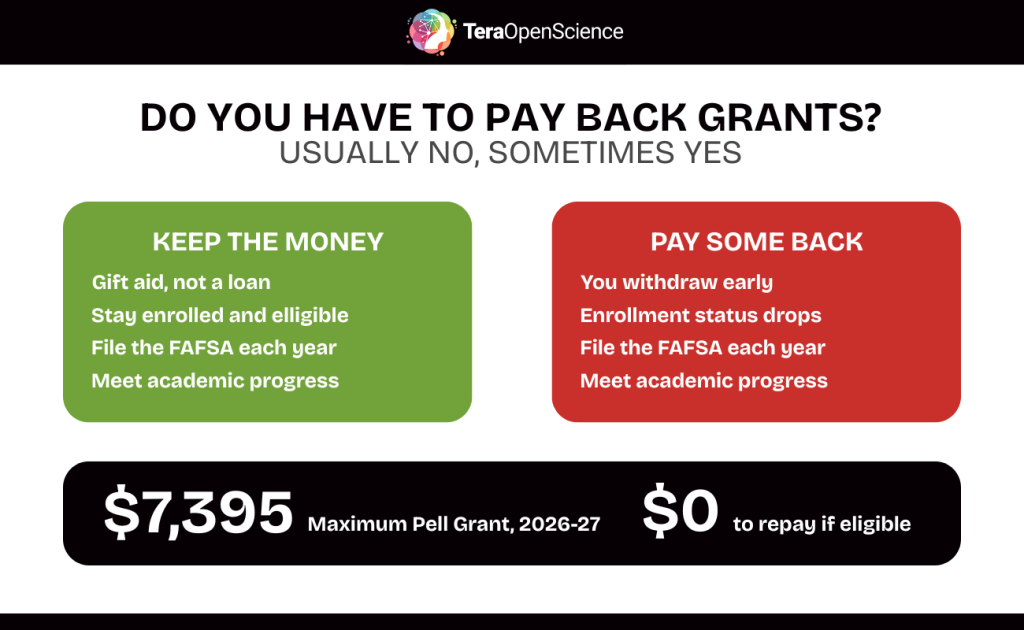
In most cases, no. A grant is designed as financial aid you keep, provided you follow the rules attached to it. For a Pell Grant, that means staying an eligible student and completing the term you enrolled in. A Pell Grant does not have to be repaid as long as you were and remain eligible.
The federal government treats most student grants as need-based support, not debt. The maximum Federal Pell Grant is $7,395 for the 2026-27 award year, and that award is money you do not pay back. The rules exist to make sure grant money reaches low-income students who use it for its purpose, so problems usually start only when a student leaves early or breaks an agreement.
The Main Types of Student Grants
There are several federal and state grant programs, each with its own eligibility requirements and award amounts. Most share one trait: you apply with the free application, and the money does not need to be repaid unless something changes. The table below compares the most common options for college students.
| Grant | Who it helps | Typical award | Repay? |
| Federal Pell Grant | Undergraduate students with financial need | Up to $7,395 (2026-27) | No, if you stay eligible |
| FSEOG | Undergraduates with the greatest need | $100 to $4,000 per year | No, in most cases |
| TEACH Grant | Future teachers in high-need fields | Up to $4,000 per year | Only if service is not met |
| Cal Grant | California residents in college | Varies by school and type | No, if you stay eligible |
The Pell Grant is the foundation of federal financial aid for undergraduate students who have not earned a bachelor’s degree. The FSEOG adds $100 to $4,000 in additional funds for students with the greatest financial need, and because each school gets a fixed pool, it is awarded by the financial aid office on a first-served basis until the money runs out. Graduate students have fewer grant options, though some programs and fellowships apply.
When You Do Have to Pay Back a Grant
You have to repay part or all of a grant in a handful of specific situations. Most involve leaving school early, changing your plans, or failing to meet a promise you made in exchange for the money. Knowing these triggers in advance is the best way to protect your grant money.
- You withdraw early: If you drop out before finishing the term, your school calculates how much of the grant you earned through attendance and may bill you for the rest.
- Your enrollment status changes: Moving from full-time to part-time can reduce your Pell Grant award, and you may owe back the difference.
- You receive other aid: New scholarships or grants can lower your financial need, which may reduce a need-based grant.
- You break a service agreement: This is the big one for the TEACH Grant, covered below.
The TEACH Grant Exception
The TEACH Grant is the clearest case where a grant can become a loan. It provides up to $4,000 a year to students who agree to teach in a high-need field at a low-income school. The service obligation is four years of qualifying teaching completed within eight years of finishing your program.
If you do not meet that obligation, the consequences are steep. All of your TEACH Grants convert to Direct Unsubsidized Loans that you must repay in full, with interest charged from the date of each disbursement. Once converted, the loan cannot be turned back into a grant unless the request was made in error, so this is an agreement to read carefully before signing.
State Grants and the Cal Grant
State grants work much like federal ones and usually do not need to be repaid. California’s program is a good example. A Cal Grant is state money for college that you do not pay back, and it comes in three types, A, B, and C, based on your situation and a minimum cumulative GPA.
Cal Grant B is aimed at low-income students and dependent children in families with limited income. It includes an access award of about $1,648 for books and living costs, on top of help with tuition at four-year schools. As with federal aid, you apply through the free application and must maintain satisfactory academic progress to keep the award through your fall and spring semesters.

How to Keep Your Grant Money
Keeping a grant comes down to staying eligible and following the terms. Since eligibility is checked each year through the FAFSA and your Student Aid Index, small changes in your family income or enrollment can affect your award. A few habits protect your funding.
- File the Free Application for Federal Student Aid at studentaid.gov early each year, since some aid is limited.
- Maintain satisfactory academic progress and the required cumulative GPA.
- Finish the terms you enroll in, and talk to your financial aid office before withdrawing.
- Meet any service obligation tied to a conditional grant.
Your eligibility also depends on numbers set by the federal government. For 2026-27, a Student Aid Index at or above $14,790 makes a student ineligible for a Pell Grant, which is twice the maximum award. Your Pell eligibility and award are calculated from your FAFSA for each award year, which runs from July 1 to June 30.
Turn Grant Funding Into Real Momentum
Grants are one of the few ways to fund an education or a project without taking on debt, as long as you stay eligible and honor the terms. The rules reward students who plan ahead, complete their programs, and keep their paperwork current with federal student aid.
That same logic applies to research and innovation. TeraOpenScience is an open platform where students, researchers, and professionals can access grant funding, free research tools, and a global community, while being seen by potential grant funders and collaborators. Create a TeraOpenScience account to share your work, find support for your ideas, and connect with people who fund them. Explore the TeraOpenScience platform and remember its motto: be open, be seen.