The Blueprint Behind Every Study
Research design is the plan that determines whether a study can actually answer its research question, and choosing the right one shapes everything that follows.
At a Glance:
- Research design is the overall strategy that ties a study’s parts together so the question gets answered before data collection starts.
- Quantitative research measures with numbers; qualitative research interprets meaning through words, and many studies combine both.
- Only experimental designs with a control group and a manipulated variable can prove cause and effect.
- Observational designs like cohort, cross-sectional, and case studies show relationships but cannot prove causation.
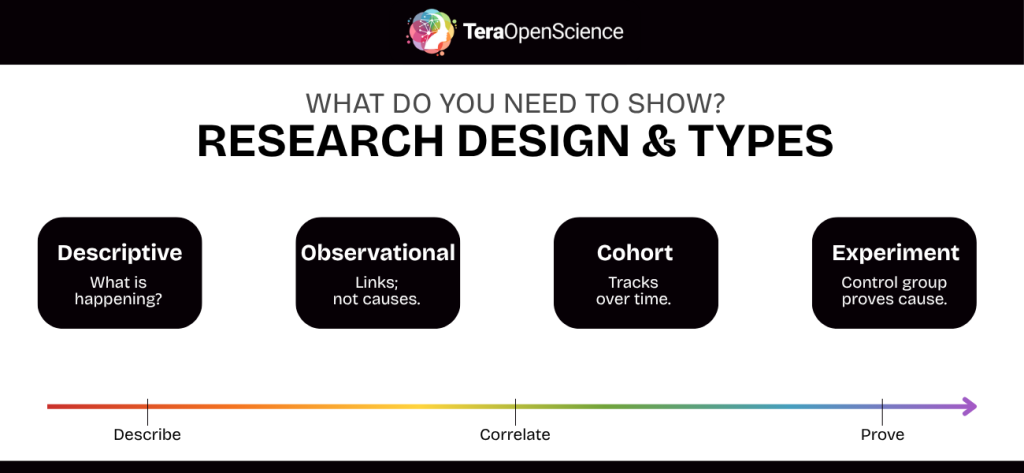
- The right design depends on your research question, choosing to describe, correlate, or prove.
Every credible study rests on a design chosen before a single data point is gathered. Get it right, and your conclusions hold up to scrutiny; get it wrong and no amount of statistical analysis can rescue the results.

What Research Design Actually Means
Research design is the overall strategy a researcher uses to integrate the different parts of a study coherently, so the research question gets answered with clear evidence. It defines how participants are selected, how variables are measured, when data is collected, and how the analysis will run. The design is the skeleton the whole research study hangs on.
A well-chosen design does three things. It aligns the method with the question, it controls for factors that could distort the findings, and it sets realistic limits on what the study can claim. A design built to describe a population cannot prove cause, and a design built to prove cause is often too narrow to describe a population. Naming that trade-off early is part of good research methodology.
Qualitative vs. Quantitative Research
The first fork in any research design is whether you are measuring or interpreting. Quantitative research collects numerical data and tests relationships between an independent variable and a dependent variable using statistical methods. Qualitative research collects non-numerical data through interviews, observation, and open-ended questions to understand meaning, context, and experience.
Neither is superior. They answer different kinds of questions, and many strong projects combine them.
| Feature | Quantitative research | Qualitative research |
| Core question | How much, how many, how often | Why, how, what does it mean |
| Data type | Numbers, measurements | Words, themes, observations |
| Common methods | Surveys, experiments, clinical trials | Case study, focus group, interviews |
| Analysis | Statistical analysis | Thematic coding |
| Output | Correlations, effect sizes | Rich description, theory |
Quantitative methods dominate fields like a randomized controlled trial in medicine, where a correlation coefficient or effect size gives a precise answer. Qualitative methods lead in social science when the goal is understanding lived experience rather than counting it. A mixed approach, using qualitative studies to generate hypotheses and quantitative data to test them, often produces the fullest picture.
Experimental Research Design
Experimental research design is the only family of designs that can establish cause and effect, because the researcher actively manipulates the independent variable and randomly assigns participants to groups. A true experiment compares an experimental group that receives the intervention against a control group that does not, holding everything else constant.
The randomized controlled trial is the most rigorous form of experimental study and is widely treated as the gold standard for testing whether a treatment works. Random assignment is what makes it powerful, because it distributes both known and unknown risk factors evenly across groups, so any difference in health outcomes can be attributed to the intervention rather than to a hidden variable like socioeconomic status.
Experimental designs share a few common features:
- A manipulated independent variable controlled by the researcher.
- Random assignment of participants to an experimental group and a control group.
- A measured dependent variable that captures the outcome.
- Tight control over conditions to rule out alternative explanations.
The trade-off is reach. Because experimental research controls conditions so tightly, the setting can drift away from real-world settings, which limits how far the findings generalize. That gap between a controlled lab and messy reality is the standing critique of experimental work.
Observational and Correlational Designs
Observational study designs measure variables without manipulating them, which makes them the right choice when an experiment would be unethical or impractical. You cannot randomly assign people to smoke or not smoke, so the link between smoking and disease was built largely on observational evidence. These designs can reveal a positive correlation between two variables, but correlation alone does not prove causation.
Correlational research measures the strength and direction of a relationship using a correlation coefficient that runs from -1 to +1. A value near +1 signals a strong positive correlation, a value near -1 a strong negative one, and a value near 0 no linear relationship. It is a descriptive tool, not a causal one.
Three observational designs come up constantly:
- A cross-sectional study measures a population at one point in time, giving a fast snapshot of how variables relate but no sense of sequence.
- A cohort study follows different groups forward over time to see who develops an outcome, making it a common longitudinal study format.
- A case study examines a single person, group, or event in depth, trading breadth for detail.

Descriptive Research Design
Descriptive research design answers what is happening without asking why. A descriptive study documents the characteristics of a population or phenomenon, such as how often a condition occurs or how a behavior is distributed, without testing a relationship between variables. It is often the first step that later experimental research builds on.
Descriptive research design is the workhorse of early-stage inquiry. Surveys, observation, and records review all fall under it. Its strength is an accurate picture of the current state of things; its limit is that it cannot explain the causes behind that picture. A descriptive study can tell you that a health outcome is more common in one region, but a different design is needed to explain the reason.
The Systematic Review
A systematic review sits above individual studies by collecting and analyzing all the research on a question using a predefined method. Rather than running new data collection, it synthesizes existing experimental and observational evidence into one assessment, which is why it ranks at the top of most evidence hierarchies alongside the meta-analysis that often accompanies it.
Systematic reviews matter because a single study rarely settles anything. By pooling results across many studies, a review smooths out the quirks of any one sample and gives a clearer estimate of the truth. Organizations like Cochrane built their reputation on exactly this method for evaluating healthcare interventions.
Comparing the Main Study Designs
The right design depends entirely on your research question, your resources, and whether you need to describe, correlate, or prove. This table lays the main options side by side.
| Study design | Establishes cause | Time frame | Best for |
| Randomized controlled trial | Yes | Prospective | Testing whether an intervention works |
| Cohort study | Suggests, not proves | Longitudinal | Tracking outcomes over time |
| Cross-sectional study | No | Single point | Snapshots of prevalence |
| Case study | No | Varies | In-depth single-case insight |
| Descriptive study | No | Varies | Documenting characteristics |
| Systematic review | Synthesizes evidence | Retrospective | Summarizing an entire field |
Reading down the causal column shows the core rule of research design. Only a design with a manipulated variable and a control group can claim cause. Everything else describes, correlates, or synthesizes, and each of those jobs is valuable in its own right.
How to Choose the Right Design
Start with the research question, not the method. If the question asks whether something causes something else, you need an experimental design with a control group. If it asks how common or how distributed something is, a descriptive or cross-sectional study fits. If it asks why people behave a certain way, a qualitative research design is the honest choice.
Work through it in order:
- Define the research objectives in a single sentence before anything else.
- Decide whether you need numbers, meaning, or both.
- Identify your independent variable and dependent variable if the question is causal.
- Check what is ethical and practical, since that often rules out a true experiment.
- Match the timeframe, choosing a longitudinal study for change over time or a cross-sectional one for a snapshot.
The design that fits a clinical trial rarely fits a social science project, and forcing the wrong one produces data that cannot answer the question asked.
Bring Your Research Design to a Community That Gets It
Choosing a research design is easier when you can compare notes with people who have run the same study designs across different fields. TeraOpenScience is an open science platform that connects students, researchers, and professionals across STEM, healthcare, and social science, so you can refine a research question, get manuscript feedback, and find collaborators before your data collection begins. Share your work, validate it through peer input, and build on what others have already learned. Join TeraOpenScience and turn a solid research design into research that gets seen. Be open. Be seen.