The Short Version Before We Go Deep
Good knowledge management is the difference between an organization that learns and grows and one that keeps solving the same problems from scratch.
At a Glance:
- Knowledge management is the process of capturing, organizing, and distributing valuable knowledge so the right people can access it at the right time
- Effective knowledge management reduces knowledge loss when employees leave, accelerates onboarding for new hires, and directly improves customer satisfaction
- The best practices covered here include building a structured knowledge base, distinguishing between explicit knowledge and tacit knowledge, using version control, and selecting the right technology
- AI-powered tools are transforming knowledge management by automating capture, surfacing relevant information, and reducing the manual effort required to keep a knowledge base current
- TeraOpenScience applies open-collaboration principles to knowledge sharing at a global scale, making it a practical model for organizations looking to build a better knowledge management strategy
Organizations that manage knowledge well outperform those that do not. McKinsey research estimates that employees spend an average of 1.8 hours per day searching for information they need to do their jobs. Better knowledge management gives that time back.
What Is Knowledge Management, and Why Should You Care?
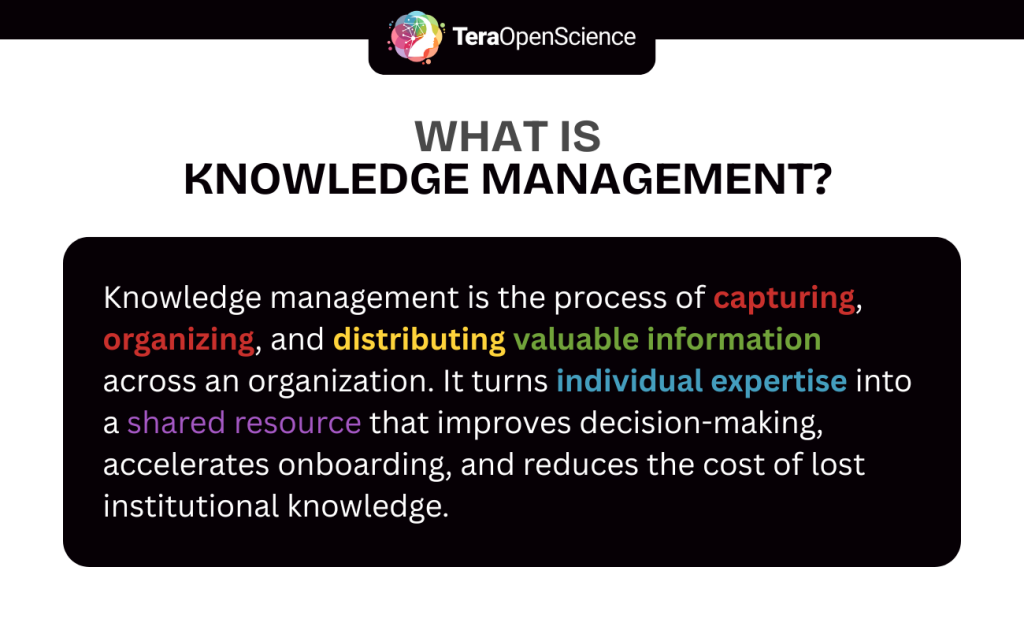
Knowledge management is a structured approach to identifying, capturing, organizing, and distributing the intellectual capital within an organization so it can be used effectively. It covers both explicit knowledge, which includes documented processes, manuals, and data, and tacit knowledge, which includes the experience and judgment that subject matter experts carry in their heads. A strong knowledge management process treats both types as valuable assets worth preserving.
Organizations that invest in effective knowledge management see measurable outcomes. A report by Deloitte found that companies with mature knowledge-sharing practices are 5 times more likely to be high-performing organizations. The benefits extend across nearly every function:
- Faster onboarding: New hires reach full productivity more quickly when institutional knowledge is documented and accessible
- Better decision-making: Teams make faster, more accurate choices when critical information is easy to find rather than buried in inboxes or locked in the minds of a few people
- Reduced redundancy: Documented knowledge prevents teams from reinventing solutions that already exist elsewhere in the organization
- Stronger customer experience: Service desk employees and customer support teams resolve issues faster when they have a well-maintained knowledge base to draw from
- Continuous improvement: When knowledge creation is a regular organizational habit, teams build on previous work rather than starting over
Knowledge Management Best Practices
1. Distinguish Between Explicit and Tacit Knowledge
The first step in any knowledge management strategy is recognizing that not all organizational knowledge looks the same. Explicit knowledge is the easier category: it includes written documents, procedures, reports, and data that can be stored in document management systems and retrieved on demand. Tacit knowledge is harder. It lives in the expertise of senior team members, the intuition of experienced customer service agents, and the pattern recognition of long-tenured subject matter experts.
Best practice here is to create deliberate systems for capturing tacit knowledge before it walks out the door. Structured interviews with departing employees, peer-to-peer knowledge transfer sessions, and mentorship programs are all proven methods. According to IBM, replacing an experienced employee costs between 50% and 200% of their annual salary, a cost that knowledge transfer practices directly reduce.
2. Build a Centralized, Searchable Knowledge Base
A knowledge base is the operational core of any knowledge management system. It should be a single, searchable repository where team members can find accurate, current information without having to ask someone or dig through archived emails. The right technology matters here. Platforms like Microsoft Teams, Confluence, and dedicated knowledge management tools provide the infrastructure, but the structure and governance around the knowledge base matter just as much as the software itself.
A useful knowledge base has these characteristics:
- Clear taxonomy: Content is organized in a way that matches how end users think and search
- Version control: Every document carries a clear record of when it was last updated and by whom
- Defined ownership: Each knowledge asset has an assigned knowledge manager or subject matter expert responsible for accuracy
- Easy access: The knowledge base is integrated into daily workflows, not a separate tool people have to remember to open
3. Prioritize Version Control and Regular Updates
Outdated information is often worse than no information at all. A customer support agent who follows a procedure that was superseded six months ago creates friction for the customer and liability for the organization. Version control solves this by creating a transparent record of every change made to a document, who made it, and when.
Best practice is to pair version control with a scheduled review cycle. Assign each knowledge asset an expiration date that triggers a review. High-turnover content, like product specs, pricing, and compliance procedures, may need quarterly review. More stable content, like foundational process documentation, may only need annual attention. The key performance indicators for this practice include the percentage of documents reviewed on schedule and the number of outdated documents flagged and corrected per quarter.
4. Capture Knowledge at the Point of Creation
Waiting until the end of a project to document what the team learned almost always results in incomplete records. The best knowledge management processes build documentation into the workflow itself rather than treating it as a post-project task. This means:
- Creating project templates that include a knowledge capture section
- Using AI-powered tools to automatically generate meeting summaries, decision logs, and action item records
- Building after-action reviews into standard operating procedures for completed projects
- Encouraging team members to document solutions as they solve problems, not afterward
When knowledge creation is a byproduct of doing the work, the organizational knowledge base grows continuously without requiring dedicated documentation effort.

5. Use AI to Scale Knowledge Management
Artificial intelligence has changed what is possible in knowledge management. AI-powered tools can now automatically tag and categorize new content, surface relevant documents based on context, identify gaps in the knowledge base, and flag information that may be outdated. Organizations that integrate AI into their knowledge management process reduce the manual effort required to maintain a useful knowledge base and increase the speed at which valuable information reaches the people who need it.
A 2023 study by PwC found that AI adoption in knowledge management functions reduces information search time by up to 40%. For organizations managing large volumes of documentation, customer support content, or research output, that reduction translates directly into better decision-making speed and lower operational costs.
6. Build a Knowledge-Sharing Culture
Technology alone does not produce effective knowledge management. The organizational culture has to value knowledge sharing as a professional norm, not as an optional extra. This requires visible leadership commitment, recognition systems that reward employees who contribute to the knowledge base, and clear communication about why knowledge sharing matters to the entire organization.When leaders model knowledge-sharing behavior and when contributions are recognized, team members follow. A culture of open knowledge sharing produces a self-reinforcing cycle: better information leads to better outcomes, which builds trust in the knowledge base, which encourages more contributions.
7. Measure What Matters
A knowledge management strategy without key performance indicators is difficult to improve. Track the metrics that reflect actual value delivered, not just activity. Useful KPIs include:
- Time to find information: Average time a team member spends locating critical information needed to complete a task
- Knowledge base utilization rate: Percentage of team members actively using the knowledge base in a given period
- First-contact resolution rate: For customer support and service desk employees, this measures how often an issue is resolved without escalation, a direct proxy for knowledge base quality
- New hire ramp time: How long it takes a new employee to reach baseline productivity
- Document freshness rate: Percentage of documents reviewed and confirmed current within their assigned review window
Tracking these numbers quarterly gives knowledge managers the data needed to justify investment, identify weak points, and demonstrate business value to stakeholders.
Knowledge Management Best Practices Overview
| Best Practice | What It Addresses | Key Benefit |
| Distinguish Between Explicit and Tacit Knowledge | Knowledge goes undocumented when teams only focus on written records | Prevents loss of institutional expertise when employees leave |
| Build a Centralized, Searchable Knowledge Base | Information scattered across emails, drives, and tools | Reduces time spent searching and eliminates duplicate effort |
| Prioritize Version Control and Regular Updates | Outdated information causing errors and poor decisions | Keeps the knowledge base accurate and legally defensible |
| Capture Knowledge at the Point of Creation | End-of-project documentation that is incomplete or never happens | Grows organizational knowledge continuously as work is done |
| Use AI to Scale Knowledge Management | Manual documentation effort slowing knowledge base growth | Reduces search time by up to 40% and surfaces relevant content automatically |
| Build a Knowledge-Sharing Culture | Employees hoarding knowledge or lacking incentive to contribute | Creates a self-reinforcing cycle of contribution and quality improvement |
| Measure What Matters | No visibility into whether the knowledge management strategy is working | Enables data-driven improvements and stakeholder buy-in |
The Open Science Model as a Knowledge Management Framework
The principles behind effective knowledge management and the principles behind open science overlap significantly. Both prioritize making valuable knowledge accessible, preventing loss of critical information through poor documentation, and building the systems that allow knowledge to compound over time rather than disappear when people change roles or organizations.
TeraOpenScience applies this model at a global scale. The platform functions as a living knowledge base for researchers, students, and professionals across STEM, healthcare, and business disciplines. Members contribute to a shared pool of intellectual capital through peer-reviewed posts, open collaboration on projects, and cross-disciplinary discussion forums. The AI-powered tools on the platform support knowledge creation and knowledge transfer in ways that traditional academic publishing and siloed enterprise systems cannot match.
For organizations building or refining their knowledge management strategy, the open science model offers a useful benchmark: what would your knowledge base look like if it were designed with the assumption that knowledge sharing creates value for everyone involved?
Put These Practices to Work
Effective knowledge management starts with a decision to treat organizational knowledge as the valuable asset it is. The best practices outlined here, distinguishing knowledge types, building a searchable knowledge base, enforcing version control, capturing knowledge at creation, integrating AI, building a sharing culture, and measuring outcomes, give any organization a practical framework to follow.
If your work involves research, innovation, or any form of knowledge creation, TeraOpenScience is a platform built around the same principles. It brings together students, researchers, and professionals in an open, AI-powered ecosystem designed to make valuable knowledge accessible and to turn individual contributions into shared intellectual capital.
Join TeraOpenScience today.
Students get free access to the full collaborative platform. Professionals can start a 90-day free trial with no credit card required. Create your profile and start contributing to the world’s collective knowledge base.