What Every Innovator Should Know Before Leaving Money on the Table
Your ideas have financial value, and the gap between “idea” and “income” is smaller than most researchers, inventors, and professionals realize.
At a Glance:
- Intellectual property (IP) is a legally protectable asset that can generate revenue through licensing agreements, patent sales, royalty payments, and strategic partnerships
- Most IP goes unmonetized not because it lacks value, but because owners lack a clear monetization strategy or the right network to connect them with buyers and collaborators
- A platform like TeraOpenScience gives researchers and professionals the tools, visibility, and ecosystem to turn dormant IP into active revenue streams
- The most effective IP monetization strategies align with market demand, protect ip rights from the start, and leverage open collaboration to increase an asset’s reach and value
- Blockchain-verified IP protection, AI-powered tools, and a global R&D network make TeraOpenScience a uniquely positioned platform for commercializing ideas
Your intellectual property may be the most valuable thing you own, and most people never see a dollar from it. TeraOpenScience is changing that by building the infrastructure researchers and innovators need to connect ideas with capital.
What Is IP Monetization, and Why Does It Matter?
IP monetization is the process of generating revenue from intellectual property assets, including patents, trade secrets, trademarks, copyrights, and proprietary research. Done well, it turns intangible assets into measurable business outcomes. According to the World Intellectual Property Organization (WIPO), intangible assets now account for more than 90% of S&P 500 company value, up from roughly 17% in 1975. That shift means the ability to monetize IP is no longer a niche legal strategy; it is a core business strategy for any individual or organization producing original work.
IP monetization matters because it creates additional revenue streams without requiring a company or researcher to build an entirely new product from scratch. The IP asset already exists. The work is in positioning it, protecting it, and finding the right pathway to market.
There are several reasons why so much IP goes unrealized:
- Lack of Visibility: Innovators cannot find potential buyers or licensees without the right network
- Unclear IP Rights: Researchers working within institutions often do not know who owns the IP rights to their work
- No Monetization Strategy: Most scientists and engineers are not trained in patent enforcement, licensing agreements, or patent sales
- Insufficient Legal Protection: IP without proper documentation or blockchain-verified timestamps is vulnerable and harder to defend
TeraOpenScience directly addresses all four of these barriers.
The Core IP Monetization Strategies
There is no single best approach to IP monetization. The right path depends on market conditions, the type of IP portfolio involved, and the innovator’s business goals. The four most widely used methods are licensing, direct patent sales, joint ventures, and strategic partnerships.
| IP Strategy | Best For | Revenue Type | Risk Level |
| Licensing Agreement | Ongoing passive income from existing IP | Royalty payments | Low to Medium |
| Patent Sales | Immediate capital return | Lump sum | Low (post-sale) |
| Joint Venture | Shared development of new technology | Profit sharing | Medium to High |
| Strategic Alliance | Market access, co-development | Variable | Medium |
Licensing Agreements
A licensing agreement grants a potential licensee the right to use your IP in exchange for royalty payments or a fixed fee. Exclusive rights tend to command higher fees but limit how broadly the IP can be deployed. Non-exclusive licenses trade lower per-deal value for broader market reach. According to a 2022 analysis by the Licensing Executives Society, global licensing revenue across all industries exceeds $300 billion annually, a figure driven largely by patent portfolios in pharmaceuticals, software, and manufacturing.
Patent Sales
Patent sales involve transferring IP rights to a potential buyer outright. This approach is well-suited when a researcher or company wants to capture immediate capital rather than manage an ongoing licensing agreement. The United States Patent and Trademark Office (USPTO) recorded over 350,000 patent applications in fiscal year 2023, a figure that reflects both the volume of new IP being created and the competitive market for acquiring it.
Joint Ventures and Strategic Partnerships
A joint venture brings two or more parties together to develop or commercialize technology while sharing both the risk and the reward. A strategic alliance stops short of a formal joint venture but still creates a collaborative framework to pursue a shared strategic goal. Both approaches are common in research institutions, where universities increasingly partner with enterprises to move discoveries from the lab to the market.
How TeraOpenScience Supports IP Monetization
TeraOpenScience is not a traditional patent brokerage or IP management firm. It is an AI-powered open innovation platform that creates the conditions for IP monetization to happen naturally, by connecting the people who create IP with the organizations that want to use it.
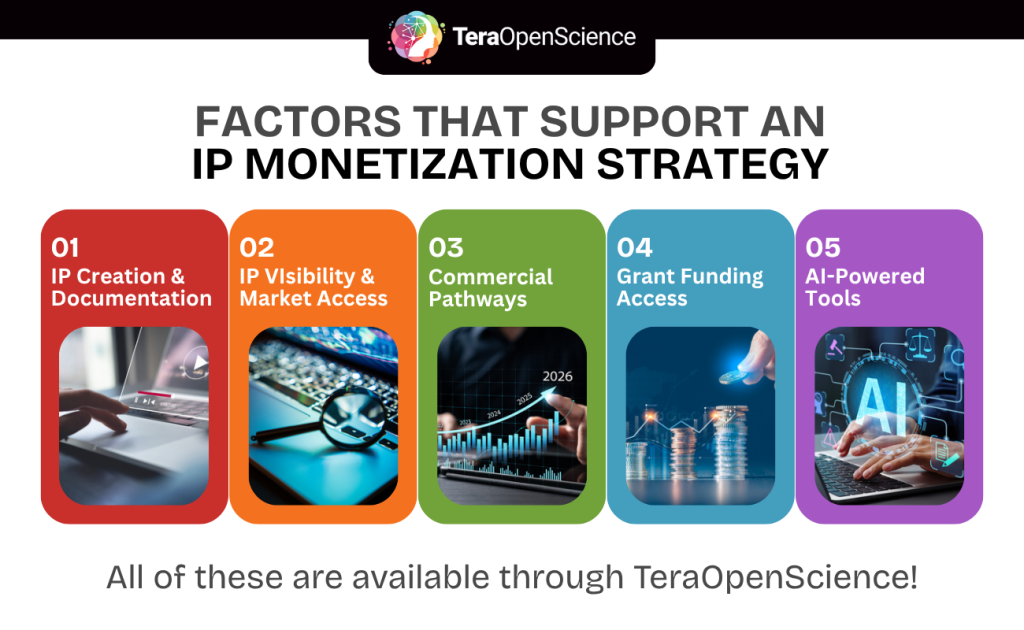
Here is how the platform supports each stage of a successful IP monetization strategy:
IP Creation and Documentation
Every project on TeraOpenScience uses blockchain-verified timestamps to create an immutable record of intellectual property from the moment of creation. This documentation layer is foundational. In a patent application or licensing negotiation, being able to prove the date of creation and the chain of development is a competitive advantage that goes far beyond what a lab notebook provides.
IP Visibility and Market Access
One of the biggest obstacles to patent monetization is simple obscurity. Researchers working in isolation rarely encounter the right enterprise partner or potential buyer at the right time. TeraOpenScience puts IP directly in front of investors, industry leaders, and research institutions within a global network built for cross-sector collaboration. The platform’s AI-assisted matching connects innovators with the partners most likely to see value in their ip asset.
Commercialization Pathways
TeraOpenScience guides members through a structured commercialization pipeline that includes:
- Multidisciplinary team formation around the IP
- Field testing and validation of proposed solutions
- Business plan development and documentation
- Strategies for successful market entry and launch
This is the difference between an idea sitting on a shelf and an idea generating revenue.
Grant Funding Access
Capital is often the missing ingredient in an otherwise viable ip monetization strategy. TeraOpenScience provides a curated database of grant funding opportunities, along with an AI Grant Assistant that identifies relevant funding matches and helps draft initial applications. For research institutions and independent researchers alike, this can bridge the gap between development and commercialization.
AI-Powered Tools
The platform’s artificial intelligence capabilities extend across project documentation, business plan generation, and IP documentation. This matters because administrative friction is one of the most common reasons ip monetization strategies stall. When the process of documenting, organizing, and presenting an IP portfolio is faster and more accessible, more researchers follow through.
Best Practices for Building a Strong IP Monetization Strategy
Following these best practices increases the likelihood of converting intellectual property into real revenue:
1. Document Everything Early
The strength of a patent application or licensing claim often depends on establishing a clear development timeline. Blockchain-based timestamp tools, like those offered through TeraOpenScience, make this automatic.
2. Understand What You Own
Researchers affiliated with universities or enterprises may share IP rights with their institution. Clarify ownership before pursuing any monetization pathway.
3. Conduct Due Diligence on the Market
Market demand drives the value of any IP asset. Before pursuing a licensing agreement or patent sale, research comparable transactions and benchmark against existing patent portfolios in the same space.
4. Protect Your IP Rights Before Going Public
Disclosing a discovery publicly before filing a patent application can forfeit legal protection in some jurisdictions. File first.
5. Think Beyond Patents
Trade secrets, proprietary methodologies, datasets, and software code are all valuable IP assets that can be licensed or sold. A narrow focus on patents alone can leave significant value on the table.
6. Build Visibility Before You Need It
The researchers and professionals who get the best licensing terms are the ones who already have a reputation and a network. TeraOpenScience builds both over time through peer validation, open collaboration, and a public-facing profile system.
The Open Science Advantage in IP Monetization
Open science and ip monetization are not in conflict. In fact, building a public record of research activity through a platform like TeraOpenScience actively strengthens an inventor’s position when the time comes to negotiate a licensing agreement or attract a potential buyer. Visibility is leverage.
A 2021 paper published in Nature found that open access research articles receive, on average, 18% more citations than papers behind paywalls. More citations mean more awareness, more credibility, and ultimately more market demand for the underlying technology. The same logic applies to any ip portfolio supported by a transparent, well-documented body of published work.
TeraOpenScience operates under a Creative Commons 4.0 ShareAlike license for public content while providing NDA-protected private environments for sensitive research. This means members can participate in open collaboration to build their profile and reputation while keeping proprietary ip assets secure until the right commercialization moment arrives.
The platform also enables access to digital platforms that would otherwise be difficult to reach: prize committees for awards like the Nobel, Fields Medal, and Turing Award are among the organizations that can discover researchers through TeraOpenScience. These recognitions translate directly into higher perceived value for an ip portfolio.

From Idea to Income: Your Next Step
The gap between a good idea and a new revenue stream is not as wide as it looks. It requires clear documentation, a smart monetization strategy, the right network, and tools that reduce the friction between creation and commercialization. TeraOpenScience is built to provide all four.
Researchers, professionals, and enterprises that have yet to act on their IP are leaving high-value assets dormant while the market moves forward. The best time to build an IP monetization strategy was when the idea was first developed. The second best time is now.
Join TeraOpenScience today and put your ideas to work.
Students can sign up for free and access the full collaborative ecosystem immediately. Professionals can start a 90-day free trial, no credit card required, and experience the platform’s full enterprise-grade R&D and IP commercialization tools before making any commitment. Create your profile and connect your IP with the people who need it.