The Question Every Tech User Should Be Asking Right Now
The line between who built AI and who controls it is blurrier than most people realize.
At a Glance:
- No single person, company, or government owns artificial intelligence as a concept
- Large tech companies like Google, Microsoft, OpenAI, and Amazon hold the most powerful AI systems through proprietary models and infrastructure
- Copyright law has not kept pace with AI development, and major questions around ai-generated content and authorship remain unresolved
- The U.S. Copyright Office has ruled that ai-generated work created without meaningful human authorship cannot receive copyright protection
- Foundation models trained on publicly available data sit at the center of most ownership disputes
- The coming years will likely bring new legislation, court decisions, and international agreements that reshape intellectual property rights in AI
Artificial intelligence is one of the most contested technologies in human history, not because of what it can do, but because of who gets to decide. The question of who owns artificial intelligence touches copyright law, patent application processes, corporate competition, and global policy all at once.
The Short Answer: Nobody and Everybody
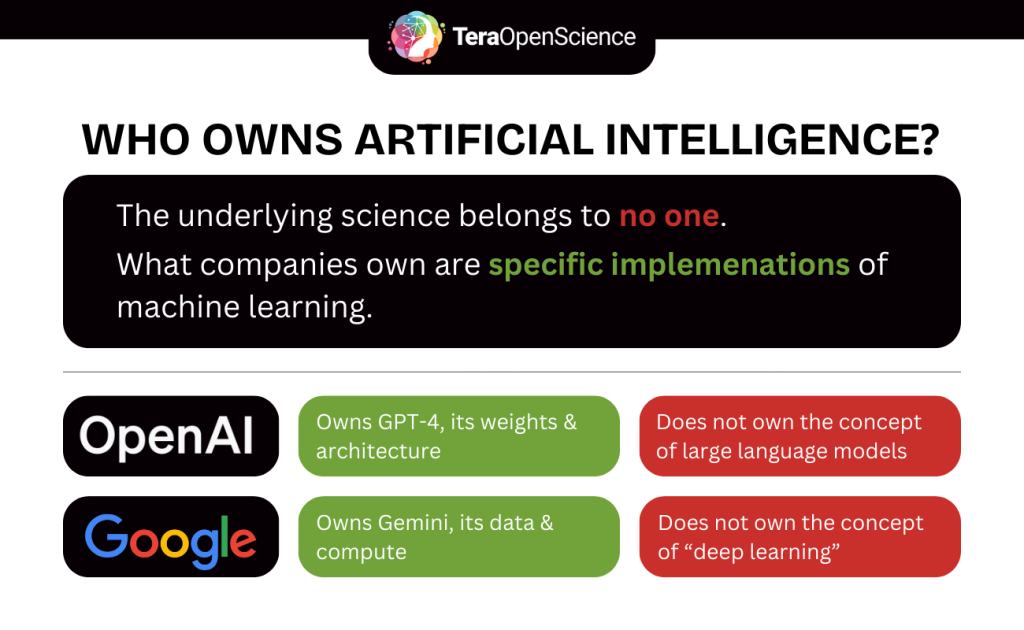
Asking who owns artificial intelligence is a little like asking who owns mathematics. The underlying science, the algorithms, the general concept of machine learning, none of that belongs to any one entity. What companies own are specific implementations: the trained ai models, the proprietary datasets, the infrastructure, and the software products built on top of them.
That distinction matters. OpenAI does not own the idea of a large language model. It owns GPT-4 and the specific architecture, training process, and weights that make it work. Google does not own deep learning. It owns Gemini, its associated infrastructure, and the mountains of data and compute used to build it. These are intellectual property claims tied to execution, not concept.
But ownership over execution is still enormously powerful, and a relatively small number of companies currently hold most of it.
A Brief History of Who Got Here First
The history of AI development is not a story of lone inventors. It is a story of institutions, funding, and scale.
The foundational research behind modern ai systems stretches back to the mid-20th century, with Alan Turing’s theoretical work on computing and the early neural network experiments of the 1950s and 60s. For decades, AI remained largely an academic exercise, something universities and government-funded labs explored without obvious commercial application.
That changed in the 2010s. Deep learning techniques that had existed in theory for years suddenly became practical as computing power caught up. Companies began pouring money into AI research, and the race to build usable generative ai tools accelerated fast.
A few key moments shaped the ownership landscape:
- 2015: OpenAI was founded as a nonprofit with backing from Elon Musk, Sam Altman, and others, including early investment from Microsoft, with a stated mission of developing responsible AI for humanity’s benefit
- 2017: Google researchers published the “Attention Is All You Need” paper, introducing the transformer architecture that underpins most modern language models
- 2019: OpenAI transitioned to a capped-profit model, and Microsoft deepened its investment, eventually committing over $10 billion
- 2022: ChatGPT launched publicly and hit one million users in five days, signaling that generative ai had arrived for mainstream audiences
- 2023 to present: A wave of foundation models from Google, Meta, Anthropic, Mistral, and others entered the market, alongside growing legal battles over training data and ai-generated material
The companies that invested earliest in compute, data, and talent now hold the most valuable AI assets. That head start translates directly into market power.
Who Are the Major Players Today
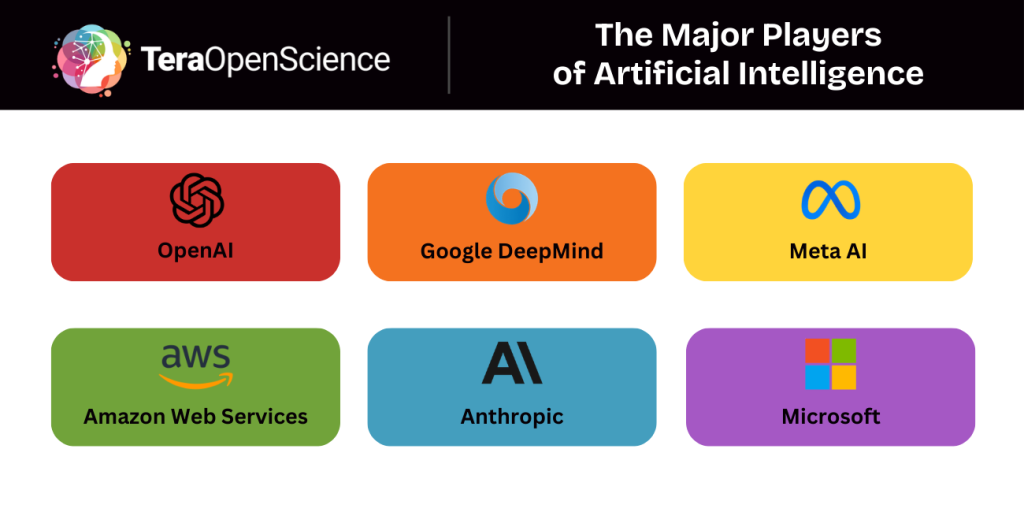
The AI ownership landscape today is dominated by a mix of tech giants, well-funded startups, and cloud infrastructure providers.
OpenAI
OpenAI holds some of the most recognized generative ai models in the world through GPT-4 and its successors, along with DALL-E for image generation. Its partnership with Microsoft gives it access to Azure’s computing infrastructure and distribution through products like Copilot.
Google DeepMind
This combines Google’s original DeepMind acquisition with its internal AI teams, producing models like Gemini and powering search engines, cloud tools, and enterprise software. Google’s data advantage through Search, YouTube, and Maps gives it training resources few can match.
Meta AI
Meta has taken a more open approach, releasing its LLaMA foundation models publicly to accelerate adoption and developer ecosystems. Meta’s social media platforms also generate significant behavioral data relevant to natural language processing and recommendation systems.
Amazon Web Services
Amazon powers much of the AI industry’s infrastructure. Through Amazon Bedrock and its investments in Anthropic, AWS holds a strong position as both an ai factory and a platform provider, hosting other companies’ models as a service provider.
Anthropic
This model focuses on responsible AI and safety-oriented large language models, including the Claude series. Founded by former OpenAI researchers, it has received major investment from both Google and Amazon.
Microsoft
Microsoft deserves a separate mention. Rather than building all of its AI in-house, it has embedded OpenAI’s models deeply into its product stack, from Office 365 to GitHub Copilot, making it one of the biggest winners in terms of commercial distribution.
Outside the United States, Baidu, Alibaba, and Huawei are major players in China, while the United Kingdom and European Union are actively funding domestic AI programs to reduce dependence on U.S. and Chinese systems.
Who Owns the Output: The Copyright Problem
One of the most contested questions in AI right now is not who owns the models but who owns what the models produce.
The U.S. Copyright Office has issued guidance stating that ai-generated content does not qualify for copyright protection when it lacks meaningful human authorship. Under current copyright law in the United States, copyright attaches to works created by human beings. A piece of writing, artwork, or code generated entirely by an ai system without meaningful human creative input falls into the public domain by default.
This creates complicated situations for content creators, companies, and developers:
- An illustrator who uses an ai tool to generate 90% of an image may have limited copyright claims over the final product
- A corporation that builds a product using ai-generated work may not hold exclusive rights to that output
- Courts and the federal register are actively working through cases that will set precedent for how these rules apply
The copyright office has indicated that it will evaluate AI-assisted works on a case-by-case basis, weighing how much human creative control shaped the final result. The more a human directs, selects, and modifies the ai-generated material, the stronger the copyright claim.
Patent application processes face similar friction. AI cannot be listed as an inventor under current United States patent law, but inventions developed with substantial AI assistance sit in a legal gray area that courts have not fully resolved.
Training Data and the Ownership of Inputs
Underneath every modern AI model is a training process that requires enormous amounts of data. That data came from somewhere, and who owned it before it was used to train an AI is now the subject of major litigation.
Several class-action lawsuits have been filed by writers, visual artists, and musicians who claim that their copyrighted work was scraped from the internet and used to train generative ai tools without permission or compensation. The outcomes of these cases will directly affect the intellectual property rights of both creators and AI companies.
Key arguments in these disputes include:
- Whether training on copyrighted content constitutes fair use under copyright law
- Whether AI-generated content that resembles original work constitutes infringement
- Whether AI companies have an obligation to compensate the creators whose data trained their models
No definitive ruling has resolved these questions in the United States as of 2025, and similar copyright issues are working their way through courts in the European Union and the United Kingdom.
What Comes Next
The ownership of artificial general intelligence, the theoretical next stage of AI development that could reason and operate across domains like a human, is already being debated even though that technology does not yet exist. The stakes are high enough that governments, researchers, and companies are staking positions in advance.
In the near term, expect:
- More international regulation. The EU AI Act is already in force. The United States is developing federal frameworks. Other countries are following.
- More litigation over training data. Courts will continue to define what AI companies can and cannot do with the work of human creators.
- More open-source pressure. Publicly available foundation models from Meta and others are creating competitive pressure on closed systems and challenging the idea that any single company can dominate AI.
- More scrutiny of sensitive information. As AI tools are embedded in healthcare, finance, and government, questions about what data these systems access and retain will intensify.

Where Open Science Fits In
The ownership of AI is not just a legal or corporate question. It is a scientific one. Much of the research that makes AI work, the papers, the datasets, the open-source code, originated in academic environments where knowledge was meant to be shared. As AI development has moved into private hands, the question of who benefits from that research has followed.
TeraOpenScience is an AI-powered open science platform built to keep the benefits of scientific collaboration accessible. If you are a researcher, student, or industry professional looking to work on real-world R&D projects in an environment that respects both open sharing and intellectual property, TeraOpenScience is worth exploring. The platform connects multidisciplinary talent with live projects across STEM and social sciences, offering:
- Open Creative Commons workspaces for publicly shareable research
- NDA-protected environments for confidential collaboration
- Career visibility tools for students and early-career researchers
- Grant funding support and manuscript review resources
The question of who owns AI may not have a clean answer. But who gets to participate in shaping it is a question you can start answering today. Join TeraOpenScience and be part of the research that comes next.