Your Next Research Opportunity Might Be One Click Away
Finding the right research experience doesn’t have to mean cold-emailing faculty members or waiting for a posting on your university’s department websites. Here’s what you need to know.
At a Glance:
- Research experience is one of the most valuable additions to any student’s resume or portfolio
- Open science platforms like TeraOpenScience connect undergraduate students, graduate students, and professionals with real-world R&D projects virtually
- TeraOpenScience rewards contributors with ScienceCoins, a blockchain-based cryptocurrency, and NFT awards
- Students can join for free and build a visible profile seen by hiring managers and industry leaders
- Projects span STEM, social sciences, public health, environmental science, and beyond
- The platform supports career goals at every stage, from undergraduate researcher to research career professional
Whether you are a college student looking to bulk up your resume before graduate school or a working professional looking to stay active in your research area, finding meaningful research opportunities online has never been more accessible. TeraOpenScience is built specifically to make that connection happen.
What Is an Open Science Platform?
An open science platform is a digital environment where researchers, students, and organizations share data, findings, and project work openly rather than keeping it locked behind institutional paywalls or restricted to a single research institution. The goal is to accelerate discovery by removing the barriers that typically slow science down.
Traditional research often operates in silos. A faculty member at one university may be working on a project that would benefit enormously from the perspective of an undergraduate student at another school, or from the input of a professional in a related industry, but those connections rarely happen organically. Open science platforms change that by creating a shared space where collaboration is the default.
TeraOpenScience takes this model further by layering in Web3.0 technology, including blockchain-based rewards and NFT recognition, to actively incentivize participation. Contributing to a project on the platform is not just a line on your CV; it comes with tangible recognition built into the system.
Why Research Experience Matters for Students and Professionals
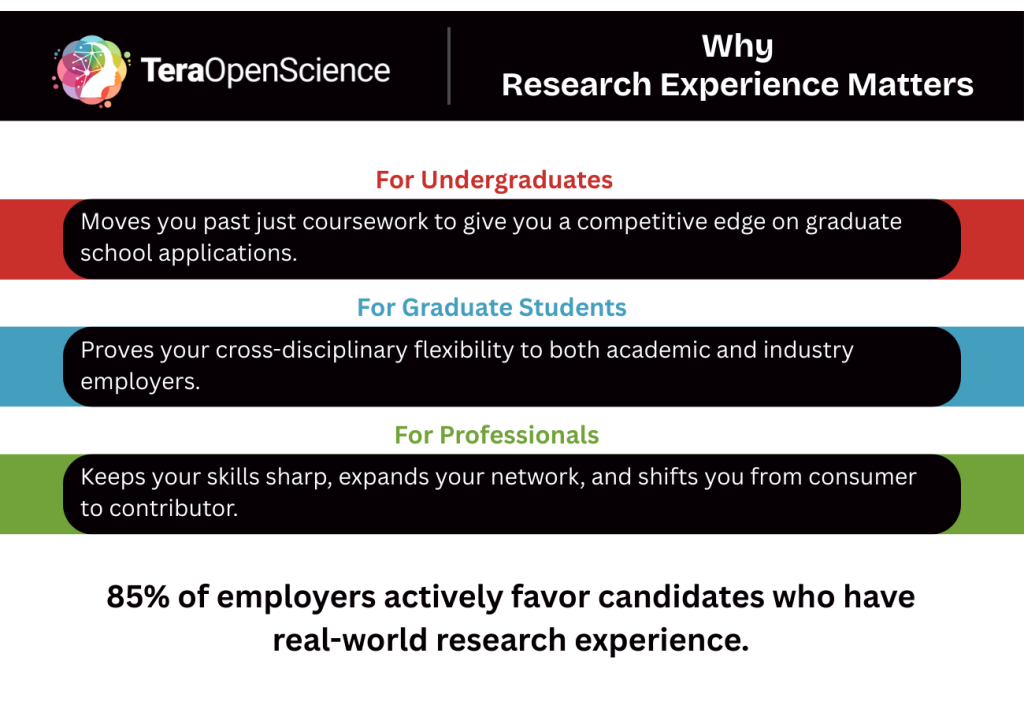
Hands-on experience in a real research project does something that coursework alone cannot. It puts you in the room where decisions are made, methods are debated, and findings are tested against reality. That kind of exposure builds research skills that follow you through every stage of your career.
For undergraduate students, a research position can be the deciding factor in a graduate school application. As Science Magazine reports, admissions committees at competitive programs want to see that applicants understand what research actually involves, not just that they read about it. An undergraduate researcher who has contributed to a live project has a clear advantage over one who has not.
For graduate students, the stakes are just as high. Building a portfolio of collaborative work across disciplines signals to both academic and industry employers that you are capable of operating outside your narrow specialty. That flexibility matters more now than it ever has.
For professionals, staying active in research keeps your skills current and your network growing. It also positions you as a contributor to your field rather than just a consumer of other people’s work.
The benefits stack up quickly:
- Strengthens your resume and portfolio with real project contributions
- Builds connections with faculty, industry leaders, and peer researchers
- Demonstrates initiative and intellectual curiosity to future employers, with 85% of employers saying they favor candidates with research experience
- Supports career transitions into research-based roles or professional school
- Provides the kind of transformative experience that changes how you think about problems
How TeraOpenScience Makes It Easy to Find Research Opportunities
Most students who want to get involved in research hit the same wall: they do not know where to look. Checking department websites, tracking down an academic advisor, finding a faculty mentor willing to take on an undergraduate, figuring out the application process, watching application deadlines pass before you even knew they existed. It adds up.
TeraOpenScience removes most of that friction by putting everything in one place.
The platform operates as a virtual R&D coordination environment where projects are already organized and looking for contributors. You do not need to be enrolled at a research-based university to participate. You do not need to secure a paid position or navigate federal work-study paperwork or apply for course credit through a specific department. You create a profile, browse available projects, and start contributing.
Here is how the process works in practice:
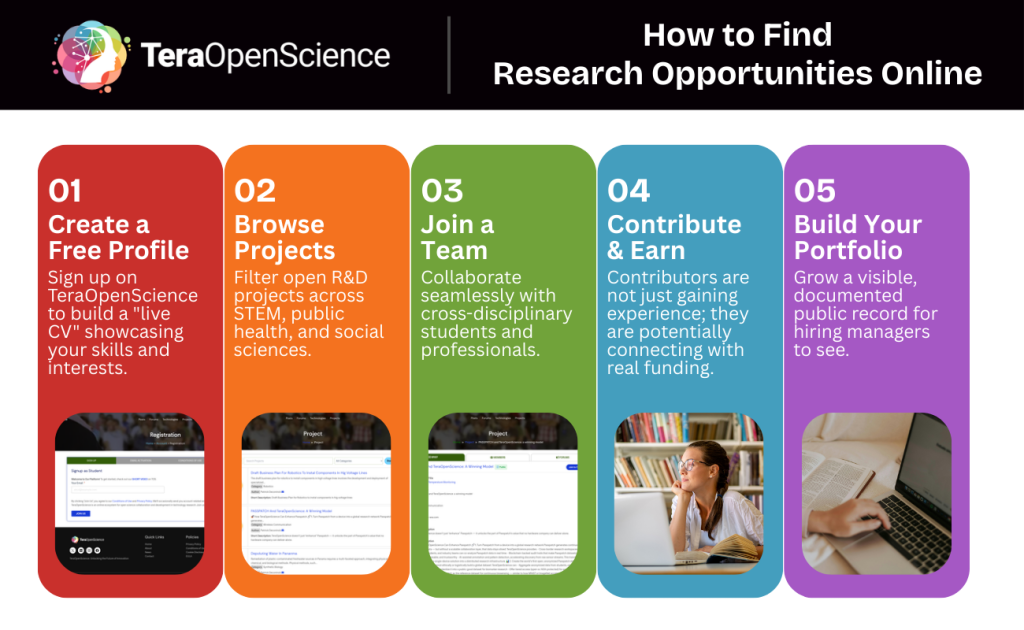
- Create Your Profile
Students join for free. Your profile functions as a live CV, showcasing your academic interests, research skills, and any work you have already completed on the platform. Hiring managers and industry professionals can see your contributions directly.
- Browse Projects by Research Area
Projects span a wide range of disciplines including STEM, social sciences, public health, and environmental science. You can filter by the areas that align with your research interest and career goals.
- Join a Project Team
TeraOpenScience facilitates multidisciplinary team formation, so you are not limited to collaborating with people in your own field. That cross-disciplinary exposure is part of what makes the experience so valuable.
- Contribute and Earn Recognition
Every contribution to a project is tracked and tied to your profile. Active participants build a visible, documented record of their involvement across projects, peer reviews, and collaborative work. That record is visible to hiring managers and industry professionals on the platform, making your contributions a living part of your professional portfolio rather than work that disappears once a project wraps.
- Build Your Visible Portfolio
As you contribute to projects, your profile grows. Dissertation work, manuscripts, project summaries, and peer reviews all become part of a professional portfolio that follows you beyond any single campus or academic year.
How TeraOpenScience Incentivizes Participation
Most platforms that connect students with research opportunities stop at access. TeraOpenScience goes further by building in reasons to stay engaged and keep contributing.
The primary incentive is visibility. Every contribution you make on the platform becomes part of a live, public-facing profile that hiring managers, faculty members, and industry professionals can view directly. As Capella University’s career development resources note, a documented portfolio illustrates career progression and demonstrates tangible evidence of evolving skills in a way a resume alone cannot. You are not submitting work into a void; you are building a record that grows with every project you touch.
Beyond visibility, the platform is structured to reward participation through recognition within the research community itself. Contributing to peer review, advancing a project, and collaborating across disciplines all build your standing and credibility as a researcher. As F1000 explains in its overview of open peer review, reviewers who share their contributions openly can further demonstrate their reputation in their field and their value to their institution. That reputation compounds over time in ways that a grade or a single resume line simply cannot replicate.
TeraOpenScience also facilitates grant funding for projects, meaning that serious contributors are not just gaining experience; they are potentially connecting with real funding pipelines that can support continued research work. For context on how broad those pipelines can be, the AAAS maintains a searchable directory of research funding sources spanning government agencies, foundations, and international programs. For students and professionals looking to move from contributor to lead researcher, having a platform that actively supports that transition matters.
Who Uses TeraOpenScience?
The platform is built for a wide audience, and that breadth is part of what makes it useful.
- Undergraduate students looking for hands-on research experience and resume-building opportunities outside of traditional campus programs
- Graduate students seeking peer review, mentorship, and visibility with potential employers in both academic and industry settings
- Faculty members and academic researchers who want to collaborate beyond institutional silos and publish without paywalls
- Corporate R&D leaders who need access to a global pool of research talent and want fresh perspectives on active challenges
- Healthcare organizations and government agencies working on interdisciplinary problems in human health, environmental science, and public health
That mix of participants means that when you join a project on TeraOpenScience, you are not just working alongside other students. You are working in the same environment as professionals who make hiring decisions and researchers who shape fields.
What You Can Post and Share
TeraOpenScience is not just a place to find work; it is a place to show your work. The platform supports:
- CV and dissertation posting for student researchers
- Manuscript submission and review through a developing preprint server
- Open technology sharing under Creative Commons 4.0 licensing
- Private project environments for work that involves patents or NDA-protected collaboration
- Grant funding facilitation for projects that need external support
That combination of open and protected environments means the platform can support both the exploratory, share-everything side of open science and the more commercially sensitive work that research careers often involve.

Start Building Your Research Portfolio With TeraOpenScience
Finding research opportunities as a student or early-career professional used to require the right connections, the right campus, or the right timing on an application deadline. TeraOpenScience changes that equation by making collaborative online research available to anyone with an internet connection and a genuine interest in contributing to real work.
The platform is free for students, active across disciplines from STEM to social sciences to public health, and built to reward participation with credentials that follow you into every stage of your career. If you are ready to build your research experience, expand your portfolio, and connect with a global community of researchers and industry leaders, there is no better time to get started. Join TeraOpenScience now and take the first step toward the research career you are working toward.