A Practical Look at IP and Its Untapped Potential
Every invention, formula, logo, and line of code starts as an idea, and intellectual property law exists to protect those ideas once they take shape. But what happens when valuable IP sits unused, collecting dust instead of generating impact?
At a Glance:
- Intellectual property (IP) refers to creations of the mind that are granted legal protection, including inventions, brand names, artistic works, and confidential business information.
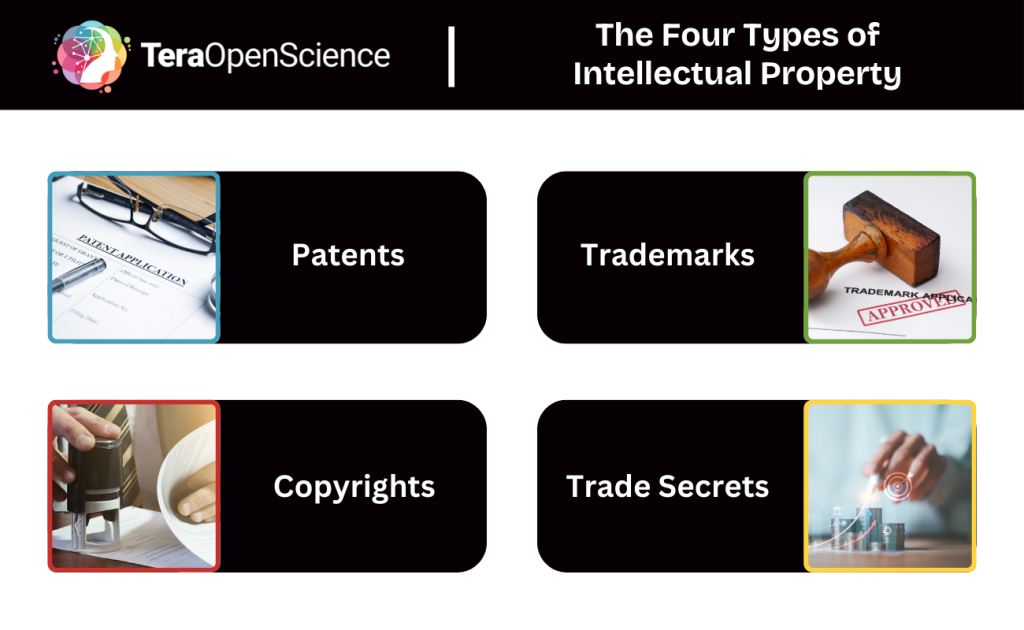
- The four main categories of IP are patents, trademarks, copyrights, and trade secrets, each offering different types of ownership rights and legal protection.
- IP represents one of the most valuable categories of intangible assets for individuals, universities, and businesses alike.
- A large volume of patented inventions, scholarly work, and creative output goes underutilized every year, representing missed opportunities for innovation and revenue.
- Open science platforms like TeraOpenScience are creating new pathways for researchers and organizations to share, license, and build on unused intellectual property through collaborative R&D environments.
Intellectual property is one of the foundational concepts behind innovation, business strategy, and creative expression. Understanding the different types of IP, how they work, and what to do when they go unused can help researchers, entrepreneurs, and organizations make smarter decisions about the ideas they create and the ones they inherit.
What is Intellectual Property?
Intellectual property refers to creations of the mind that are recognized and protected under the law. These creations can range from a novel software algorithm to a brand name, a musical work, or even a secret recipe. Unlike physical property, IP falls under the category of intangible assets, meaning it has no physical form but still holds real economic and strategic value.
Intellectual property rights give creators and owners the exclusive right to use, sell, license, or otherwise control how their work is distributed and monetized. These rights are enforced through intellectual property law, which varies by country but generally falls into four main categories: patents, trademarks, copyrights, and trade secrets.
In the United States, IP protection is governed by a combination of federal agencies (like the United States Patent and Trademark Office), federal statutes (including copyright law, patent law, and trademark law), and state-level regulations covering areas like unfair competition and confidential information.
The Four Main Types of Intellectual Property (With Examples)
Patents
A patent gives the patent owner the exclusive right to make, use, sell, or license an invention for a set period of time, typically 20 years from the date of the patent application. Patents are granted by the trademark office (specifically the USPTO in the United States) and are designed to protect new, useful, and non-obvious inventions.
There are several types of patents, but the most common is the utility patent, which covers new processes, machines, manufactured items, or compositions of matter. Design patents protect ornamental designs, and plant patents cover new plant varieties.
Examples of Patented IP:
- A pharmaceutical company’s newly developed drug compound
- A tech firm’s proprietary algorithm for artificial intelligence applications
- A manufacturing process that improves efficiency in producing biological materials
- Computer software that performs a function in a novel way
Patents offer strong patent protection, but they also require full public disclosure of the invention. Once a patent expires, the invention enters the public domain and can be used by anyone.
Trademarks
A trademark protects words, phrases, symbols, logos, or designs that identify and distinguish the goods or services of one party from another. A service mark functions the same way but applies specifically to services rather than goods. Trademark rights can last indefinitely as long as the mark remains in active commercial use and is properly maintained through the trademark office.
Examples of Trademarked IP:
- A company’s brand name and logo (think of the Coca Cola script logo)
- A product’s distinctive packaging or color scheme (known as trade dress)
- A slogan used in advertising campaigns
- A geographical indication that ties a product to a specific region
Trademarks serve as a form of consumer protection by preventing unauthorized use of a brand’s identity. They also give businesses a competitive advantage by building recognition and trust in the marketplace.
Copyrights
Copyright protection applies to original creative works that are fixed in a tangible medium of expression. This includes literary works, dramatic works, musical works, artistic works, computer software, scholarly work, and more. Under copyright law, protection is automatic the moment a copyrightable work is created, though registering with the U.S. Copyright Office provides additional legal benefits.
Examples of Copyrighted IP:
- A published novel or research paper
- A song’s lyrics and composition
- A film or documentary
- Architectural blueprints
- A derivative work such as a translation or adaptation of an existing piece
Copyright gives the creator the exclusive right to reproduce, distribute, perform, display, and create derivative works based on the original. These rights generally last for the life of the author plus 70 years in the United States.
Trade Secrets
A trade secret is any piece of confidential information that gives a business a competitive advantage because it is not publicly known. Unlike patents, trade secrets do not require registration or public disclosure. Their protection lasts as long as the information remains secret and the owner takes reasonable steps to keep it that way, such as through non-disclosure agreements and other contractual obligations.
Examples of Trade Secret IP:
- A proprietary recipe or formula (Coca Cola’s recipe is one of the most cited examples)
- A customer list or pricing strategy
- Manufacturing techniques or processes
- Internal algorithms used for data analysis or logistics
Trade secrets are protected under both state and federal law in the United States, including the Defend Trade Secrets Act. The primary risk with trade secrets is that once the information is disclosed, whether intentionally or through a breach, the protection is lost.
Why So Much IP Goes Unused
Despite the time, money, and effort that goes into developing intellectual property, a surprising amount of it never reaches its full potential. Universities produce thousands of patented inventions each year through federally funded research, yet many of those patents are never commercialized. Corporations accumulate large patent portfolios as defensive strategies, with no intention of bringing every invention to market. Individual researchers and inventors often lack the resources, networks, or business expertise to move their ideas forward.
Some common reasons IP goes unused include:
- The original patent owner or principal investigator moves on to other projects.
- The IP doesn’t align with the organization’s current business strategy.
- There is no clear path to market, or the cost of commercialization is too high.
- The inventor lacks access to collaborators, funding, or industry partners who could help develop the idea further.
- Licensing and technology transfer processes are slow, bureaucratic, or expensive.
This is a real problem, not just for the people who created the IP, but for the broader innovation ecosystem. When good ideas sit idle, everyone misses out.
How to Capitalize on Unused Intellectual Property
If you or your organization hold IP that isn’t being actively developed, there are several strategies worth considering.
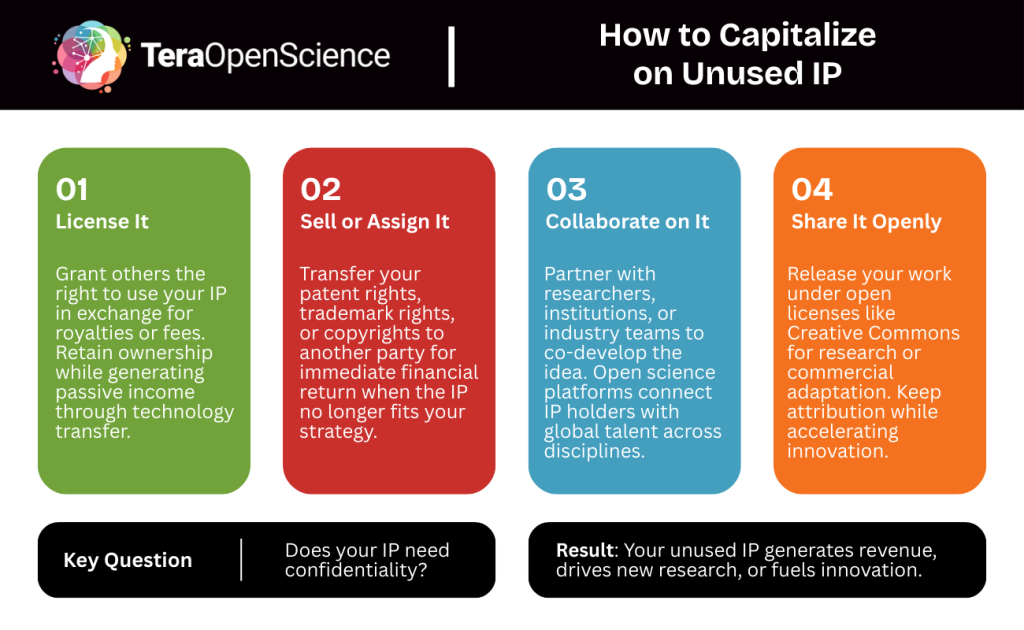
License it. Licensing allows IP owners to grant others the right to use their invention, brand, or creative work in exchange for royalties or fees. This is one of the most common forms of technology transfer and can generate passive income without giving up ownership rights.
Sell or assign it. If you have no plans to use the IP yourself, selling or assigning your patent rights, trademark rights, or copyrights to another party can provide immediate financial return. This is especially common in industries where patent portfolios are actively traded.
Collaborate on it. Partnering with other researchers, companies, or institutions to develop unused IP can bring fresh perspectives and resources to an idea that stalled. This is where open science platforms play a particularly valuable role.
Share it openly. In some cases, releasing IP into the public domain or under open licenses (such as Creative Commons) can accelerate innovation and build your reputation as a contributor to the broader scientific or creative community. Open licensing doesn’t mean giving up credit. It means making your work accessible for educational purposes, further research, or commercial adaptation under defined terms.
Where Platforms Like TeraOpenScience Come In
One of the biggest barriers to capitalizing on unused IP is access. Access to collaborators. Access to funding. Access to the right audience who can see the potential in an idea that someone else set aside.
TeraOpenScience is built to address exactly this gap. As an AI-powered open science platform, it connects students, researchers, and industry leaders in a shared virtual environment designed for real-world R&D collaboration. For IP holders, this means an opportunity to bring dormant inventions, research findings, and scholarly work in front of people who can actually do something with them.
Here’s how TeraOpenScience supports the lifecycle of intellectual property:
- Open technology repository: Researchers and organizations can share IP openly under Creative Commons licensing, making it accessible to a global community of collaborators while retaining attribution.
- NDA-protected collaboration: For IP that requires confidentiality, the platform offers private workspaces where patent rights and trade secrets can be discussed and developed under formal contractual obligations.
- Multidisciplinary team formation: Unused IP often needs expertise from outside the original field. TeraOpenScience brings together talent from STEM, humanities, and social sciences to form research teams that can approach old problems from new angles.
- Grant funding facilitation: The platform helps connect projects with funding sources, removing one of the most common barriers to moving IP from concept to commercialization.
- Career and talent visibility: Graduate students and early-career researchers can contribute to IP development projects, gaining hands-on experience while helping advance ideas that might otherwise go nowhere.
Whether the goal is licensing a patent, co-developing a research finding, or open-sourcing a technology for broader use, platforms like TeraOpenScience are creating infrastructure that makes it easier to turn unused intellectual property into real-world outcomes.

Put Your Unused IP to Work
Intellectual property only holds value when it’s being used, developed, or shared with the right people. If you’re sitting on patents, research findings, or creative works that aren’t going anywhere, there’s no reason to let them gather dust. TeraOpenScience gives researchers, inventors, and organizations a place to showcase unused IP, connect with collaborators, and move ideas forward in a structured, supportive environment. Join TeraOpenScience to explore how the platform can help you unlock the potential of your intellectual property.