The Short Answer
Peer review is the evaluation process where experts in a field assess scientific research before it gets published. This quality control mechanism helps verify that research methods are sound, conclusions are supported by evidence, and the work adds value to the scientific community. In open science platforms like TeraOpenScience, peer review takes on added importance by making knowledge accessible while maintaining high standards of validity.
When you read a research paper in a scholarly journal, that work has typically passed through a careful evaluation by other experts before reaching you. This process, known as peer review, serves as a cornerstone of scientific credibility. Understanding what peer review is and how it works helps researchers, students, and professionals appreciate why their contributions gain more impact when they undergo this validation. For open science platforms committed to democratizing knowledge, effective peer review becomes the bridge between accessibility and academic rigor.
Understanding the Peer Review Process
At its core, the peer review process involves submitting a manuscript to experts who evaluate its quality, accuracy, and contribution to existing knowledge. These peer reviewers examine the research methodology, analyze whether the data supports the conclusions, and identify any errors or gaps that need addressing.
The traditional review process follows a general pattern. First, a researcher submits their work to an academic journal or publication platform. A journal editor conducts an initial screening to determine if the submission fits the publication’s scope and meets basic standards. If the manuscript passes this first check, the editor sends it to two or more peer reviewers who specialize in the relevant field.
These reviewers then prepare a peer review report containing their assessment and recommendations. The feedback might range from minor suggestions about clarity to identification of a fundamental flaw in the methodology. Based on the reviewer comments, the editor makes a final decision: accept the manuscript, request revisions, or reject it entirely.
This cycle of submission, evaluation, and revision strengthens scientific research by catching errors before publication and pushing authors to improve their work.
Types of Peer Review Systems
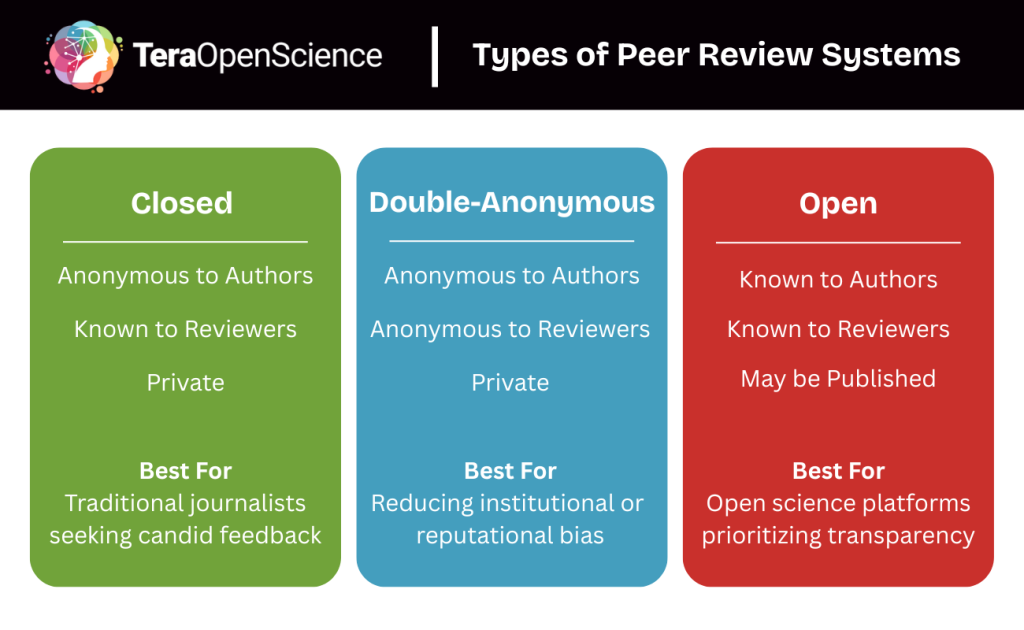
Not all peer review systems operate identically. The scientific community has developed several approaches, each with distinct characteristics.
Closed peer review represents the traditional model where the reviewer identity remains anonymous to the authors, though reviewers know who wrote the manuscript. This approach aims to allow honest critique without fear of professional repercussions.
Double-anonymous peer review takes anonymity further by concealing both the authors’ and reviewers’ identities from each other. Proponents argue this reduces bias based on an author’s reputation, institution, or background.
Open peer review has gained momentum alongside the open science movement. In this model, authors and reviewers are aware of each other’s identity. Some platforms also publish the review reports alongside the article, allowing the academic community to see how the work was evaluated and improved.
Each system has merits. Open peer review, in particular, promotes transparency and accountability while fostering collaboration between authors and reviewers.
Why Peer Review Matters
The peer review process serves multiple functions that benefit researchers, readers, and the broader pursuit of knowledge.
Quality control for research: Before scientific findings influence policy, medical practice, or further research, they need validation. Peer reviewers check that the methods were appropriate, the analysis was conducted properly, and the conclusions follow logically from the evidence. This scrutiny helps prevent flawed research from entering the scientific record.
Constructive feedback for authors: Even when a manuscript gets rejected, the review process provides valuable insights. Reviewer comments highlight weaknesses, suggest additional analyses, and point authors toward relevant literature they may have missed. This feedback improves not just the current paper but the author’s future work as well.
Credibility for publication: When research appears in a peer-reviewed journal, readers can have greater confidence in its validity. The peer-reviewed articles in scientific journals carry more weight in academic discussions, grant applications, and policy decisions because they have undergone independent evaluation.
Advancement of knowledge: By filtering out unreliable findings and improving valid ones, peer review helps the scientific community build on solid foundations. Each verified contribution adds to the collective understanding that drives innovation.
The Role of Peer Review in Open Science
Open science represents a movement toward making scientific research accessible to everyone. This includes open access publication, open data sharing, and transparent research practices. Within this framework, peer review takes on particular importance.
Traditional subscription-based journals often restrict access to research behind paywalls, limiting who can read and build upon new findings. Open science platforms remove these barriers, but accessibility alone does not guarantee quality. Without peer validation, open platforms risk becoming repositories of unchecked claims.
This is where platforms like TeraOpenScience demonstrate value. By combining open collaboration with peer review mechanisms, TeraOpenScience enables researchers and students worldwide to share their work freely while maintaining the academic standards that give that work credibility.
The benefits of peer review in open science include:
-
- Maintaining research quality without restricting access
-
- Building trust in openly shared findings
-
- Creating opportunities for interdisciplinary feedback
-
- Supporting researchers who may lack institutional resources
-
- Reducing misinformation by validating claims before wide distribution
How TeraOpenScience Approaches Peer Review
TeraOpenScience operates as an AI-powered open innovation platform that connects students, researchers, professionals, and enterprises across STEM, healthcare, and business fields. The platform integrates open collaboration, peer validation, and knowledge sharing into a unified ecosystem.
The manuscript review tool within TeraOpenScience allows community members to submit their research for evaluation by peers across disciplines. This interdisciplinary approach means that a submission might receive feedback not just from specialists in the narrow topic area but from researchers who bring different perspectives and methodologies.
Key elements of the TeraOpenScience approach include:
-
- Open discussion boards where ideas can be shared and discussed before formal submission
-
- Community-based review that draws on the collective expertise of platform members
-
- Integration with other features like grant funding information, knowledge content, and career opportunities
-
- Blockchain-based recognition through ScienceCoins cryptocurrency and NFT awards that acknowledge contributors
This model reflects the platform’s mission of creating a collaborative ecosystem where knowledge flows freely while quality remains protected. The peer validation process becomes part of a larger system designed to help researchers gain visibility, connect with potential collaborators, and receive recognition for their contributions.
What Makes Effective Peer Review?
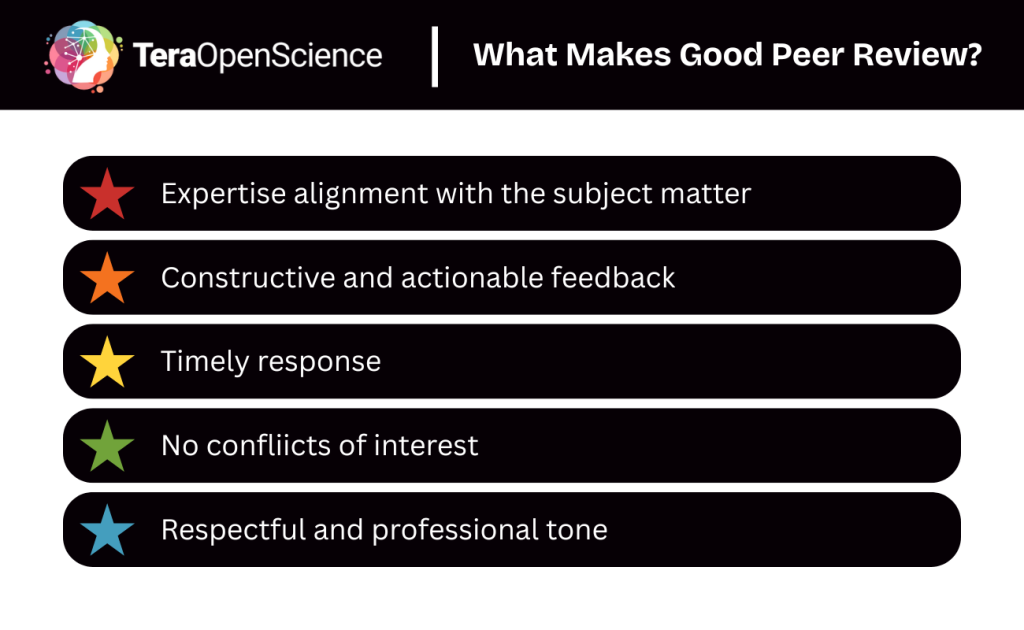
Not all reviews provide equal value. Effective peer review requires specific qualities from both the system and the individuals participating in it.
Expertise alignment: Reviewers should have relevant knowledge in the subject matter being evaluated. A peer reviewer assessing a quantum physics paper needs different expertise than one evaluating a public health study.
Constructive feedback: Good reviewer comments identify specific issues and suggest improvements rather than offering vague criticism. Authors benefit most from detailed, actionable feedback they can use to strengthen their work.
Timely manner: Research has value in part because of its timeliness. Review processes that drag on for months or years diminish the relevance of findings and frustrate researchers. Platforms committed to effective peer review work to provide decisions promptly.
Freedom from conflict of interest: Reviewers should not have personal or professional stakes in the outcome of their evaluation. Most peer review systems ask reviewers to disclose potential conflicts before proceeding.
Respectful tone: Even when identifying serious flaws, reviewers should maintain professionalism. Personal attacks or harsh language discourage authors and undermine the collaborative spirit that peer review should embody.
Challenges and Evolution in Peer Review
The peer review system faces ongoing challenges. Finding qualified reviewers willing to donate their time has become increasingly difficult as the volume of scientific publication grows. Some fields struggle with reviewer fatigue, leading to delays and sometimes superficial evaluations.
Bias remains a concern as well. Studies have shown that reviewer assessments can be influenced by authors’ institutional affiliations, geographic locations, or established reputations. Double-anonymous review addresses some of these issues but cannot eliminate them entirely.
Open science platforms offer potential solutions. By broadening the pool of potential reviewers, creating incentives for participation, and increasing transparency, these platforms can address weaknesses in traditional models. TeraOpenScience’s approach of rewarding contributors through blockchain-based tokens represents one innovation aimed at encouraging quality participation.
The evolution of peer review continues as the scientific community experiments with new approaches. Preprint servers allow researchers to share findings before formal review, inviting community comment. Post-publication review enables ongoing evaluation of published work. These developments complement rather than replace traditional peer review, creating a more dynamic system for validating research.

Join the TeraOpenScience Community
Understanding what peer review is helps you appreciate why validated research carries more weight than unreviewed claims. The process protects the integrity of scientific knowledge while providing authors with valuable feedback to improve their work.
TeraOpenScience offers researchers and students a platform where open collaboration meets quality validation. Whether you want to share your own research, contribute as a peer reviewer, or simply access interdisciplinary knowledge from a global community, TeraOpenScience provides the tools and ecosystem to support your goals.
By joining TeraOpenScience, you become part of a community dedicated to making science accessible while maintaining the standards that make scientific findings trustworthy. The platform’s unique integration of peer review, open discussion, grant resources, and recognition systems creates opportunities that traditional closed models cannot match.Be open. Be seen. Start collaborating with the global scientific community at TeraOpenScience today.